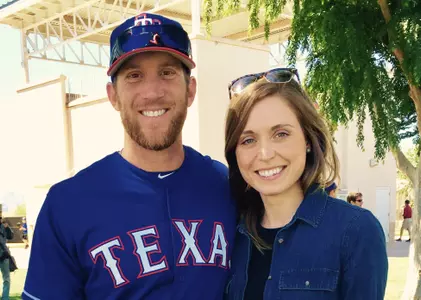
SE: Jared Goedert Uses K-State BSB Influence as Minor League Coach
Nov 15, 2017 | Baseball, Sports Extra
By Corbin McGuire
Jared Goedert walks into the K-State baseball locker room and sits under a locker he thinks used to be his.
It's been more than a decade since his nameplate and gear decorated this locker but Goedert still feels a strong connection to it, to the field a few feet outside, to the program.
"When you've been through Coach (Brad) Hill's program, and I've been a lifelong K-State fan, you do have that pride still inside of you," said Goedert, who played at K-State from 2005-06.
Despite the short stay at K-State, Goedert said those two years set the foundation for his life afterward. Specifically, he said they helped him sustain a successful nine-year run in the minor leagues. More recently, they have served as a guide in his transition to coaching, an unexpected one at that.
"I had no intention of coaching, honestly," said Goedert, whose focus was always on reaching the major leagues as a player.
When no offers came after his 2014 season with the Buffalo Bisons, the AAA affiliate of the Toronto Blue Jays, Goedert returned to Manhattan, where he and his wife, Audrey, have called home since 2011. He re-enrolled at K-State in the fall of 2015 to finish his degree in finance and he graduated the following spring.
During his time back in the classroom, Goedert did not make any specific post-graduation career plans. So, when he was presented an opportunity to return to the dugout, this time as a coach, he jumped on it.
"The more I heard about it, the more I was interested and thought this may be a good opportunity," said Goedert. "I think maybe if I had this specific route I knew I wanted to go (in finance), I'd be doing that right now. But I didn't."
So Goedert has continued living a baseball life.
In the 2016 season, the Wildcats' former third baseman served as an assistant coach for the Spokane Indians, the Class A short-season affiliate of the Texas Rangers, and worked with their catchers and outfielders. This year, he was the hitting coach for the rookie-level Arizona Rangers.
This fall, Goedert went to the Rangers' complex in the Dominican Republic to help with its instructional league for the second year in a row. He described the experience as "eye opening."
"A lot of Latin American players don't have the privileges that go along with living and growing up in the United States," said Goedert, who will return to Spokane, Washington, to become the Indians' hitting coach next season. "It makes me appreciate a lot more of where they come from, what they've been through, why baseball is the ticket out for them, why they're willing to work so hard and sacrifice so much for that just to get over here."
Overall, Goedert said his two years of coaching have reinforced to him the importance of communication and building trust with his players. He's also found an increased level of satisfaction from success in coaching.
"It's rewarding to you to see someone you helped out a little bit, or pushed or encouraged, have success," he said. "It's a better, selfless experience than the playing side."
He may not have realized it at the time, but Goedert's playing days at K-State helped mold his eventual coaching philosophy.
"What I believe is important, as far as coaching, is a lot of what I got from Coach Hill," said Goedert, also crediting the influence of his father, Joe Goedert, who also played baseball at K-State. "I try to be consistent with them. I try to demand a lot from them to get the most out of what they're capable of."
Goedert knows this coaching style brought the best out of him at K-State, where he hit .339 for his two-year career and was a Second Team All-Big 12 selection in 2006.
A ninth-round draft pick in 2006, Goedert enjoyed a respected career in the minors. He played five seasons at the AAA level, slashing .269/.349/.446 to go with 123 home runs and 522 RBIs for his minor league career.
"I didn't know it at the time, but the way (Hill) runs the program here, I felt like I couldn't have been any better prepared to go to professional baseball. He's tough but it's a good tough, in my opinion, because baseball's not an easy game," Goedert said. "Baseball rewards the tough, I think, and punishes the weak."
While Goedert was a naturally gifted infielder, he said the mental and physical toughness, along with the "expectations of being consistent," instilled by his father growing up and Hill at K-State set the table for his professional career.
"Obviously the baseball instruction was very good here, but I'm more thankful for the foundation that was established as far as being able to take on a professional season, a long difficult grind of a professional season," he said. "When you get knocked down, you're ready to come back the next day. I feel like this program prepared me for that as well as anything could have."
Now he's trying to prepare players who are chasing a once-familiar dream the way K-State prepared him. An impact like that is not soon forgotten, which is why he can still remember which locker was his and why he has always kept a close eye on the program since he left.
Goedert remembers rushing home from a game to watch the Wildcats play Oregon State in a Super Regional in 2013, and he's excited to see what the major renovations planned for Tointon Family Stadium can bring the program.
"I feel tremendous pride and joy seeing how far the program has come since I was here in '05 and '06," he said. "The facilities, the players they're getting in, just everything that they have going, it's fun to follow and you still feel very much part of it."
Jared Goedert walks into the K-State baseball locker room and sits under a locker he thinks used to be his.
It's been more than a decade since his nameplate and gear decorated this locker but Goedert still feels a strong connection to it, to the field a few feet outside, to the program.
"When you've been through Coach (Brad) Hill's program, and I've been a lifelong K-State fan, you do have that pride still inside of you," said Goedert, who played at K-State from 2005-06.
Despite the short stay at K-State, Goedert said those two years set the foundation for his life afterward. Specifically, he said they helped him sustain a successful nine-year run in the minor leagues. More recently, they have served as a guide in his transition to coaching, an unexpected one at that.
"I had no intention of coaching, honestly," said Goedert, whose focus was always on reaching the major leagues as a player.
When no offers came after his 2014 season with the Buffalo Bisons, the AAA affiliate of the Toronto Blue Jays, Goedert returned to Manhattan, where he and his wife, Audrey, have called home since 2011. He re-enrolled at K-State in the fall of 2015 to finish his degree in finance and he graduated the following spring.
During his time back in the classroom, Goedert did not make any specific post-graduation career plans. So, when he was presented an opportunity to return to the dugout, this time as a coach, he jumped on it.
"The more I heard about it, the more I was interested and thought this may be a good opportunity," said Goedert. "I think maybe if I had this specific route I knew I wanted to go (in finance), I'd be doing that right now. But I didn't."
So Goedert has continued living a baseball life.
In the 2016 season, the Wildcats' former third baseman served as an assistant coach for the Spokane Indians, the Class A short-season affiliate of the Texas Rangers, and worked with their catchers and outfielders. This year, he was the hitting coach for the rookie-level Arizona Rangers.
This fall, Goedert went to the Rangers' complex in the Dominican Republic to help with its instructional league for the second year in a row. He described the experience as "eye opening."
"A lot of Latin American players don't have the privileges that go along with living and growing up in the United States," said Goedert, who will return to Spokane, Washington, to become the Indians' hitting coach next season. "It makes me appreciate a lot more of where they come from, what they've been through, why baseball is the ticket out for them, why they're willing to work so hard and sacrifice so much for that just to get over here."
Overall, Goedert said his two years of coaching have reinforced to him the importance of communication and building trust with his players. He's also found an increased level of satisfaction from success in coaching.
"It's rewarding to you to see someone you helped out a little bit, or pushed or encouraged, have success," he said. "It's a better, selfless experience than the playing side."
He may not have realized it at the time, but Goedert's playing days at K-State helped mold his eventual coaching philosophy.
"What I believe is important, as far as coaching, is a lot of what I got from Coach Hill," said Goedert, also crediting the influence of his father, Joe Goedert, who also played baseball at K-State. "I try to be consistent with them. I try to demand a lot from them to get the most out of what they're capable of."
Goedert knows this coaching style brought the best out of him at K-State, where he hit .339 for his two-year career and was a Second Team All-Big 12 selection in 2006.
A ninth-round draft pick in 2006, Goedert enjoyed a respected career in the minors. He played five seasons at the AAA level, slashing .269/.349/.446 to go with 123 home runs and 522 RBIs for his minor league career.
"I didn't know it at the time, but the way (Hill) runs the program here, I felt like I couldn't have been any better prepared to go to professional baseball. He's tough but it's a good tough, in my opinion, because baseball's not an easy game," Goedert said. "Baseball rewards the tough, I think, and punishes the weak."
While Goedert was a naturally gifted infielder, he said the mental and physical toughness, along with the "expectations of being consistent," instilled by his father growing up and Hill at K-State set the table for his professional career.
"Obviously the baseball instruction was very good here, but I'm more thankful for the foundation that was established as far as being able to take on a professional season, a long difficult grind of a professional season," he said. "When you get knocked down, you're ready to come back the next day. I feel like this program prepared me for that as well as anything could have."
Now he's trying to prepare players who are chasing a once-familiar dream the way K-State prepared him. An impact like that is not soon forgotten, which is why he can still remember which locker was his and why he has always kept a close eye on the program since he left.
Goedert remembers rushing home from a game to watch the Wildcats play Oregon State in a Super Regional in 2013, and he's excited to see what the major renovations planned for Tointon Family Stadium can bring the program.
"I feel tremendous pride and joy seeing how far the program has come since I was here in '05 and '06," he said. "The facilities, the players they're getting in, just everything that they have going, it's fun to follow and you still feel very much part of it."
K-State Baseball | Game Highlights vs Oklahoma State Game 2
Sunday, April 12
K-State Baseball | Game Highlights vs Oklahoma State Game 1
Saturday, April 11
K-State Baseball | Wichita State Game Recap
Wednesday, April 08
K-State Baseball | Game Highlights vs TCU
Saturday, April 04