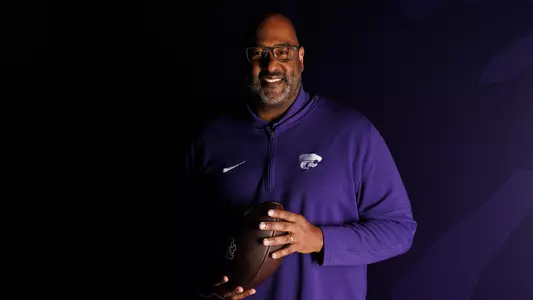
Wyatt Happy to Continue Being Around Good People
Dec 17, 2025 | Football, Sports Extra
By: D. Scott Fritchen
Collin Klein, who Buddy Wyatt had coached against while he served on defensive staffs at Texas A&M and Kansas, and who Wyatt saw mature into a coaching talent during Klein's five years on staff at K-State, sat in a chair in Wyatt's office in middle of December.
Wyatt, who began his career as a graduate assistant at TCU in 1991 and who had just completed his seventh season as K-State defensive ends coach in 2025, was unsure how the meeting with Klein, the newly hired K-State head coach, would go.
Over the years, Wyatt served on coaching staffs at TCU, Minnesota, Oklahoma State, Northwestern, Colorado, Texas A&M, Alabama, Nebraska, Kansas, SMU, and was hired by former K-State head coach Chris Klieman prior to the 2019 season.
Wyatt carries a track record of success.
In Wyatt's first seven years at K-State, he coached his defensive ends to 10 All-Big 12 honors, including five All-Big 12 First Team honors. Another fact? He coached three players that earned Big 12 Defensive Lineman of the Year honors at K-State. He also coached Adam Carriker at Nebraska to 2006 Big 12 Defensive Lineman of the Year honors as well. That meant that Wyatt has coached the most Big 12 Defensive Linemen of the Year in league history.
But as one of Wyatt's mentors once told him, "Football is a great game, but it's a horrible business."
Now here sat Wyatt in his office in the Vanier Family Football Complex with Klein seated on the other side of the desk.
What would happen next?
Klein looked at Wyatt.
"I want to retain you," Klein said. "Do you want to stay?"
Wyatt grinned.
"Sure," Wyatt replied. "I want to stay."

D. SCOTT FRITCHEN: You worked alongside Collin Klein in each of his first five seasons when he served on the K-State coaching staff. What were your initial impressions of Collin when you first met him?
BUDDY WYATT: Collin was a good human being. I saw he was humble, but he's very knowledgeable for his age. He's a young guy, but he's very knowledgeable about the game. With all the success he had as a player and with everything that he had done, if you didn't know that you wouldn't have thought that he had accomplished all that just by the way he carried himself. I really admired that about him.
As I got to know him and watched him and some of the other K-State coaches, they'd compete against some of our players in different games and drills, and Collin was so competitive. Collin was like Clark Kent turning into Superman when it came time to compete. He's a great family man, and he's very smart. He's just a really great guy.
FRITCHEN: Was there a particular time that you thought to yourself that Collin might have the capacity to serve as a head coach at someplace and at some time?
WYATT: No doubt, Collin had that head-coaching ability in him. He was groomed by excellent coaches in Coach Snyder and then Coach Klieman and now Coach Elko. I'm sure Collin is going to take a lot from those guys, but he's going to put his spin on it. He had that "it" factor just with his personality and how he carried himself. I always knew he was going to become a head coach at some point.
FRITCHEN: Fast-forward. When did you speak to Collin for the first time after his official hiring as K-State head coach? What kinds of things did you talk about?
WYATT: The first time, I just text him, "Congratulations," once he was announced as the head coach. Collin, just like Collin, I knew he had a lot going on at K-State and at Texas A&M, but he got back to me and told me, "Thank you. We'll talk soon." I knew he'd get to me when he had time because that's just who he is. When we finally had that conversation, it was good to know — at my age and for as long as I've been coaching, when I was a younger coach, it was about where you are and "I want to coach at this school," but as you get older it's about the people and the kind of people you're going to be working for and working with. When Collin got the job, I already knew what kind of person he was, so if he gave me the opportunity to stay, I was definitely going to consider staying.
FRITCHEN: So, you sat down with Collin to discuss your future. Was this meeting in his office?
WYATT: Collin actually came into my office, and we had that meeting. It had been a long day for him. I mean, he'd flown in from College Station and had met with a lot of people and did a lot of interviewing, and all the head coaching things you have to do that's part of your responsibilities, but he went to each and every one of our offices, and met with you face-to-face and told you whether he was going to keep you or wasn't going to keep you.
FRITCHEN: What were the thoughts running through your head as Collin sat down in your office for your meeting?
WYATT: Well, there were a lot of guys who weren't retained, so I wasn't for sure. When he told me that he wanted to keep me, the relief came. I was a little relieved. We didn't talk a lot of specifics. He just said, "I want to retain you. Do you want to stay?" I said, "Sure, I want to stay."

FRITCHEN: You've spent seven years in Manhattan now. How dear as the K-State football program become in your heart?
WYATT: Manhattan has become very important to me and my wife now that our kids are older and grown up. There are good people in Manhattan. I'm about being around good people and K-State and the players, and the culture of the program is really, from Coach Snyder to Coach Klieman, has been that way for a while. It falls in line with my beliefs and values. That's why I want to stay.
FRITCHEN: You've had a lot of impressive stints in your career. Was there any point that you thought your longest stint would be in Manhattan?
WYATT: I did not. In this profession, you never know. You have that wish list and those hopes, and I really didn't — Kansas State wasn't really on my radar. It just popped up. I'm a big believer and God puts you in places you're meant to be in. God put me here for a reason, and I hope that's to help develop these young men. But you know what? A lot of these young men pour into me. And Manhattan has been spiritually, just the way my wife and I are, we enjoy our church and the people here and I enjoy coaching here at Kansas State.
FRITCHEN: When you hear the words "Kansas State Football" what comes to mind first?
WYATT: Tough. Hard-nosed. The mentality of this program, even before I got here, I played against Kansas State at a lot of schools that I coached at. You always knew the kids were going to play hard, play physical, be well-coached, and you looked at them on film and didn't think they had the best talent, but, man, were they well coached. When you got done playing K-State, you knew that you had been in a football game because they were physical and tough and relentless. K-State over the years, people wouldn't know it, and I didn't know it, how much success K-State football has had over the years. Until you get in here and you get into the program, and you look at the history of it, there's good football here.
FRITCHEN: Of course, K-State had some great years in particular with Collin Klein at quarterback. Did your path as a coach ever cross Collin Klein when he was a player at K-State?
WYATT: Collin Klein, you looked at him, and you didn't think he was running as fast as he was, but nobody could catch him. That goes for a lot of the players at K-State. But, boy, Collin was a competitor. He wanted the ball in his hands when the game was on the line. Obviously, the coaches wanted the ball in his hands when the game was on the line. He was a competitor. When you watched tape, you didn't really know that, but when you got into the game and played against him, it was like, "Man, this dude is tough."

FRITCHEN: Describe the coaching style of Buddy Wyatt?
WYATT: Well, I have a little bit of everything. I can get on my players when they need to be gotten on. I like to do my hard coaching during the week and then when the game comes, hey, it's your time to go out and play. Then I just try to guide them, lead them, and help them be successful in the game. I believe that a kid, they'll play hard for you if they know you care for them. So, I care for my players and let them know it's not just about football, but also about helping you become the man that you want to become. I just try to help them grow as a person as well as a football player. My purpose is to help develop young people.
FRITCHEN: Coaching defensive ends between 2019 and 2025 seems to be an anomaly in your coaching career. Every other stop in your career, you've served as defensive line coach, responsible for the entirety of the line. What do you enjoy most about being the all-encompassing defensive line coach and what unique challenges go along with that?
WYATT: I really enjoy getting to know more people and getting to work closer with more guys. I get to know all the guys on the team, but you have a special bond with your position group, and even though (former defensive tackles coach) Mike Tuiasosopo and I worked close together, I wasn't always around the defensive tackles. Now I get to be around all of them. I enjoy being a part of their lives and helping them navigate academics and spiritual and social aspects, but also their football part of their lives.
Once we get the new defensive coordinator, and he gets in, and we get the whole staff, we can figure everything out a little bit better. But I'm sure there'll be some more defensive line coaches, because the defensive line is unique because it's about technique, and you can't think about it, you just react, because you're close to that football. I always tell my guys, "That football is a bomb, and the closer you are, the faster that explosion is going to get to you." You don't have time to think, your muscle-memory and training has to take over, so you have to react. So, it's a lot of drill work, technique, footwork, hand placement, pad level. All those things, you have to drill it over and over again to where it's second nature to them. There's a lot of tedious training, and to make that fun for them is a challenge. It's not like running a route or carrying the ball. It's nothing like that. You're taking on double teams, and taking on blocks, so you have to find ways to make it fun. If they know you can help them become better, then they'll do whatever you ask them to do.

FRITCHEN: Over your 30-year career, have you found a couple milestones or statistics that you really hold onto that in your mind best measure the success or lack of success for a defensive line?
WYATT: I don't really look at statistics. I never have looked at statistics. I look at if a team can run the ball on you or can't run the ball on you, or if it's a passing situation and you can rush four and get after the quarterback or do you have to bring pressure to get to the quarterback. If we can rush four and get to the quarterback, then I think we have a pretty good defensive line pass-rush wise. If we have guys that make a team one-dimensional and have to throw the ball, then I think we have a good front. I really don't look at the stats. I look at if we can take over a game with just the four guys up front, then we're pretty good.
FRITCHEN: In your first seven years at K-State, you coached your defensive ends to 10 All-Big 12 honors, including five All-Big 12 First Team honors. I know it takes a heck of a lot of work. Another fact? You have coached three players that have earned Big 12 Defensive Lineman of the Year honors at K-State. You coached Adam Carriker at Nebraska to 2006 Big 12 Defensive Lineman of the Year honors as well. That means you have coached the most Big 12 Defensive Linemen of the Year in league history. How does that feel?
WYATT: You know what? I had no idea until I read that, and then my wife read it and said, "I didn't know that." I said, "I didn't, either." Those guys are good players, but I've had some really good players that didn't even earn those Big 12 honors, and I'm probably most proud of those guys. I'm proud of Brendan Mott, who came in as a walk-on and worked his tail off to develop into a Big 12 Defensive Lineman of the Year. That's what I'm proud of more so than having however many ever honorees. I coached a kid at Alabama, who ended up playing in the NFL, and he is probably one of the best, instinctive football players I've coached. He didn't win any honors but got a free-agent contract and played in the league because he was a good football player. I coached another player at Alabama, and he was a 5-foot-10 and 290-pound nose tackle, and we were No. 1 in the nation in defense with him, and he was a walk-on in the SEC. Those are the type of kids that I'm really proud of to see those kids who everybody wrote off, but they had that in them. I was just a part of helping them get it out. The other thing I'm really proud of is a lot of guys I've had an opportunity to coach, they're now coaching, and they say, "You're the reason I wanted to coach." That's what I'm most proud of.
FRITCHEN: Looking ahead, who are some K-State defensive linemen you plan to lean on next fall?
WYATT: We have a pretty good group that's coming back. I'm really fired up about Malcolm Alcorn-Crowder. He can be really good. Tui did a great job with him. We had some younger kids at defensive tackle, Holden Bass, a walk-on from an hour away. You have Patrick Tackie. We lost two really good ones in Uso Seumalo and Damian Ilalio. At the defensive end position, we lose Cody Stufflebean, but we have Travis Bates, Chiddi Obiazor, Ryan Davis, Tobi Osunsanmi and Jordan Allen coming back. That'll be really solid. Now that they have more experience, they're going to be even better than a year ago. I'm excited about that group of guys. We have to fill a couple positions there, but those are the guys I think we'll lean on. Trey Scott, our general manager, is working really hard so when the portal hits, we can get some guys that can help us next year.

FRITCHEN: What are a few immediate questions you ponder about the defensive line before embarking upon this initial stage of preparation for 2026?
WYATT: Right now, the way college football is with the transfer portal, my question is: Who can we keep? That's big. The next thing is, obviously, with the change of scheme, how fast can we get them up to speed — first getting myself up to speed with the new staff coming in, and then getting those guys up to speed. Those are the two things that are at the top of my list.
FRITCHEN: You began your career as a graduate assistant at TCU in 1991. Now you're entering your eighth season at K-State. From the time you were a GA in 1991 to where you are in 2025, what has Buddy Wyatt learned most about himself during his journey?
WYATT: Good question. I do think that I've learned that when I was younger in 1991, I had to become more patient. That was number one. Number two, I've learned that no matter what the situation, whether we were doing well or whether we were not doing so well, that I had to keep the faith, and that God had a plan for me. That was my biggest thing. When things started going really bad is when I tried to take over the plan and not let Him take control. I've learned that. I've had to do that in my life. If not, coaching would drive you crazy. One of my mentors, a coach and who I then worked with, he would always say, "Football is a great game, but it's a horrible business." And it can be tough — on your family. Right now, a lot of guys that didn't get retained are looking and their family is having to move, and that's the tough part. I'll always believe that God has a plan for us. Do we know what that plan is? Not really. Not all the time. Sometimes, we do and sometimes we don't.
When we were at SMU, we qualified for a bowl game, first bowl game in 15 years or something like that, and then the head coach left to go to Arkansas, and he didn't take any of the defensive staff with him. I couldn't get a job. So, I was out for a year. But during that time, my son, Fred, who's now coaching at Air Force, was playing at Northwestern his senior year, and I got to watch more games that year than I had in his previous four years because I was always coaching. So that was a blessing. That's when I knew God was in control.
Collin Klein, who Buddy Wyatt had coached against while he served on defensive staffs at Texas A&M and Kansas, and who Wyatt saw mature into a coaching talent during Klein's five years on staff at K-State, sat in a chair in Wyatt's office in middle of December.
Wyatt, who began his career as a graduate assistant at TCU in 1991 and who had just completed his seventh season as K-State defensive ends coach in 2025, was unsure how the meeting with Klein, the newly hired K-State head coach, would go.
Over the years, Wyatt served on coaching staffs at TCU, Minnesota, Oklahoma State, Northwestern, Colorado, Texas A&M, Alabama, Nebraska, Kansas, SMU, and was hired by former K-State head coach Chris Klieman prior to the 2019 season.
Wyatt carries a track record of success.
In Wyatt's first seven years at K-State, he coached his defensive ends to 10 All-Big 12 honors, including five All-Big 12 First Team honors. Another fact? He coached three players that earned Big 12 Defensive Lineman of the Year honors at K-State. He also coached Adam Carriker at Nebraska to 2006 Big 12 Defensive Lineman of the Year honors as well. That meant that Wyatt has coached the most Big 12 Defensive Linemen of the Year in league history.
But as one of Wyatt's mentors once told him, "Football is a great game, but it's a horrible business."
Now here sat Wyatt in his office in the Vanier Family Football Complex with Klein seated on the other side of the desk.
What would happen next?
Klein looked at Wyatt.
"I want to retain you," Klein said. "Do you want to stay?"
Wyatt grinned.
"Sure," Wyatt replied. "I want to stay."
D. SCOTT FRITCHEN: You worked alongside Collin Klein in each of his first five seasons when he served on the K-State coaching staff. What were your initial impressions of Collin when you first met him?
BUDDY WYATT: Collin was a good human being. I saw he was humble, but he's very knowledgeable for his age. He's a young guy, but he's very knowledgeable about the game. With all the success he had as a player and with everything that he had done, if you didn't know that you wouldn't have thought that he had accomplished all that just by the way he carried himself. I really admired that about him.
As I got to know him and watched him and some of the other K-State coaches, they'd compete against some of our players in different games and drills, and Collin was so competitive. Collin was like Clark Kent turning into Superman when it came time to compete. He's a great family man, and he's very smart. He's just a really great guy.
FRITCHEN: Was there a particular time that you thought to yourself that Collin might have the capacity to serve as a head coach at someplace and at some time?
WYATT: No doubt, Collin had that head-coaching ability in him. He was groomed by excellent coaches in Coach Snyder and then Coach Klieman and now Coach Elko. I'm sure Collin is going to take a lot from those guys, but he's going to put his spin on it. He had that "it" factor just with his personality and how he carried himself. I always knew he was going to become a head coach at some point.
FRITCHEN: Fast-forward. When did you speak to Collin for the first time after his official hiring as K-State head coach? What kinds of things did you talk about?
WYATT: The first time, I just text him, "Congratulations," once he was announced as the head coach. Collin, just like Collin, I knew he had a lot going on at K-State and at Texas A&M, but he got back to me and told me, "Thank you. We'll talk soon." I knew he'd get to me when he had time because that's just who he is. When we finally had that conversation, it was good to know — at my age and for as long as I've been coaching, when I was a younger coach, it was about where you are and "I want to coach at this school," but as you get older it's about the people and the kind of people you're going to be working for and working with. When Collin got the job, I already knew what kind of person he was, so if he gave me the opportunity to stay, I was definitely going to consider staying.
FRITCHEN: So, you sat down with Collin to discuss your future. Was this meeting in his office?
WYATT: Collin actually came into my office, and we had that meeting. It had been a long day for him. I mean, he'd flown in from College Station and had met with a lot of people and did a lot of interviewing, and all the head coaching things you have to do that's part of your responsibilities, but he went to each and every one of our offices, and met with you face-to-face and told you whether he was going to keep you or wasn't going to keep you.
FRITCHEN: What were the thoughts running through your head as Collin sat down in your office for your meeting?
WYATT: Well, there were a lot of guys who weren't retained, so I wasn't for sure. When he told me that he wanted to keep me, the relief came. I was a little relieved. We didn't talk a lot of specifics. He just said, "I want to retain you. Do you want to stay?" I said, "Sure, I want to stay."
FRITCHEN: You've spent seven years in Manhattan now. How dear as the K-State football program become in your heart?
WYATT: Manhattan has become very important to me and my wife now that our kids are older and grown up. There are good people in Manhattan. I'm about being around good people and K-State and the players, and the culture of the program is really, from Coach Snyder to Coach Klieman, has been that way for a while. It falls in line with my beliefs and values. That's why I want to stay.
FRITCHEN: You've had a lot of impressive stints in your career. Was there any point that you thought your longest stint would be in Manhattan?
WYATT: I did not. In this profession, you never know. You have that wish list and those hopes, and I really didn't — Kansas State wasn't really on my radar. It just popped up. I'm a big believer and God puts you in places you're meant to be in. God put me here for a reason, and I hope that's to help develop these young men. But you know what? A lot of these young men pour into me. And Manhattan has been spiritually, just the way my wife and I are, we enjoy our church and the people here and I enjoy coaching here at Kansas State.
FRITCHEN: When you hear the words "Kansas State Football" what comes to mind first?
WYATT: Tough. Hard-nosed. The mentality of this program, even before I got here, I played against Kansas State at a lot of schools that I coached at. You always knew the kids were going to play hard, play physical, be well-coached, and you looked at them on film and didn't think they had the best talent, but, man, were they well coached. When you got done playing K-State, you knew that you had been in a football game because they were physical and tough and relentless. K-State over the years, people wouldn't know it, and I didn't know it, how much success K-State football has had over the years. Until you get in here and you get into the program, and you look at the history of it, there's good football here.
FRITCHEN: Of course, K-State had some great years in particular with Collin Klein at quarterback. Did your path as a coach ever cross Collin Klein when he was a player at K-State?
WYATT: Collin Klein, you looked at him, and you didn't think he was running as fast as he was, but nobody could catch him. That goes for a lot of the players at K-State. But, boy, Collin was a competitor. He wanted the ball in his hands when the game was on the line. Obviously, the coaches wanted the ball in his hands when the game was on the line. He was a competitor. When you watched tape, you didn't really know that, but when you got into the game and played against him, it was like, "Man, this dude is tough."
FRITCHEN: Describe the coaching style of Buddy Wyatt?
WYATT: Well, I have a little bit of everything. I can get on my players when they need to be gotten on. I like to do my hard coaching during the week and then when the game comes, hey, it's your time to go out and play. Then I just try to guide them, lead them, and help them be successful in the game. I believe that a kid, they'll play hard for you if they know you care for them. So, I care for my players and let them know it's not just about football, but also about helping you become the man that you want to become. I just try to help them grow as a person as well as a football player. My purpose is to help develop young people.
FRITCHEN: Coaching defensive ends between 2019 and 2025 seems to be an anomaly in your coaching career. Every other stop in your career, you've served as defensive line coach, responsible for the entirety of the line. What do you enjoy most about being the all-encompassing defensive line coach and what unique challenges go along with that?
WYATT: I really enjoy getting to know more people and getting to work closer with more guys. I get to know all the guys on the team, but you have a special bond with your position group, and even though (former defensive tackles coach) Mike Tuiasosopo and I worked close together, I wasn't always around the defensive tackles. Now I get to be around all of them. I enjoy being a part of their lives and helping them navigate academics and spiritual and social aspects, but also their football part of their lives.
Once we get the new defensive coordinator, and he gets in, and we get the whole staff, we can figure everything out a little bit better. But I'm sure there'll be some more defensive line coaches, because the defensive line is unique because it's about technique, and you can't think about it, you just react, because you're close to that football. I always tell my guys, "That football is a bomb, and the closer you are, the faster that explosion is going to get to you." You don't have time to think, your muscle-memory and training has to take over, so you have to react. So, it's a lot of drill work, technique, footwork, hand placement, pad level. All those things, you have to drill it over and over again to where it's second nature to them. There's a lot of tedious training, and to make that fun for them is a challenge. It's not like running a route or carrying the ball. It's nothing like that. You're taking on double teams, and taking on blocks, so you have to find ways to make it fun. If they know you can help them become better, then they'll do whatever you ask them to do.
FRITCHEN: Over your 30-year career, have you found a couple milestones or statistics that you really hold onto that in your mind best measure the success or lack of success for a defensive line?
WYATT: I don't really look at statistics. I never have looked at statistics. I look at if a team can run the ball on you or can't run the ball on you, or if it's a passing situation and you can rush four and get after the quarterback or do you have to bring pressure to get to the quarterback. If we can rush four and get to the quarterback, then I think we have a pretty good defensive line pass-rush wise. If we have guys that make a team one-dimensional and have to throw the ball, then I think we have a good front. I really don't look at the stats. I look at if we can take over a game with just the four guys up front, then we're pretty good.
FRITCHEN: In your first seven years at K-State, you coached your defensive ends to 10 All-Big 12 honors, including five All-Big 12 First Team honors. I know it takes a heck of a lot of work. Another fact? You have coached three players that have earned Big 12 Defensive Lineman of the Year honors at K-State. You coached Adam Carriker at Nebraska to 2006 Big 12 Defensive Lineman of the Year honors as well. That means you have coached the most Big 12 Defensive Linemen of the Year in league history. How does that feel?
WYATT: You know what? I had no idea until I read that, and then my wife read it and said, "I didn't know that." I said, "I didn't, either." Those guys are good players, but I've had some really good players that didn't even earn those Big 12 honors, and I'm probably most proud of those guys. I'm proud of Brendan Mott, who came in as a walk-on and worked his tail off to develop into a Big 12 Defensive Lineman of the Year. That's what I'm proud of more so than having however many ever honorees. I coached a kid at Alabama, who ended up playing in the NFL, and he is probably one of the best, instinctive football players I've coached. He didn't win any honors but got a free-agent contract and played in the league because he was a good football player. I coached another player at Alabama, and he was a 5-foot-10 and 290-pound nose tackle, and we were No. 1 in the nation in defense with him, and he was a walk-on in the SEC. Those are the type of kids that I'm really proud of to see those kids who everybody wrote off, but they had that in them. I was just a part of helping them get it out. The other thing I'm really proud of is a lot of guys I've had an opportunity to coach, they're now coaching, and they say, "You're the reason I wanted to coach." That's what I'm most proud of.
FRITCHEN: Looking ahead, who are some K-State defensive linemen you plan to lean on next fall?
WYATT: We have a pretty good group that's coming back. I'm really fired up about Malcolm Alcorn-Crowder. He can be really good. Tui did a great job with him. We had some younger kids at defensive tackle, Holden Bass, a walk-on from an hour away. You have Patrick Tackie. We lost two really good ones in Uso Seumalo and Damian Ilalio. At the defensive end position, we lose Cody Stufflebean, but we have Travis Bates, Chiddi Obiazor, Ryan Davis, Tobi Osunsanmi and Jordan Allen coming back. That'll be really solid. Now that they have more experience, they're going to be even better than a year ago. I'm excited about that group of guys. We have to fill a couple positions there, but those are the guys I think we'll lean on. Trey Scott, our general manager, is working really hard so when the portal hits, we can get some guys that can help us next year.
FRITCHEN: What are a few immediate questions you ponder about the defensive line before embarking upon this initial stage of preparation for 2026?
WYATT: Right now, the way college football is with the transfer portal, my question is: Who can we keep? That's big. The next thing is, obviously, with the change of scheme, how fast can we get them up to speed — first getting myself up to speed with the new staff coming in, and then getting those guys up to speed. Those are the two things that are at the top of my list.
FRITCHEN: You began your career as a graduate assistant at TCU in 1991. Now you're entering your eighth season at K-State. From the time you were a GA in 1991 to where you are in 2025, what has Buddy Wyatt learned most about himself during his journey?
WYATT: Good question. I do think that I've learned that when I was younger in 1991, I had to become more patient. That was number one. Number two, I've learned that no matter what the situation, whether we were doing well or whether we were not doing so well, that I had to keep the faith, and that God had a plan for me. That was my biggest thing. When things started going really bad is when I tried to take over the plan and not let Him take control. I've learned that. I've had to do that in my life. If not, coaching would drive you crazy. One of my mentors, a coach and who I then worked with, he would always say, "Football is a great game, but it's a horrible business." And it can be tough — on your family. Right now, a lot of guys that didn't get retained are looking and their family is having to move, and that's the tough part. I'll always believe that God has a plan for us. Do we know what that plan is? Not really. Not all the time. Sometimes, we do and sometimes we don't.
When we were at SMU, we qualified for a bowl game, first bowl game in 15 years or something like that, and then the head coach left to go to Arkansas, and he didn't take any of the defensive staff with him. I couldn't get a job. So, I was out for a year. But during that time, my son, Fred, who's now coaching at Air Force, was playing at Northwestern his senior year, and I got to watch more games that year than I had in his previous four years because I was always coaching. So that was a blessing. That's when I knew God was in control.
Players Mentioned

DT
/ Football
DE
/ Football
DT
/ Football
DE
/ Football
DE
/ Football
DT
/ Football
DE
/ Football
DE
/ Football
DE
/ Football
DT
/ Football
DE
/ Football
DT
/ FootballK-State Volleyball | Spring Scrimmage vs Oklahoma Recap
Wednesday, April 01
K-State Rowing | Regan Ahlers Senior Video
Friday, March 27
K-State Rowing | Kennedy Loyd Senior Video
Thursday, March 26
K-State Football | Collin Klein Spring Press Conference - March 25, 2026
Wednesday, March 25