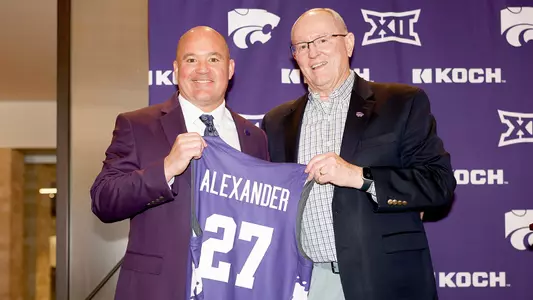
K-State Introduces Casey Alexander as Men’s Basketball Coach
Mar 16, 2026 | Men's Basketball
The Chattanooga, Tenn., native is the 27th coach in school history
MANHATTAN, Kan. – Casey Alexander, who guided Belmont to 166 wins and four conference titles in the last seven seasons, including the 2026 Missouri Valley Conference Championship, was formally introduced as the 27th head men's basketball coach at Kansas State during a press conference on Monday morning (March 16) in the Shamrock Zone inside Bramlage Coliseum.
Alexander, 53, was hired as head coach on Friday morning (March 13) after accumulating 303 victories (303-180; .627) in his 15-year head coaching career (2011-26), which includes stints at Stetson (2011-13), Lipscomb (2013-19) and his alma mater Belmont (2019-26), with 6 conference championships (2018 Atlantic Sun Conference Tournament, 2019 Atlantic Sun Conference regular season, 2020, 2021 Ohio Valley Conference regular season, 2020 Ohio Valley Conference Tournament and 2026 Missouri Valley Conference regular season).
Alexander was joined at Monday's introductory press conference by Director of Athletics Gene Taylor, along with members of the search committee (Casey Scott, Kenny Lannou, Rob Heil and Jordan Henriquez-Roberts), as well as his family, which included his wife, Sunni, and children Allie, Reed and Mason.
Alexander agreed to a 5-year contract, which was approved by the K-State Athletics, Inc., Board of Directors and President Richard Linton. Alexander will be paid $3.3 million in 2026-27 and will receive a $50,000 base salary increase each year remaining on the contract ($3.35 million in 2027-28, $3.4 million in 2028-29, $3.45 million in 2029-30, $3.5 million in 2030-31).
"I'm incredibly excited to join the team at K-State and can't wait to get the journey started," Alexander said. "K-State has such a rich tradition and a wildly passionate fan base and I'm grateful for the opportunity provided by Gene Taylor to be a part of it."
Alexander has led teams to 10 consecutive 20-win seasons (238-91; .723 winning percentage), which includes double-digit conference win totals each season (138-42; .767 winning percentage), despite navigating three different conferences (Atlantic Sun, Ohio Valley and Missouri Valley). In that span, his teams have averaged nearly 24 wins a season (23.8), including nearly 14 (13.8) in conference play, with six total championships, including four regular-season league titles, and three runner-up finishes while placing no lower than fourth place.
Alexander is one of 4 coaches to win 20 or more games in 10 consecutive seasons, joining Gonzaga's Mark Few, Houston's Kelvin Sampson and Kansas' Bill Self.
Belmont is one of only 16 Division I programs with 165 or more victories since the start of the 2019-20 season, which includes the likes of Houston, Gonzaga, Duke, Arizona and Kansas. The Bruins are one of only four teams outside the traditional multi-bid leagues (Akron, Drake, Liberty and VCU) in that fraternity. The 166 wins since 2019-20 are the 16th-most among Division I programs, while the .735 winning percentage is 11th in Division I in that span.
Despite playing in one-bid leagues in his entire head coaching career, Alexander's teams have appeared in the postseason 3 times, including the 2018 NCAA Tournament where Lipscomb lost to 2-seed North Carolina in the first round and twice in the Postseason NIT (2019, 2022), including a trip to the championship game in 2019. In that run to the finals, the Bison won 3 consecutive road games at Davidson, UNC Greensboro and N.C. State and a neutral-site victory over Wichita State in Madison Square Garden before a loss to Texas in the championship game.
Alexander's first Belmont squad in 2019-20 earned an automatic bid to the NCAA Tournament after winning the OVC Tournament before it was cancelled due to the COVID-19 pandemic.
His current Belmont squad would've given him another postseason after winning the Missouri Valley Conference regular season title but declined an NIT bid.
"We couldn't be more excited to announce Casey Alexander as the next head men's basketball coach at K-State," Taylor said. "We had significant interest in our job from numerous talented and successful coaches from around the country. What was evident throughout the search was the positive reputation of K-State basketball, and of the coaches we talked with Casey emerged as the one who best fit our program. He is known nationally as a tremendous evaluator of talent and one of the best offensive minds in the college game. He has built and maintained successful and winning programs at Stetson, Lipscomb and Belmont, and his reputation of developing players and a strong culture all make him a perfect fit for us. We are pleased to welcome Casey, his wife Sunni and their children - Allie, Reed and Mason - to Manhattan and the K-State family."
A majority of his 303 wins have come at the helm of his alma mater Belmont, which he has guided to a 166-60 (.735) overall record, including a 102-33 (.756) in conference play, since following the legendary Rick Byrd as head coach in 2019-20. His teams have won 4 conference championships in that span, including the most recent Missouri Valley Conference title.
Alexander's success as a head coach followed his tremendous pedigree as first a player (1991-95) then as an assistant coach (1995-2011) for Byrd, who won 713 games in developing Belmont into a NAIA powerhouse from 1986-96 before transiting to Division I in 1996-97 and making the Bruins an NCAA Tournament mainstay before his retirement in 2019.
Alexander succeeded Byrd as the 10th head coach in Belmont history on April 10, 2019.
Belmont is one of three Division I programs (along with Gonzaga and Kansas) to win 20 or more games in each of the last 16 seasons, while the 21 combined conference championships (13 regular season and 8 tournament) since 2006 are only surpassed by the aforementioned programs. Belmont, along with Houston and Louisville, are the only Division I programs to win conference championships in three different conferences over the last two decades.
Alexander played point guard for Byrd at Belmont from 1991-95, where he led the school to the top of the NAIA ranks with a 119-25 record, four postseason appearances and two conference championships. As a senior in 1995, he directed the then-Rebels to a 37-2 record, a No. 1 national ranking and an appearance in the NAIA National Semifinals.
Alexander joined Byrd's coaching staff upon graduation in 1995, spending the next 16 seasons (1995-2011) with the Hall of Famer, where he was part of 287 wins. In Alexander's final eight seasons on staff, the Bruins tallied 172 victories, six postseason appearances (4 NCAA Tournaments, one NIT, one CIT), four Atlantic Sun Conference regular-season championships and four more tournament titles. The team was a remarkable 132-41 (.763) in conference play in that span and posted road victories over Missouri, Alabama and Cincinnati.
Alexander was inducted into the Belmont University Athletics Hall of Fame in 2005.
Alexander returned to his alma mater after spending six seasons (2013-19) across town at Lipscomb University, where he produced a program renaissance in leading the Bison to the best 3-year stretch (72-31) of their NCAA Division I era and the first NCAA Tournament appearance in school history in 2017-18. Overall, he led the school to a 113-84 (.574) record, including a 59-31 (.656) mark in Atlantic Sun Conference play.
Alexander earned his first head coaching job at Stetson University located in Deland, Fla., in 2011-12, guiding the Hatters to 24 wins in two seasons (2011-13), including 18 in Atlantic Sun Conference play. He grew the win total from nine in year one to 15 in year two, including the school's most ASUN wins (11) since 1987.
Alexander earned a bachelor's degree in physical education from Belmont in 1995 before obtaining a Master's degree in sports management from Austin Peay in 1996.
Alexander was born on June 8, 1972 in Nashville, Tenn., and prepped at Brentwood Academy. He and his wife, the former Sunni Dixon, also a 1995 Belmont graduate, are the parents of three children: Allie, Reed and Mason.
Alexander will take over a Kansas State program that recently finished the 2025-26 season with a 12-20 overall record, including a 3-15 mark in Big 12 play.
PRESS CONFERENCE QUOTES
DIRECTOR OF ATHLETICS GENE TAYLOR
Opening statement…
"Good morning, everybody. I think you guys are kind of liking going to press conferences for coaches, we've kind of done it the last couple of weeks. Anyway, I really do thank everybody for being here, I certainly want to welcome coach's family, Sunni, Allie, Mason and Reed, good to have you. We got them up really early this morning, they're going to have a long day by the time they get back to Nashville, but it's great to have you guys and welcome to K-State. I want to thank the guys that helped put this guy and bring this guy here, our search committee, Kenny Lannou, Casey Scott, Rob Heil and Jordan Henriquez. They did a great job, and they kept us focused, kept us looking and asking me really hard questions about what was important. And so them really helping me through this has been a pleasure, so thank you guys very, very much. We also had some donors that helped, certainly provide insight and talk to our candidates a little bit, and you can just feel how much they care about our program. So again, just a lot of thanks to everybody. I'm not gonna be too long, but one of the things that came very, very clear during this process was the interest level in K-State basketball. And Casey [Alexander] pointed out many times about the history and tradition of our program, the fact that we've had three different coaches in recent history go to the Elite Eight, the financial support for our basketball program and probably the biggest thing that he talked about was Bramlage Coliseum and the fan support, and how excited he was to be able to coach in probably one of the toughest venues in the country and that came out a lot with Casey, very, very clearly. Coach checked a lot of our boxes that we were looking for, we were looking for an experienced head coach. We want a coach with a proven track record of success and consistent success wherever he's coached. He's won in every place that he's been and those are things that were important to us as we look for our next head coach. But the most important thing is he really, really wanted to be a K-State. He wanted this job really bad and that came through very clearly in our conversations with him. You know, he talked about the transition from Belmont, Lipscomb, to here, and he's very clear the Big 12 is not an easy place to coach. But his plan and his vision for our program and how to get there was very, very clear and very well thought out, and we really appreciated that. He wants a program that you as fans can enjoy watching and being a part of and can fill Bramlage [Coliseum] up, he talked about the excitement of that more than anything. So it's my pleasure to introduce to you our next head men's basketball coach, Casey Alexander."
K-STATE MEN'S BASKETBALL HEAD COACH CASEY ALEXANDER
Opening statement…
"Awesome stuff, thanks so much. He said, I checked a lot of the boxes, one of them was not that I stand tall like a basketball coach. I was an NAIA player, if I was a division one player back in the day I'd be about 6' 5" right now, but you're gonna get 5' 8", but you're gonna get all of 5' 8". You know, a lot of people are going to ask and with great expectation, why K-State, right? And I'm looking at it, awesome. This crowd, people that are passionate about their team and the school is the reason why, above all else, that I wanted to be here. We'll talk more about it, but I'm really privileged to be here. I'm grateful that you guys are here. I look forward to getting to know literally all of you, if I can, so excited about that. Ironically, President Rich Linton is not here, right? Rich and Sally reached out to me early in the process, we had a great bouquet of flowers on our table right now that they sent so, looking forward to personal contact there. Really grateful for you Gene and the process that ended with today, along with the other members of the search committee. I guess that part of the process is now over, and now we're on the job, so let's turn the page right. To Casey and Rob and Kenny and JO, guys put in a lot of time and effort to make sure that K-State got the right guy. And I think I'm the right guy, and I look forward to you feeling the same way over time. It'll take some time, but we'll all get there together for sure. I've had great communication with a lot of the staff and coaches in the department. That's meant a lot to me that the people who are now my colleagues and people that I'll work with every day have welcomed me, it says a lot about this community. It'll be very important to me as we move forward, that that's reciprocated, that other coaches in the department, other teams in the department, the community in general, knows that I'm committed to being one of them. Really important to me that we share that vision together, and that includes the Manhattan community, the campus community, really all the people who root for K-State. I mean, it's one of my favorite parts about the business, and the job is just connecting and sharing a like minded approach toward what we're all trying to accomplish and so that's again, it's represented in this room, but I told him [Gene Taylor] several times in our conversations along the way, just, you know, it's a thrill for me to be in a place where everybody in the town cares about K-State and everybody on this campus is wearing K-State gear. The President [Linton] told me to make sure I wear purple every day, and I gotta do some shopping to get that done, but we'll get there for sure. But it's really exciting and very much awesome facility, been here one time, 20 or so years ago, but I've watched a lot of games, I've seen the Wabash, I've seen it all, and I can't wait to get started in there. What a great, great opportunity for us and privilege to be a part of in the Octagon of Doom right here. That's nice, that's nice. Some thank yous here, obviously, my family, my immediate family, Sunni, Allie, Reed, Mason, so so good, such a blessing. And my job to have a family who is invested, committed and loves it, loves it, supportive in every good way, never supportive in a negative way or or a tough way. And I'm so grateful for you guys, for all of it, and that you're here today, so appreciate that. A lot has gone into this for me and won't mean as much to you, but I would be doing a disservice if I didn't thank my previous opportunities. My first head coaching job at Stetson University and Jeff Altier and Wendy Libby, to Lipscomb with Philip Hutcheson and Randy Lowry, now to Belmont with Scott Corley and Bob Fisher, who hired me, and their current president, Greg Jones, those people are very important in my life. And it's not lost on me at all the opportunities that were given to me that allowed me to do what I do and allow me to stand here in front of you today, so really, really grateful for them. 27 years in one form or fashion at Belmont, a small college player to an assistant coach and a head coach for the last seven years, so a lot of relationships there that we're leaving behind. Those are hard relationships to leave behind, but when you love each other, you carry each other with you, you carry them with you, and I'll stay connected to them, but definitely ready to turn this page so, but that's a great, great community. So I'll flip from thank you's to kind of, what more that you want to know about probably, is what's it going to look like, right? And it's going to be a work in progress, but everything for me starts with style like, style of play, style of player, style of program, and we can get deeper into it, but the style of play kind of dictates everything else. You know, if you're gonna be a wishbone team coach, you know, we gotta have a certain number of guys. We're probably not going to do that, but if we were, it would look a little different, right? But, you know, we want to be a style that is fun to play, fun to watch, fun to cheer for and leads to wins. Obviously, we want to be high tempo, every coach in the world is going to say they want to be high tempo, all right, and get up and down the floor. Not every coach can say they're typically in the top 25 in the country, in that category per year, or scoring per game. We want to be a high assist team, we want to be a really unselfish team. We want to get a lot of work done at the three point line, but we don't want to live and die at the three point line, we want to be really efficient outside the arc, inside the arc. Our team this year at Belmont was the number one effective field goal percentage team in the country, you know, so we had great success offensively through the years, but we do it in an efficient way. It's not a track meet, it's just, let's figure out how to get the right kind of players who have the right skills, above all else, understand what it means to play together, right, that want to share the ball, that understand what it means to be a great, great teammate, all the things that this day and age are a little tougher to come by quite honestly. There's a lot out there that distracts from the business at hand, which is winning, but we want guys that are still committed to that, and that's exactly how we're going to build. You know, the good thing about doing this in this modern day is things can change quickly, you know, and sometimes you throw darts and you hope you get lucky and strike gold, and it happens, and it's some short term pleasure that everybody loves. What I would love for you to see is a program that from year to year you know what the identity of our team is, you recognize faces from year to year. You know, when you walk in there, the style of play you're going to get, and it's super predictable. We got to be able to adapt, you got to be able to change that stuff happens all the time in athletics and within a game, but I want you to see some consistency. I want you to know our players, I want them to be in the community, I want them to be here consistently, I want to see some retention, all right. I don't want to flip a roster over every season, you know, and that might take a minute or two for us to get to that point, I think you probably have quite a bit of turnover this go around. But we don't want to see that on an annual basis, we want to build a program, you know. And I think that's another thing that really, really impressed me about K-State, but I really authentically believe that it's the kind of place with the kind of people that want that. Everybody wants to win, everybody wants excitement, but what I believe about this community is you want something you can really hold on to and believe in and track with and wrap your arms around. And so that's really important to me, that we do it that way, so excited about that. So with that being said, thanks for having me, thanks for the really warm welcome. I'm so grateful to be here. I'm really, really excited. I know we've got some questions, so I look forward to that, and we'll learn a little bit more about each other in that process."
On what went through his mind knowing he was being considered for this job…
"Well, I was thrilled to be considered. I mean, I was thrilled for sure. You know, it's the best basketball conference in the country and with unbelievable opportunities. And I recognize the great tradition here, players, coaches, it's a long standing tradition. Every coach that you can look back on has had success at one time or another, and most of those coaches, longevity of success. So I was really excited about just the process I had. You know, it was kind of out of, I don't know if it's right field or left field, but it came out of one of those fields and so I was happy about it."
On how he's adapted as a head coach…
"Yeah, so there has been a lot of change across the board, and it really doesn't matter what level you've been coaching and playing in. It is just a significant change and it still is changing, I think we're all getting used to it. We're learning a little bit more about it, but just when we think we get it figured out, you know, it flips again. And I have been on the other side of it. We've had so many really good players that have played for us [Belmont] that we have no ability to keep because we just couldn't afford it. And they ended up in places like K-State, you know, and so that's obviously one thing that really attracts me about this job, is not just being resourced, you know, but it allows me to coach in such a way that we can do it the way I want to do it, which let's go find the players that fit our program right. Collectively, the puzzle pieces work and you have a chance to keep those guys, retain those guys, develop those guys, build a team, have some retention. And retention more so than just like faces that are coming back, but that's leadership, that's style of play, that's culture in the locker room. Like all those things are what make, to me, what makes programs good. There's a lot of ways to win, there are teams that are going to turn their roster over every season, and a few of them will be able to figure out how to make that work, but it's not a great formula for most places. I think you have to do it a little bit, you have to live in the modern world of change and [transfer] portal and everything else. But you also have to, I think there's still a really great opportunity for a little bit of old school and how you build a program and do it that way."
On his most important objective when coaching a team…
"I think you're asking it this way, I'll answer it this way. I said this to these guys, like my primary responsibility is to the players in our program, all right. Whether that's a one year guy or a five, or what's become like a six or seven year guy, that's my responsibility, and so I look at it on the back end first. Like, when those guys leave K-State, I want them to tell me that they would sign up and do it all over again, like that's a job well done, right there, alright. And so from the moment they decide this is their place, to the moment where we have that goodbye hug to finish it out, you know, that's what we're trying to accomplish, is that they feel good about their experience, and they would sign up and do it all over again. Doesn't work that way for everybody, but that's the goal."
On all of the learning from going to a mid major to a high major program…
"Yeah, I've got a lot, I've got plenty to learn. You know, I mean, we all do, whether I was going to be back at Belmont for another year, I would still have plenty to learn. And there's, you know, the level is very different, I'm not naive to anything that we're walking into right here. It's a heck of a league with some great teams and some Hall of Fame coaches, unbelievable venues, fan bases that dictate winning and losing. You know, there's a curve that's out there for us, for sure, but I'm confident in who we are, I'm confident in how we're going to do it. I'm confident we can win here, I'm confident we can win here quickly. I'm confident we can live here consistently, you know, and that'll be my job. Work with the staff and attract the right kind of players, and with your help, we'll get there and we'll stay there."
On his offensive philosophy…
"Well, the best thing you can do to get guys to shoot at such a high clip is recruit, recruit guys that can shoot at a high clip. That's really important, really important. Square peg, round hole thing there. Offensive philosophy is to build a roster with a lot of guys that can do that though, you know. I'll say this first before somebody asks, you can't do anything well if you're not good on both ends of the floor, you know. It's complimentary football, and you don't really hear it that way in basketball, but it's really the same thing. Like you can be fun and score points and have a bunch of numbers, but you can't win if you're not good on both ends of the floor. So there's no sacrifice to the defensive end, just because we've been really good offensively throughout my career. But we want to build a team, like it's important to me that we have a high skill level. Like you got to have athletes, you got to have guys that can guard, you got to have size, got to have all that, all right. But it's really important that, to me, a tiebreaker for me most often is, can the guy play offense and does he have a really high IQ, is he unselfish? And when you get enough of those pieces working together, you can put together a really dynamic team, but that's how it's happened. And again, at Belmont, we made more three pointers than any team in the country since we've been division one, like that's always been a staple of ours. But we also had year after year where we were the best two-point percentage team in the country, all right, and years where we led the country in assists per game, or assist turnover ratio, like all that stuff works together, all right. So there's zero reason here where we can recruit a better player while we can't accomplish all those same things and have the same kind of success on that floor. But I appreciate you asking the question, I figured it would probably come."
On what he's learned most about himself…
"It has been a journey, and my favorite part of coaching is the journey. I mean, we're all measured by wins and losses, no escaping that. But whether it's the journey of taking a team from the beginning of a season to the end, that's a really special short period of time, or just the journey of a player's career, or the journey of my career, whatever. But you know what I've learned the most is there's a lot of, you know, as a young coach, you can have everything figured out, and if everybody will just do what you say, then it's going to work out for everybody. And I think it's important to have that kind of confidence, but at the same time, you know, in reflection, in hindsight, you realize pretty quickly that you got a lot to learn, and no matter, regardless of the success that's happening now, you know being a lifelong learner and learning how to adapt, and learning how to do it with new people, and learning how to do it in new places like that's what life is right there. And this is just another chapter of that for me."
On the retention and recruiting of high school players…
"I think it's critical, I think it's a missing piece for a lot of programs out there right now that are fluctuating from, you know, bad to good to great. It just depends on what year you're looking at, you know, and it's not easy at all. There are a lot of guys out there with people in their ear, and, you know, everybody seems to have a different agenda, but the like mindedness that it requires to be a really good team and a really good program requires some retention from year to year. In my opinion, it'll be probably the most important part of our plan, when you think about recruiting and year to year and building something. Again, in the old days, when a coach got hired, you know, it was like, 'Hey, let's give that guy three or four years to get his players in here.' I mean, my gosh, you know, that's about a three or four month turnaround now and then they'll never know what's going to happen. But the retention piece is so huge, we want to recruit some really good high school players, and we want to keep them, and the more you do that annually, the more retention you're going to have. You're always going to have to have people out of the portal, you're always going to have to fill needs with portal guys, all right, but we don't want fruit basket turnover where everything is brand new every year as best as we can help. You know, the language in the system, the carryover from, you know, just year to year with leadership, all those things are so important to the success of your team, if you really care about the team, and so that'll be a focus of ours."
How to follow the 'Cats: For complete information on K-State men's basketball, visit www.kstatesports.com and follow the team's social media channels on X, Instagram and Facebook.
Alexander, 53, was hired as head coach on Friday morning (March 13) after accumulating 303 victories (303-180; .627) in his 15-year head coaching career (2011-26), which includes stints at Stetson (2011-13), Lipscomb (2013-19) and his alma mater Belmont (2019-26), with 6 conference championships (2018 Atlantic Sun Conference Tournament, 2019 Atlantic Sun Conference regular season, 2020, 2021 Ohio Valley Conference regular season, 2020 Ohio Valley Conference Tournament and 2026 Missouri Valley Conference regular season).
Alexander was joined at Monday's introductory press conference by Director of Athletics Gene Taylor, along with members of the search committee (Casey Scott, Kenny Lannou, Rob Heil and Jordan Henriquez-Roberts), as well as his family, which included his wife, Sunni, and children Allie, Reed and Mason.
Alexander agreed to a 5-year contract, which was approved by the K-State Athletics, Inc., Board of Directors and President Richard Linton. Alexander will be paid $3.3 million in 2026-27 and will receive a $50,000 base salary increase each year remaining on the contract ($3.35 million in 2027-28, $3.4 million in 2028-29, $3.45 million in 2029-30, $3.5 million in 2030-31).
"I'm incredibly excited to join the team at K-State and can't wait to get the journey started," Alexander said. "K-State has such a rich tradition and a wildly passionate fan base and I'm grateful for the opportunity provided by Gene Taylor to be a part of it."
Alexander has led teams to 10 consecutive 20-win seasons (238-91; .723 winning percentage), which includes double-digit conference win totals each season (138-42; .767 winning percentage), despite navigating three different conferences (Atlantic Sun, Ohio Valley and Missouri Valley). In that span, his teams have averaged nearly 24 wins a season (23.8), including nearly 14 (13.8) in conference play, with six total championships, including four regular-season league titles, and three runner-up finishes while placing no lower than fourth place.
Alexander is one of 4 coaches to win 20 or more games in 10 consecutive seasons, joining Gonzaga's Mark Few, Houston's Kelvin Sampson and Kansas' Bill Self.
Belmont is one of only 16 Division I programs with 165 or more victories since the start of the 2019-20 season, which includes the likes of Houston, Gonzaga, Duke, Arizona and Kansas. The Bruins are one of only four teams outside the traditional multi-bid leagues (Akron, Drake, Liberty and VCU) in that fraternity. The 166 wins since 2019-20 are the 16th-most among Division I programs, while the .735 winning percentage is 11th in Division I in that span.
Despite playing in one-bid leagues in his entire head coaching career, Alexander's teams have appeared in the postseason 3 times, including the 2018 NCAA Tournament where Lipscomb lost to 2-seed North Carolina in the first round and twice in the Postseason NIT (2019, 2022), including a trip to the championship game in 2019. In that run to the finals, the Bison won 3 consecutive road games at Davidson, UNC Greensboro and N.C. State and a neutral-site victory over Wichita State in Madison Square Garden before a loss to Texas in the championship game.
Alexander's first Belmont squad in 2019-20 earned an automatic bid to the NCAA Tournament after winning the OVC Tournament before it was cancelled due to the COVID-19 pandemic.
His current Belmont squad would've given him another postseason after winning the Missouri Valley Conference regular season title but declined an NIT bid.
"We couldn't be more excited to announce Casey Alexander as the next head men's basketball coach at K-State," Taylor said. "We had significant interest in our job from numerous talented and successful coaches from around the country. What was evident throughout the search was the positive reputation of K-State basketball, and of the coaches we talked with Casey emerged as the one who best fit our program. He is known nationally as a tremendous evaluator of talent and one of the best offensive minds in the college game. He has built and maintained successful and winning programs at Stetson, Lipscomb and Belmont, and his reputation of developing players and a strong culture all make him a perfect fit for us. We are pleased to welcome Casey, his wife Sunni and their children - Allie, Reed and Mason - to Manhattan and the K-State family."
A majority of his 303 wins have come at the helm of his alma mater Belmont, which he has guided to a 166-60 (.735) overall record, including a 102-33 (.756) in conference play, since following the legendary Rick Byrd as head coach in 2019-20. His teams have won 4 conference championships in that span, including the most recent Missouri Valley Conference title.
Alexander's success as a head coach followed his tremendous pedigree as first a player (1991-95) then as an assistant coach (1995-2011) for Byrd, who won 713 games in developing Belmont into a NAIA powerhouse from 1986-96 before transiting to Division I in 1996-97 and making the Bruins an NCAA Tournament mainstay before his retirement in 2019.
Alexander succeeded Byrd as the 10th head coach in Belmont history on April 10, 2019.
Belmont is one of three Division I programs (along with Gonzaga and Kansas) to win 20 or more games in each of the last 16 seasons, while the 21 combined conference championships (13 regular season and 8 tournament) since 2006 are only surpassed by the aforementioned programs. Belmont, along with Houston and Louisville, are the only Division I programs to win conference championships in three different conferences over the last two decades.
Alexander played point guard for Byrd at Belmont from 1991-95, where he led the school to the top of the NAIA ranks with a 119-25 record, four postseason appearances and two conference championships. As a senior in 1995, he directed the then-Rebels to a 37-2 record, a No. 1 national ranking and an appearance in the NAIA National Semifinals.
Alexander joined Byrd's coaching staff upon graduation in 1995, spending the next 16 seasons (1995-2011) with the Hall of Famer, where he was part of 287 wins. In Alexander's final eight seasons on staff, the Bruins tallied 172 victories, six postseason appearances (4 NCAA Tournaments, one NIT, one CIT), four Atlantic Sun Conference regular-season championships and four more tournament titles. The team was a remarkable 132-41 (.763) in conference play in that span and posted road victories over Missouri, Alabama and Cincinnati.
Alexander was inducted into the Belmont University Athletics Hall of Fame in 2005.
Alexander returned to his alma mater after spending six seasons (2013-19) across town at Lipscomb University, where he produced a program renaissance in leading the Bison to the best 3-year stretch (72-31) of their NCAA Division I era and the first NCAA Tournament appearance in school history in 2017-18. Overall, he led the school to a 113-84 (.574) record, including a 59-31 (.656) mark in Atlantic Sun Conference play.
Alexander earned his first head coaching job at Stetson University located in Deland, Fla., in 2011-12, guiding the Hatters to 24 wins in two seasons (2011-13), including 18 in Atlantic Sun Conference play. He grew the win total from nine in year one to 15 in year two, including the school's most ASUN wins (11) since 1987.
Alexander earned a bachelor's degree in physical education from Belmont in 1995 before obtaining a Master's degree in sports management from Austin Peay in 1996.
Alexander was born on June 8, 1972 in Nashville, Tenn., and prepped at Brentwood Academy. He and his wife, the former Sunni Dixon, also a 1995 Belmont graduate, are the parents of three children: Allie, Reed and Mason.
Alexander will take over a Kansas State program that recently finished the 2025-26 season with a 12-20 overall record, including a 3-15 mark in Big 12 play.
PRESS CONFERENCE QUOTES
DIRECTOR OF ATHLETICS GENE TAYLOR
Opening statement…
"Good morning, everybody. I think you guys are kind of liking going to press conferences for coaches, we've kind of done it the last couple of weeks. Anyway, I really do thank everybody for being here, I certainly want to welcome coach's family, Sunni, Allie, Mason and Reed, good to have you. We got them up really early this morning, they're going to have a long day by the time they get back to Nashville, but it's great to have you guys and welcome to K-State. I want to thank the guys that helped put this guy and bring this guy here, our search committee, Kenny Lannou, Casey Scott, Rob Heil and Jordan Henriquez. They did a great job, and they kept us focused, kept us looking and asking me really hard questions about what was important. And so them really helping me through this has been a pleasure, so thank you guys very, very much. We also had some donors that helped, certainly provide insight and talk to our candidates a little bit, and you can just feel how much they care about our program. So again, just a lot of thanks to everybody. I'm not gonna be too long, but one of the things that came very, very clear during this process was the interest level in K-State basketball. And Casey [Alexander] pointed out many times about the history and tradition of our program, the fact that we've had three different coaches in recent history go to the Elite Eight, the financial support for our basketball program and probably the biggest thing that he talked about was Bramlage Coliseum and the fan support, and how excited he was to be able to coach in probably one of the toughest venues in the country and that came out a lot with Casey, very, very clearly. Coach checked a lot of our boxes that we were looking for, we were looking for an experienced head coach. We want a coach with a proven track record of success and consistent success wherever he's coached. He's won in every place that he's been and those are things that were important to us as we look for our next head coach. But the most important thing is he really, really wanted to be a K-State. He wanted this job really bad and that came through very clearly in our conversations with him. You know, he talked about the transition from Belmont, Lipscomb, to here, and he's very clear the Big 12 is not an easy place to coach. But his plan and his vision for our program and how to get there was very, very clear and very well thought out, and we really appreciated that. He wants a program that you as fans can enjoy watching and being a part of and can fill Bramlage [Coliseum] up, he talked about the excitement of that more than anything. So it's my pleasure to introduce to you our next head men's basketball coach, Casey Alexander."
K-STATE MEN'S BASKETBALL HEAD COACH CASEY ALEXANDER
Opening statement…
"Awesome stuff, thanks so much. He said, I checked a lot of the boxes, one of them was not that I stand tall like a basketball coach. I was an NAIA player, if I was a division one player back in the day I'd be about 6' 5" right now, but you're gonna get 5' 8", but you're gonna get all of 5' 8". You know, a lot of people are going to ask and with great expectation, why K-State, right? And I'm looking at it, awesome. This crowd, people that are passionate about their team and the school is the reason why, above all else, that I wanted to be here. We'll talk more about it, but I'm really privileged to be here. I'm grateful that you guys are here. I look forward to getting to know literally all of you, if I can, so excited about that. Ironically, President Rich Linton is not here, right? Rich and Sally reached out to me early in the process, we had a great bouquet of flowers on our table right now that they sent so, looking forward to personal contact there. Really grateful for you Gene and the process that ended with today, along with the other members of the search committee. I guess that part of the process is now over, and now we're on the job, so let's turn the page right. To Casey and Rob and Kenny and JO, guys put in a lot of time and effort to make sure that K-State got the right guy. And I think I'm the right guy, and I look forward to you feeling the same way over time. It'll take some time, but we'll all get there together for sure. I've had great communication with a lot of the staff and coaches in the department. That's meant a lot to me that the people who are now my colleagues and people that I'll work with every day have welcomed me, it says a lot about this community. It'll be very important to me as we move forward, that that's reciprocated, that other coaches in the department, other teams in the department, the community in general, knows that I'm committed to being one of them. Really important to me that we share that vision together, and that includes the Manhattan community, the campus community, really all the people who root for K-State. I mean, it's one of my favorite parts about the business, and the job is just connecting and sharing a like minded approach toward what we're all trying to accomplish and so that's again, it's represented in this room, but I told him [Gene Taylor] several times in our conversations along the way, just, you know, it's a thrill for me to be in a place where everybody in the town cares about K-State and everybody on this campus is wearing K-State gear. The President [Linton] told me to make sure I wear purple every day, and I gotta do some shopping to get that done, but we'll get there for sure. But it's really exciting and very much awesome facility, been here one time, 20 or so years ago, but I've watched a lot of games, I've seen the Wabash, I've seen it all, and I can't wait to get started in there. What a great, great opportunity for us and privilege to be a part of in the Octagon of Doom right here. That's nice, that's nice. Some thank yous here, obviously, my family, my immediate family, Sunni, Allie, Reed, Mason, so so good, such a blessing. And my job to have a family who is invested, committed and loves it, loves it, supportive in every good way, never supportive in a negative way or or a tough way. And I'm so grateful for you guys, for all of it, and that you're here today, so appreciate that. A lot has gone into this for me and won't mean as much to you, but I would be doing a disservice if I didn't thank my previous opportunities. My first head coaching job at Stetson University and Jeff Altier and Wendy Libby, to Lipscomb with Philip Hutcheson and Randy Lowry, now to Belmont with Scott Corley and Bob Fisher, who hired me, and their current president, Greg Jones, those people are very important in my life. And it's not lost on me at all the opportunities that were given to me that allowed me to do what I do and allow me to stand here in front of you today, so really, really grateful for them. 27 years in one form or fashion at Belmont, a small college player to an assistant coach and a head coach for the last seven years, so a lot of relationships there that we're leaving behind. Those are hard relationships to leave behind, but when you love each other, you carry each other with you, you carry them with you, and I'll stay connected to them, but definitely ready to turn this page so, but that's a great, great community. So I'll flip from thank you's to kind of, what more that you want to know about probably, is what's it going to look like, right? And it's going to be a work in progress, but everything for me starts with style like, style of play, style of player, style of program, and we can get deeper into it, but the style of play kind of dictates everything else. You know, if you're gonna be a wishbone team coach, you know, we gotta have a certain number of guys. We're probably not going to do that, but if we were, it would look a little different, right? But, you know, we want to be a style that is fun to play, fun to watch, fun to cheer for and leads to wins. Obviously, we want to be high tempo, every coach in the world is going to say they want to be high tempo, all right, and get up and down the floor. Not every coach can say they're typically in the top 25 in the country, in that category per year, or scoring per game. We want to be a high assist team, we want to be a really unselfish team. We want to get a lot of work done at the three point line, but we don't want to live and die at the three point line, we want to be really efficient outside the arc, inside the arc. Our team this year at Belmont was the number one effective field goal percentage team in the country, you know, so we had great success offensively through the years, but we do it in an efficient way. It's not a track meet, it's just, let's figure out how to get the right kind of players who have the right skills, above all else, understand what it means to play together, right, that want to share the ball, that understand what it means to be a great, great teammate, all the things that this day and age are a little tougher to come by quite honestly. There's a lot out there that distracts from the business at hand, which is winning, but we want guys that are still committed to that, and that's exactly how we're going to build. You know, the good thing about doing this in this modern day is things can change quickly, you know, and sometimes you throw darts and you hope you get lucky and strike gold, and it happens, and it's some short term pleasure that everybody loves. What I would love for you to see is a program that from year to year you know what the identity of our team is, you recognize faces from year to year. You know, when you walk in there, the style of play you're going to get, and it's super predictable. We got to be able to adapt, you got to be able to change that stuff happens all the time in athletics and within a game, but I want you to see some consistency. I want you to know our players, I want them to be in the community, I want them to be here consistently, I want to see some retention, all right. I don't want to flip a roster over every season, you know, and that might take a minute or two for us to get to that point, I think you probably have quite a bit of turnover this go around. But we don't want to see that on an annual basis, we want to build a program, you know. And I think that's another thing that really, really impressed me about K-State, but I really authentically believe that it's the kind of place with the kind of people that want that. Everybody wants to win, everybody wants excitement, but what I believe about this community is you want something you can really hold on to and believe in and track with and wrap your arms around. And so that's really important to me, that we do it that way, so excited about that. So with that being said, thanks for having me, thanks for the really warm welcome. I'm so grateful to be here. I'm really, really excited. I know we've got some questions, so I look forward to that, and we'll learn a little bit more about each other in that process."
On what went through his mind knowing he was being considered for this job…
"Well, I was thrilled to be considered. I mean, I was thrilled for sure. You know, it's the best basketball conference in the country and with unbelievable opportunities. And I recognize the great tradition here, players, coaches, it's a long standing tradition. Every coach that you can look back on has had success at one time or another, and most of those coaches, longevity of success. So I was really excited about just the process I had. You know, it was kind of out of, I don't know if it's right field or left field, but it came out of one of those fields and so I was happy about it."
On how he's adapted as a head coach…
"Yeah, so there has been a lot of change across the board, and it really doesn't matter what level you've been coaching and playing in. It is just a significant change and it still is changing, I think we're all getting used to it. We're learning a little bit more about it, but just when we think we get it figured out, you know, it flips again. And I have been on the other side of it. We've had so many really good players that have played for us [Belmont] that we have no ability to keep because we just couldn't afford it. And they ended up in places like K-State, you know, and so that's obviously one thing that really attracts me about this job, is not just being resourced, you know, but it allows me to coach in such a way that we can do it the way I want to do it, which let's go find the players that fit our program right. Collectively, the puzzle pieces work and you have a chance to keep those guys, retain those guys, develop those guys, build a team, have some retention. And retention more so than just like faces that are coming back, but that's leadership, that's style of play, that's culture in the locker room. Like all those things are what make, to me, what makes programs good. There's a lot of ways to win, there are teams that are going to turn their roster over every season, and a few of them will be able to figure out how to make that work, but it's not a great formula for most places. I think you have to do it a little bit, you have to live in the modern world of change and [transfer] portal and everything else. But you also have to, I think there's still a really great opportunity for a little bit of old school and how you build a program and do it that way."
On his most important objective when coaching a team…
"I think you're asking it this way, I'll answer it this way. I said this to these guys, like my primary responsibility is to the players in our program, all right. Whether that's a one year guy or a five, or what's become like a six or seven year guy, that's my responsibility, and so I look at it on the back end first. Like, when those guys leave K-State, I want them to tell me that they would sign up and do it all over again, like that's a job well done, right there, alright. And so from the moment they decide this is their place, to the moment where we have that goodbye hug to finish it out, you know, that's what we're trying to accomplish, is that they feel good about their experience, and they would sign up and do it all over again. Doesn't work that way for everybody, but that's the goal."
On all of the learning from going to a mid major to a high major program…
"Yeah, I've got a lot, I've got plenty to learn. You know, I mean, we all do, whether I was going to be back at Belmont for another year, I would still have plenty to learn. And there's, you know, the level is very different, I'm not naive to anything that we're walking into right here. It's a heck of a league with some great teams and some Hall of Fame coaches, unbelievable venues, fan bases that dictate winning and losing. You know, there's a curve that's out there for us, for sure, but I'm confident in who we are, I'm confident in how we're going to do it. I'm confident we can win here, I'm confident we can win here quickly. I'm confident we can live here consistently, you know, and that'll be my job. Work with the staff and attract the right kind of players, and with your help, we'll get there and we'll stay there."
On his offensive philosophy…
"Well, the best thing you can do to get guys to shoot at such a high clip is recruit, recruit guys that can shoot at a high clip. That's really important, really important. Square peg, round hole thing there. Offensive philosophy is to build a roster with a lot of guys that can do that though, you know. I'll say this first before somebody asks, you can't do anything well if you're not good on both ends of the floor, you know. It's complimentary football, and you don't really hear it that way in basketball, but it's really the same thing. Like you can be fun and score points and have a bunch of numbers, but you can't win if you're not good on both ends of the floor. So there's no sacrifice to the defensive end, just because we've been really good offensively throughout my career. But we want to build a team, like it's important to me that we have a high skill level. Like you got to have athletes, you got to have guys that can guard, you got to have size, got to have all that, all right. But it's really important that, to me, a tiebreaker for me most often is, can the guy play offense and does he have a really high IQ, is he unselfish? And when you get enough of those pieces working together, you can put together a really dynamic team, but that's how it's happened. And again, at Belmont, we made more three pointers than any team in the country since we've been division one, like that's always been a staple of ours. But we also had year after year where we were the best two-point percentage team in the country, all right, and years where we led the country in assists per game, or assist turnover ratio, like all that stuff works together, all right. So there's zero reason here where we can recruit a better player while we can't accomplish all those same things and have the same kind of success on that floor. But I appreciate you asking the question, I figured it would probably come."
On what he's learned most about himself…
"It has been a journey, and my favorite part of coaching is the journey. I mean, we're all measured by wins and losses, no escaping that. But whether it's the journey of taking a team from the beginning of a season to the end, that's a really special short period of time, or just the journey of a player's career, or the journey of my career, whatever. But you know what I've learned the most is there's a lot of, you know, as a young coach, you can have everything figured out, and if everybody will just do what you say, then it's going to work out for everybody. And I think it's important to have that kind of confidence, but at the same time, you know, in reflection, in hindsight, you realize pretty quickly that you got a lot to learn, and no matter, regardless of the success that's happening now, you know being a lifelong learner and learning how to adapt, and learning how to do it with new people, and learning how to do it in new places like that's what life is right there. And this is just another chapter of that for me."
On the retention and recruiting of high school players…
"I think it's critical, I think it's a missing piece for a lot of programs out there right now that are fluctuating from, you know, bad to good to great. It just depends on what year you're looking at, you know, and it's not easy at all. There are a lot of guys out there with people in their ear, and, you know, everybody seems to have a different agenda, but the like mindedness that it requires to be a really good team and a really good program requires some retention from year to year. In my opinion, it'll be probably the most important part of our plan, when you think about recruiting and year to year and building something. Again, in the old days, when a coach got hired, you know, it was like, 'Hey, let's give that guy three or four years to get his players in here.' I mean, my gosh, you know, that's about a three or four month turnaround now and then they'll never know what's going to happen. But the retention piece is so huge, we want to recruit some really good high school players, and we want to keep them, and the more you do that annually, the more retention you're going to have. You're always going to have to have people out of the portal, you're always going to have to fill needs with portal guys, all right, but we don't want fruit basket turnover where everything is brand new every year as best as we can help. You know, the language in the system, the carryover from, you know, just year to year with leadership, all those things are so important to the success of your team, if you really care about the team, and so that'll be a focus of ours."
How to follow the 'Cats: For complete information on K-State men's basketball, visit www.kstatesports.com and follow the team's social media channels on X, Instagram and Facebook.

K-State MBB | New Head Coach Casey Alexander Introductory Press Conference
Monday, March 16
K-State Men's Basketball | Postgame Press Conference vs BYU (Big 12 Tournament First Round)
Wednesday, March 11
K State Men's Basketball | Postgame Press Conference at Kansas
Saturday, March 07
K-State Men's Basketball | Recap vs West Virginia
Friday, March 06