‘This Place is Special, Man’
Mar 31, 2026 | Men's Basketball, Sports Extra
By: D. Scott Fritchen
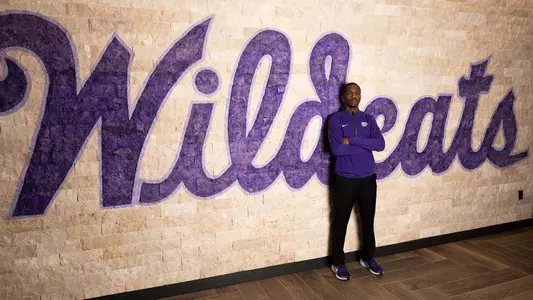
He sits inside the Shamrock Zone at Bramlage Coliseum for the first time and marvels at the spacious limestone-filled room, the wall-sized flat-screen TVs and large windows that reveal Bill Snyder Family Stadium on the other side. Kerron Johnson, a 35-year-old former point guard who played professionally in New Zealand, Germany, France, Poland, Italy and Israel, has seen some places.
The former Belmont director of player development is now wearing a purple quarter-zip with a white Powercat. This is all new. One of the most decorated players in Belmont history and a Belmont Hall of Fame inductee is here to serve as an assistant coach under new K-State head men's basketball coach Casey Alexander.
And Johnson, a native of Huntsville, Alabama, who's spent nearly half of his life in Nashville, Tennessee, cannot get enough of his new home in the Little Apple.
"Man, you kidding me?" Johnson beams. "This place is awesome. You grow up watching Michael Beasley and Jacob Pullen in here and you know how special this place is. You understand that K-State fans care a lot about their team. As a competitor, coach and athlete, that's what you want. You want people who care about winning and losing, and who care about guys in the program.
"We were more than excited about having this opportunity to come here where everybody is as invested as they are. This place is special, man. I can't wait to take my son to a football game, our women's programs, baseball, all of it."
Johnson knows ball. He ranks among the Belmont career leaders with 1,388 points, 515 assists, 206 steals and 511 made free throws. He starred on the 2011 Belmont team that went 30-5, winning conference games by an average of nearly 21 points per game. He led Belmont to four consecutive conference championships. He worked closely with two-time all-conference guard Ben Sheppard, who was selected No. 26 by the Indiana Pacers in the 2023 NBA Draft.
And now Johnson's journey has brought him here. The Bramlage Coliseum floor is lit up and ready for hoops.
March Madness?
For Johnson, it's March happiness.
Johnson spoke with K-State Sports Extra's D. Scott Fritchen about his career path and his move with Alexander to K-State.

D. Scott Fritchen: What was your immediate reaction when you heard Casey accepted the K-State job?
Kerron Johnson: I was excited for him and for everybody. We knew it was a big opportunity for him, something he's been waiting for a long time — his opportunity. To see him actually get it, to see the relief on his face when he got it, it was exciting for us. We had had conversations about potentially following him. We knew how good he was and how us having a good year would garnish some attention, so he talked to us pretty early in the process about how quickly it could happen and if we were interested. Of course, we were going to go where the captain goes. Then we found out about 10:00 p.m., I forgot who broke it on social media, but that's when we found out. That's when our phones started going crazy. Of course, we knew he was up for it, but we didn't know how it went. It was exciting. Everybody was up until 2:00 a.m. trying to figure everything out. It was exciting.
Fritchen: What do you admire most about Casey as a person and then what do you admire most about Casey as a coach?
Johnson: Him as a person, I admire how much he cares about his athletes. In the world that we live in now, we could become transactional. In a world where that's a lot of the situations, it's not for him. He invests deeply into the guys he coaches and recruits. He believes everything that he tells the family in the recruiting process about how we want to make them better men, not just better players. So, it's very important for us that we relay those messages when we talk to our guys. We have very personal relationships with our guys. At Belmont, when we lost one, it really hurt. It wasn't just, 'Good luck.' That's probably the biggest thing I admire about him as a person.
As a coach, I admire his leadership style. He gives us a lot of responsibility and trusts us a lot more, and he delegates a lot to us, and for a coach who's as smart and as accomplished as him, he doesn't have to do those things, but he knows that we all have ambitions of being head coaches one day. So, he gives us all the responsibilities that we'd need to be successful. A lot of coaches, that's hard for them to do, to relinquish control, but in doing that our responsibilities are higher, he expects a lot more of us, and he's tough on us, but he's fair and he's honest.

Fritchen: Describe your chemistry with Casey and what makes you both vibe?
Johnson: He was my coach and he recruited me at 16 years old, and he was my position coach when I played for him. Our intensity and the way we go about things and the way we see how the game should be played, we see it very similarly. We vibe from that. I tend to look more at the defensive side of the ball whereas he's an offensive guru, so that's where our balance naturally happens as far as on a coaching staff. He recruited me because he saw a lot of the same traits in being a competitor and intense and being demanding, those things, but from a coaching perspective, we just balance each other in how we see the game.
Fritchen: What makes K-State a good fit for Kerron Johnson?
Johnson: Man, you kidding me? This place is awesome. You grow up watching Michael Beasley and Jacob Pullen in here and you know how special this place is. You understand that K-State fans care a lot about their team. As a competitor, coach and athlete, that's what you want. You want people who care about winning and losing, and who care about guys in the program. We were more than excited about having this opportunity to come here where everybody is as invested as they are. This place is special, man. I can't wait to take my son to a football game, our women's programs, baseball, all of it. Growing up in Alabama, this type of community seems normal for me.
Fritchen: How would you describe this transition from Belmont to K-State strictly from the aspect of leaving one job and moving to another? There are certainly a lot of goodbyes, a lot of packing, then a lot of hellos and a lot of unpacking. It's probably a pretty emotional time, isn't it?
Johnson: Extremely emotional. I mean, a lot of us had a lot of time invested into Belmont. Belmont was a safe place for us. You grow from being a kid to being a man to winning a lot to having a lot of memories and staying in touch with old teammates – many were in my wedding – and having a relationship over time, almost 15 years of Belmont, from playing to now coaching to everything in between. It's emotional. A lot of the same people I met in administration when I went to school there are still there, so it's definitely an emotional goodbye. That was the hardest part from Casey and all of us. You invest a lot in that place, and it gives a lot back.

Fritchen: You were to begin your fourth year at Belmont overall next season and had been promoted to assistant coach at Belmont in May 2024. Now you're first-year assistant on a Power 4 team that competes in arguably the toughest conference in the nation. What are the emotions that go along with making that jump?
Johnson: Not really emotions, I mean, I think when I started this, I had a meeting with Casey, and he asked me what I wanted. I said, "I want to compete against the best." This is the best. You don't get to choose your opportunity every time. I'm excited. If you want to be the best, you have to beat the best, and this is where the best are — some of the best coaches and players in the country are in the Big 12. It's not a nervous thing, but it's being more excited about the opportunity to prove yourself. If you're a competitor that's all you can ask for, is the opportunity.
Fritchen: What kinds of thoughts were running through your head as you opened the front door and entered the K-State basketball facility for the first time?
Johnson: Wow. You stand up at the top floor and gives you a bird-eye view. Really, it's "wow." This is it. This is your opportunity. A lot of people, a lot of assistant coaches don't get this. Casey trusted us enough to bring us with him. It means a lot that we come here wanting to win and compete and make the K-State fanbase proud. These are very proud people. It makes you want to work as hard as you possibly can to make those things happen. And then you see what happens.
Fritchen: What's thumbnail sketch of the duties you'll undertake as an assistant coach on this staff?
Johnson: We do a lot. We all have a pretty wide variety of things that we cover, but a lot of the defensive strategies and scouting and player development is something that a lot of us – the younger assistants – really hone in on, and it's one of the things that made us great at Belmont, was our ability to find and develop talent. Us being able to give that time to our players here with a lot of resources, nobody has any excuses anymore. Like I said earlier, Casey gives you a lot of responsibility, so scouts and preparation, and all those things that he has on his plate, he's going to let us have, too. We just have to be ready for it.
Fritchen: You coached some great guards with Ben Sheppard going to the Indiana Pacers with the 26th pick in the 2023 NBA Draft while you also instrumental in the development of several other notable guards at Belmont such as Ja'Kobi Gillespie, Keishawn Davidson, Carter Whitt and Brody Peebles. What are the keys to being a great point guard?
Johnson: Man, competitiveness is the first thing. There's a lot of skilled players out there today, and I think competitiveness and motor are the separators. It's what separates those guys that you mention. Ja'Kobi competed every day. I saw him play a whole half of basketball with a broken right wrist. He played left-handed. Those guys are extremely competitive. It's easy to just work on skills, but developing the mental, how they watch the game, how they see the game, that's what separates them, and that's what we do a great job of. Ben, in my opinion, should've been national defensive player of the year and Larry Bird Player of the Year. That kid is a freak. It's a lot of time, dedication and trust on their part, and building that trust so they believe what you're telling them. That's all stuff you have to cultivate over time.
Fritchen: Recruiting and signing guys out of the transfer portal is more crucial today than at any other time in the history of college basketball. It's a whole new world. What's the plan of attack when the portal opens on April 7?
Johnson: We've talked about it. We're going to have every resource available to get the best players in the country. So, for us, it's even more important that we recruit the right type of kids, the right kids that are about the right things. It's instrumental in what's made us successful, it's what they trust Casey to do, is to have a bunch of guys that we know are going to be talented, but who truly care about the sacrifice that it takes to be a championship team. In an age where you have a lot of money and can get a lot of different players, it's never been more important to get the right type of kids in your program. That's our No. 1 priority is to get the right kids and everything else will take care of itself.

Fritchen: The NCAA Tournament is still going on. What kind of hunger do you feel this time of year in just imagining that next trip to a NCAA Tournament?
Johnson: Never been higher. You watch these guys, and we've never had the opportunity to have the type of seeding, the opportunity to play in the Sweet 16 and to watch guys going out there, it drives you competitively as much as possible. You watched guys like Ben McCollum at Iowa flip a program and take them that far, it drives you and its motivation for us to come in here and try to do the same thing.
Fritchen: From that little boy growing up in Huntsville, Alabama, to the man you are today, what has Kerron Johnson learned most about himself during his journey?
Johnson: That I don't break. I played professional basketball for nine years in Russia and Germany and was a long way from home, and there's been a lot of ups and downs and failures. I don't break. Whatever happens, it won't affect how we go about taking care of our business. And that's the only way I've been successful. You can bend, just don't break. You can find your way through it.
He sits inside the Shamrock Zone at Bramlage Coliseum for the first time and marvels at the spacious limestone-filled room, the wall-sized flat-screen TVs and large windows that reveal Bill Snyder Family Stadium on the other side. Kerron Johnson, a 35-year-old former point guard who played professionally in New Zealand, Germany, France, Poland, Italy and Israel, has seen some places.
The former Belmont director of player development is now wearing a purple quarter-zip with a white Powercat. This is all new. One of the most decorated players in Belmont history and a Belmont Hall of Fame inductee is here to serve as an assistant coach under new K-State head men's basketball coach Casey Alexander.
And Johnson, a native of Huntsville, Alabama, who's spent nearly half of his life in Nashville, Tennessee, cannot get enough of his new home in the Little Apple.
"Man, you kidding me?" Johnson beams. "This place is awesome. You grow up watching Michael Beasley and Jacob Pullen in here and you know how special this place is. You understand that K-State fans care a lot about their team. As a competitor, coach and athlete, that's what you want. You want people who care about winning and losing, and who care about guys in the program.
"We were more than excited about having this opportunity to come here where everybody is as invested as they are. This place is special, man. I can't wait to take my son to a football game, our women's programs, baseball, all of it."
Johnson knows ball. He ranks among the Belmont career leaders with 1,388 points, 515 assists, 206 steals and 511 made free throws. He starred on the 2011 Belmont team that went 30-5, winning conference games by an average of nearly 21 points per game. He led Belmont to four consecutive conference championships. He worked closely with two-time all-conference guard Ben Sheppard, who was selected No. 26 by the Indiana Pacers in the 2023 NBA Draft.
And now Johnson's journey has brought him here. The Bramlage Coliseum floor is lit up and ready for hoops.
March Madness?
For Johnson, it's March happiness.
Johnson spoke with K-State Sports Extra's D. Scott Fritchen about his career path and his move with Alexander to K-State.
D. Scott Fritchen: What was your immediate reaction when you heard Casey accepted the K-State job?
Kerron Johnson: I was excited for him and for everybody. We knew it was a big opportunity for him, something he's been waiting for a long time — his opportunity. To see him actually get it, to see the relief on his face when he got it, it was exciting for us. We had had conversations about potentially following him. We knew how good he was and how us having a good year would garnish some attention, so he talked to us pretty early in the process about how quickly it could happen and if we were interested. Of course, we were going to go where the captain goes. Then we found out about 10:00 p.m., I forgot who broke it on social media, but that's when we found out. That's when our phones started going crazy. Of course, we knew he was up for it, but we didn't know how it went. It was exciting. Everybody was up until 2:00 a.m. trying to figure everything out. It was exciting.
Fritchen: What do you admire most about Casey as a person and then what do you admire most about Casey as a coach?
Johnson: Him as a person, I admire how much he cares about his athletes. In the world that we live in now, we could become transactional. In a world where that's a lot of the situations, it's not for him. He invests deeply into the guys he coaches and recruits. He believes everything that he tells the family in the recruiting process about how we want to make them better men, not just better players. So, it's very important for us that we relay those messages when we talk to our guys. We have very personal relationships with our guys. At Belmont, when we lost one, it really hurt. It wasn't just, 'Good luck.' That's probably the biggest thing I admire about him as a person.
As a coach, I admire his leadership style. He gives us a lot of responsibility and trusts us a lot more, and he delegates a lot to us, and for a coach who's as smart and as accomplished as him, he doesn't have to do those things, but he knows that we all have ambitions of being head coaches one day. So, he gives us all the responsibilities that we'd need to be successful. A lot of coaches, that's hard for them to do, to relinquish control, but in doing that our responsibilities are higher, he expects a lot more of us, and he's tough on us, but he's fair and he's honest.
Fritchen: Describe your chemistry with Casey and what makes you both vibe?
Johnson: He was my coach and he recruited me at 16 years old, and he was my position coach when I played for him. Our intensity and the way we go about things and the way we see how the game should be played, we see it very similarly. We vibe from that. I tend to look more at the defensive side of the ball whereas he's an offensive guru, so that's where our balance naturally happens as far as on a coaching staff. He recruited me because he saw a lot of the same traits in being a competitor and intense and being demanding, those things, but from a coaching perspective, we just balance each other in how we see the game.
Fritchen: What makes K-State a good fit for Kerron Johnson?
Johnson: Man, you kidding me? This place is awesome. You grow up watching Michael Beasley and Jacob Pullen in here and you know how special this place is. You understand that K-State fans care a lot about their team. As a competitor, coach and athlete, that's what you want. You want people who care about winning and losing, and who care about guys in the program. We were more than excited about having this opportunity to come here where everybody is as invested as they are. This place is special, man. I can't wait to take my son to a football game, our women's programs, baseball, all of it. Growing up in Alabama, this type of community seems normal for me.
Fritchen: How would you describe this transition from Belmont to K-State strictly from the aspect of leaving one job and moving to another? There are certainly a lot of goodbyes, a lot of packing, then a lot of hellos and a lot of unpacking. It's probably a pretty emotional time, isn't it?
Johnson: Extremely emotional. I mean, a lot of us had a lot of time invested into Belmont. Belmont was a safe place for us. You grow from being a kid to being a man to winning a lot to having a lot of memories and staying in touch with old teammates – many were in my wedding – and having a relationship over time, almost 15 years of Belmont, from playing to now coaching to everything in between. It's emotional. A lot of the same people I met in administration when I went to school there are still there, so it's definitely an emotional goodbye. That was the hardest part from Casey and all of us. You invest a lot in that place, and it gives a lot back.
Fritchen: You were to begin your fourth year at Belmont overall next season and had been promoted to assistant coach at Belmont in May 2024. Now you're first-year assistant on a Power 4 team that competes in arguably the toughest conference in the nation. What are the emotions that go along with making that jump?
Johnson: Not really emotions, I mean, I think when I started this, I had a meeting with Casey, and he asked me what I wanted. I said, "I want to compete against the best." This is the best. You don't get to choose your opportunity every time. I'm excited. If you want to be the best, you have to beat the best, and this is where the best are — some of the best coaches and players in the country are in the Big 12. It's not a nervous thing, but it's being more excited about the opportunity to prove yourself. If you're a competitor that's all you can ask for, is the opportunity.
Fritchen: What kinds of thoughts were running through your head as you opened the front door and entered the K-State basketball facility for the first time?
Johnson: Wow. You stand up at the top floor and gives you a bird-eye view. Really, it's "wow." This is it. This is your opportunity. A lot of people, a lot of assistant coaches don't get this. Casey trusted us enough to bring us with him. It means a lot that we come here wanting to win and compete and make the K-State fanbase proud. These are very proud people. It makes you want to work as hard as you possibly can to make those things happen. And then you see what happens.
Fritchen: What's thumbnail sketch of the duties you'll undertake as an assistant coach on this staff?
Johnson: We do a lot. We all have a pretty wide variety of things that we cover, but a lot of the defensive strategies and scouting and player development is something that a lot of us – the younger assistants – really hone in on, and it's one of the things that made us great at Belmont, was our ability to find and develop talent. Us being able to give that time to our players here with a lot of resources, nobody has any excuses anymore. Like I said earlier, Casey gives you a lot of responsibility, so scouts and preparation, and all those things that he has on his plate, he's going to let us have, too. We just have to be ready for it.
Fritchen: You coached some great guards with Ben Sheppard going to the Indiana Pacers with the 26th pick in the 2023 NBA Draft while you also instrumental in the development of several other notable guards at Belmont such as Ja'Kobi Gillespie, Keishawn Davidson, Carter Whitt and Brody Peebles. What are the keys to being a great point guard?
Johnson: Man, competitiveness is the first thing. There's a lot of skilled players out there today, and I think competitiveness and motor are the separators. It's what separates those guys that you mention. Ja'Kobi competed every day. I saw him play a whole half of basketball with a broken right wrist. He played left-handed. Those guys are extremely competitive. It's easy to just work on skills, but developing the mental, how they watch the game, how they see the game, that's what separates them, and that's what we do a great job of. Ben, in my opinion, should've been national defensive player of the year and Larry Bird Player of the Year. That kid is a freak. It's a lot of time, dedication and trust on their part, and building that trust so they believe what you're telling them. That's all stuff you have to cultivate over time.
Fritchen: Recruiting and signing guys out of the transfer portal is more crucial today than at any other time in the history of college basketball. It's a whole new world. What's the plan of attack when the portal opens on April 7?
Johnson: We've talked about it. We're going to have every resource available to get the best players in the country. So, for us, it's even more important that we recruit the right type of kids, the right kids that are about the right things. It's instrumental in what's made us successful, it's what they trust Casey to do, is to have a bunch of guys that we know are going to be talented, but who truly care about the sacrifice that it takes to be a championship team. In an age where you have a lot of money and can get a lot of different players, it's never been more important to get the right type of kids in your program. That's our No. 1 priority is to get the right kids and everything else will take care of itself.
Fritchen: The NCAA Tournament is still going on. What kind of hunger do you feel this time of year in just imagining that next trip to a NCAA Tournament?
Johnson: Never been higher. You watch these guys, and we've never had the opportunity to have the type of seeding, the opportunity to play in the Sweet 16 and to watch guys going out there, it drives you competitively as much as possible. You watched guys like Ben McCollum at Iowa flip a program and take them that far, it drives you and its motivation for us to come in here and try to do the same thing.
Fritchen: From that little boy growing up in Huntsville, Alabama, to the man you are today, what has Kerron Johnson learned most about himself during his journey?
Johnson: That I don't break. I played professional basketball for nine years in Russia and Germany and was a long way from home, and there's been a lot of ups and downs and failures. I don't break. Whatever happens, it won't affect how we go about taking care of our business. And that's the only way I've been successful. You can bend, just don't break. You can find your way through it.
K-State Rowing | Regan Ahlers Senior Video
Friday, March 27
K-State Rowing | Kennedy Loyd Senior Video
Thursday, March 26
K-State Football | Collin Klein Spring Press Conference - March 25, 2026
Wednesday, March 25
K-State Baseball | Lincoln Sheffield complete game vs Arizona State
Monday, March 23