How the 1975 and 1976 Teams Kept K-State Baseball Going
Apr 09, 2026 | Baseball, Sports Extra
By: D. Scott Fritchen
So much will be rolling through the mind of Ted Power when the 71-year-old native of Guthrie, Oklahoma, a right-hander who played five sports at Abilene High School in Abilene, Kansas, and a fifth-round selection by the Los Angeles Dodgers in the June 1976 free agent draft, saunters onto the field and takes the pitcher's mound at Tointon Family Stadium on Saturday. Power, who played for eight Major League Baseball teams during a 13-year career, and who was inducted into the Kansas State All-Century Team in 2000, and who was inducted into the Kansas Sports Hall of Fame in 2023, during his K-State playing days from 1974-76 worked that pitcher's mound like no other pitcher in K-State history — a record 19 strikeouts in a single game and a 2.34 ERA during his junior season in 1976 before he turned pro — but there's a certain something poetic about Powers throwing out that ceremonial first pitch on Saturday, commemorating the 50-year anniversary of the 1976 K-State baseball team, as old teammates gather in Manhattan to celebrate one of the greatest stories in K-State history.
"Throwing out that first pitch will be a real honor," Power says. "K-State and K-State baseball has been very good to me, and this is just another cherry on top. I'm just hoping I don't bounce the pitch. My right arm doesn't have much in it anymore."
He pauses. He chuckles. Fifty years. Incredible.
"But, yeah," Power says, "it'll bring back some memories."
Fifty-one. Remember the number, too. It was 51 years ago — 1975 — when this story really began.

It was 51 years ago that the gears to a K-State baseball program that began on April 10, 1897, almost crept to a halt. The year 1975 remains embedded into the minds of one determined head coach and those K-State players, the ones who were issued just one single K-State baseball jersey, and who were left to mend that jersey if it ripped, and who were responsible for washing their jersey each night after practice and after games.
The jerseys remain but one passage in an unbelievable tale that hits home for those who experienced 1975. You had to be there.
"In the modern era or in the last 50 years, I don't know if this has ever happened again," says 79-year-old Phil Wilson, the K-State baseball head coach from 1973 to 1977. "I've never heard of a story like this. It was our team, and we wanted to be good, and we worked at it, and we loved K-State. We just wanted to play. I learned that you trust your instincts, never give in to adversity, and as long as you're working hard, sometimes there's a rainbow at the end."
No rainbow met the K-State baseball team at its first fall practice in 1975 at KSU Baseball Stadium (now known as Tointon Family Stadium). K-State came off a 31-16 season in 1974 and finished second in the Big Eight with a 14-7 record on a roster that featured K-State All-Century Team honorees Steve Anson and Andy Replogle, along with Lonnie Kruger, who was taken by the St. Louis Cardinals in the 21st round of the 1974 Major League Baseball Draft. The 1975 team figured to be just as good. So why then did Wilson, who also served as K-State Assistant Athletic Director, gather his boys in the first base dugout prior to the first fall practice of 1975?
Wilson, a 25-year-old former K-State pitcher in 1967-70 who was in the midst of his first tenure as a college head coach, had news all right. He had something to share. The skipper stood on the home plate end by the steps leading to the dugout. Tom Cheatham, a junior pitcher known for bullseye accuracy and his 5-foot-7, 140-pound frame, stood on the opposite end.
"Kansas State might have to get rid of baseball," Wilson told his team. "I recruited you, we have good talent here, and we're going to win some games, but if you need your release, I'm more than willing to give it to you, so you can build a future. I don't know how long this is going to stay, but I know the guys who are going to be here are going to work hard enough and long enough to keep alive baseball at Kansas State."
The team had a vote. The players voted unanimously to do anything to keep the K-State baseball program afloat.
"My heart sank when Phil said, 'Getting rid of baseball,'" Cheatham says. "He said, 'This is totally up to you guys.' When he gave us the option, and we voted to keep the baseball program going. We didn't have a lot of money, but there was a sense of relief."
Word was out that Colorado and Iowa State might lose their baseball programs. K-State easily could go as well. Maintaining Title IX balance (equal opportunities for women) meant that adding or keeping men's sports like baseball required expensive investments in women's sports. That meant that athletic departments with smaller budgets had to make big decisions.
"Ernie Barrett, of course, was the Kansas State athletic director at the time, and he laid out all the numbers," Wilson says. "Our football team wasn't very good. We just didn't have revenue. We were at the bottom of the barrel. We were eighth in athletic department revenue in the Big Eight. There was good reason to say, 'No more baseball.' If you weren't going to have baseball at Colorado and Iowa State, then why in the world would you have it at Kansas State?
"I was a very green, young coach and worked 15-16 hours a day as an assistant athletic director and baseball coach because K-State had no money. My love for the game made me a little bit worried. Colorado and Iowa State were talking about dropping their programs. I thought, 'Man, we're talking baseball here, you know?' We weren't going to allow that to happen. What happened next was due to a group of individuals, guys and their dedication."
K-State axed wrestling and men's swimming as a cost-cutting measure. Power couldn't imagine K-State getting rid of baseball. Not at this time. Now when the Wildcats always seemed to be in the thick of it in the Big Eight.
"It was crazy," Power says. "Had it not been during the era when Oklahoma and Oklahoma State baseball was so good, we could've been Big Eight Champions, because we were always right behind them."
So similar in Big Eight records on the field, yet so, so different in the financials.

The K-State baseball team began raising its own money.
"When there was a project, I'd say, 'Ernie, we're going to take care of that,'" Wilson says. "We created our own budget. We were young and energetic, and there wasn't anything physically that we couldn't do. We took pride in it, and that carried over onto the baseball field. We did what we had to do without complaint. It was always, 'What can we do next, Coach?'"
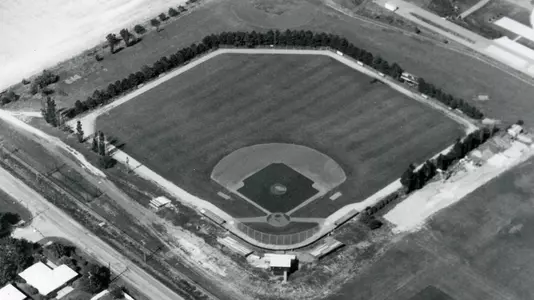
The baseball team kept its equipment in a little locker room at Memorial Stadium — somewhat of a hike by car to KSU Baseball Stadium. The team counted every baseball and marked them. Players dressed in cars, in apartments, in fraternity houses, and it was four or five players to a room on the road. The team drove itself in two vans, including one with a broken odometer, and players ate most of their meals at McDonald's on road trips — about all they could get on their $2 stipend — "and that's just the way it was," Cheatham says. The team earned $200-$300 for moving bleachers to the end of the football stadium for the KU and Nebraska games. Players shoveled snow. The team helped resod the football field at KSU Stadium and was allowed to use the leftover sod on the baseball field. The team planted trees along the outfield walls, believing they would grow as the program did, too. The team did its conditioning exercises on the soft, ripe soil at Weber Hall because the gyms were occupied by the men's and women's basketball teams. The team initiated "Diamond Darling," a cheerleading team, to liven up the ballpark and draw fans. Players sold programs at football and basketball games. The players worked crowd control at the men's basketball game in Ahearn Field House, as well, and remember how their patience were tested one game when Kansas fans rushed the court following a K-State/Kansas game.
"We did everything we could because their fans wanted to tear the nets down," Power says.
As the minutes continue to roll along during conversations with Wilson, Power and Cheatham heading toward Saturday's 50th anniversary celebration at Tointon Family Stadium, voices trail back to reveal passion and determination the Wildcats possessed to keep alive their dream.
"It was eggshells for several years," Cheatham says. "In 1975, because again, Title IX was pretty new, the finances of how it was going to impact the universities was still fluid, so you didn't know how it'd work out. You always wondered. If Phil hadn't been assistant athletic director at K-State, if he hadn't been there, I think K-State would've cut baseball. I just don't think we would've had an option.
"We were a bunch of college kids who wanted to play and play at K-State because we loved K-State, and we knew we could be pretty good. We wanted to stick together. We all had one goal and that was to make K-State win."

Wilson ended his five-year stint at K-State with a .568 winning percentage that was the highest for any K-State coach since 1948. There's a special spot in his heart for the team that kept hope alive while succeeding on the field.
"Hard work was always easy for us," Wilson says. "We were going to put in the hours. It wasn't an eight-hour day and then we quit. That wasn't even in our vocabulary. As long as there was some daylight, we were there."
The baseball field sat out in the middle of nowhere with an old white fence that merely marked the boundaries and a small press box that was barely hanging on above the backstop. As for the field? There were two sod farms at Tuttle Creek Lake, and baseball players resodded the football field at KSU Stadium and were given the leftovers to sod parts of the field at KSU Baseball Stadium. Whenever it snowed, players knew the drill. Wilson called the players together at midnight the two days before a game. They used a tractor to drag snow off the outfield and players rolled snow off the infield. Back then, you'd burn the dirt to dry it out, so they burnt the dirt all day to be ready for first pitch. Fans sat on 2x12-inch boards that measured 16 feet long with a bracket that held them together. Wilson remembers the time Oklahoma State and its big baseball budget arrived in Manhattan to discover the Wildcats scrambling to take care of their own baseball field.
"Oklahoma State was laughing at us," Wilson says. "We had 8-10 inches of snow and rolled snowballs, getting the snow off the field, so we could play a three-game series. Oklahoma State, of course, would've had a tarp to cover the diamond. So, they were laughing at us. But they stopped laughing at us when we beat them and won the series."
In 1975, K-State finished with a 24-22 overall record, and finished fourth in the Big Eight with a 9-9 mark.
"That was a very tight team," Power says. "There weren't any guys who weren't a part of a good nucleus of young men. It was a very fun-loving group. We raised hell and probably did some things we shouldn't have, but we did it together and shared the responsibility whether it was positive or negative. There were a lot of good times there, and not just having fun, but some serious good times there of accomplishing things together."
Then, while still holding the baseball program together by its seams, while still moving bleachers, and washing the same single uniform, and eating McDonald's, and leaving conditioning sessions at Weber Hall covered in soil and smelling like cattle, the 1976 Wildcats enacted a shining accomplishment that must go down as one of the most impressive feats by a program in the history of K-State Athletics.

In 1976, K-State finished atop the Big Eight standings with an 11-10 record, while its 35-19 overall record marked the most wins by a K-State team for the next 32 years (until the 2009 team won 43 games). The winningest K-State team in Big Eight history, the Wildcats played in their first conference postseason tournament in 1976. Three players from that squad — Steve Anson, Ted Power and Greg Korbe — would later be named to the K-State Baseball All-Century Team.
"We could hit," Cheatham says. "We could really hit and we could score and we could pitch. Our best three were Ted Power, Dave Tuttle and Lon Ostrom, and they could pitch. It was a great pitching staff. But we were awful defensively. Some games we had five or six errors because we didn't catch it all that great, and we couldn't throw it very well. But the things that made us really good was we hit it in key situations, and we had good power more so than speed. Guys could hit it a long ways. We could score and we could pitch.
"If we just could've caught it and thrown it better, we'd have a better record than we did. We were aggressive, had an attitude, and never thought anybody was better than us. That was key. We never thought we were out of anything — ever."
Power recorded a school-record 99 strikeouts — including a school-record 19 strikeouts in a single game — and had a 2.34 ERA in 73.0 innings pitched with 11 starts and eight complete games his junior season in 1976.
"We didn't have any trouble scoring runs, we always had run support, which for me being a pitcher, that's exactly what I needed, just a little bit of leeway," Power says. "It was a very comfortable season. That's what made it possible for me to get drafted in the Major Leagues after my third year of eligibility. I threw the ball really well that year, and it was because the team was so supportive."

Wilson goes back to that day in the dugout, the day when everything changed.
"Honestly, it could've been really easy to quit, and those guys could've said, 'That's it. We're going someplace else,'" Wilson says. "We had some talent. A couple guys made the Big Leagues. We could pitch and we could swing it with the best of them. We were pretty good, we really were."
Cheatham says the story all comes down to one primary theme.
"We're a perfect example to stop believing in the word 'can't,' Cheatham says. "We did all the crappy work, we did everything we needed to do just to play, to simply have a team and play, and then we win 35 games and we're the winningest team in K-State history there for 32 years. At K-State, we did things that nobody else would've ever done. Guys at other places would've said, 'Give me a release, and I'll go.' There's no doubt. There's no doubt."
Cheatham pauses.
"I just don't think anybody else would've done this," he says. "I just don't."
There was no official team picture taken of the K-State baseball teams in 1975 and 1976 — only yellowed newspaper clippings. But the memories carry on. And they'll carry on over cocktail hour Friday night at a Manhattan hotel as between 30 and 35 former K-State baseball players from 1974 to 1980 — and many more players from other eras — pull up into the Little Apple ahead of Saturday's K-State baseball game against Oklahoma State at Tointon Family Stadium. The K-State Baseball Alumni Weekend will bring former players from across the country to enjoy a beverage, enjoy food, enjoy baseball, and enjoy swapping those stories with former teammates — some of whom they hadn't seen in decades.

"I'm so pumped," says Cheatham, who lives in Oklahoma City, Oklahoma, and sent out e-mails to all the former K-State baseball players. "You kind of never know which new guys are going to show up."
Power will be flying in from his home in Sarasota, Florida
"I'm proud to be a part of these teams, and I enjoy getting back to see the group and really getting to see Phil Wilson," Power says. "It's just awesome."
The main topic, of course, will be the 1976 team and the 50th anniversary celebration of one of the greatest teams in K-State baseball history — a season of true triumph on so many levels born by virtue of one of the most incredible stories of perseverance and strength in K-State history, which has somewhat been buried for years.
Until now.
"I won't miss this reunion for the world," says Wilson, who lives in Harrison, Arkansas. "If I'm alive, I'm going to be there. I saw some of the team a few years ago, but it's been a long time since I've seen everyone. There are some guys I haven't seen in 50 years. It'll be a nice little event for us."
He chuckles.
"I have no choice," he says. "I have to be there. I have to supervise all the crazy stories."
So much will be rolling through the mind of Ted Power when the 71-year-old native of Guthrie, Oklahoma, a right-hander who played five sports at Abilene High School in Abilene, Kansas, and a fifth-round selection by the Los Angeles Dodgers in the June 1976 free agent draft, saunters onto the field and takes the pitcher's mound at Tointon Family Stadium on Saturday. Power, who played for eight Major League Baseball teams during a 13-year career, and who was inducted into the Kansas State All-Century Team in 2000, and who was inducted into the Kansas Sports Hall of Fame in 2023, during his K-State playing days from 1974-76 worked that pitcher's mound like no other pitcher in K-State history — a record 19 strikeouts in a single game and a 2.34 ERA during his junior season in 1976 before he turned pro — but there's a certain something poetic about Powers throwing out that ceremonial first pitch on Saturday, commemorating the 50-year anniversary of the 1976 K-State baseball team, as old teammates gather in Manhattan to celebrate one of the greatest stories in K-State history.
"Throwing out that first pitch will be a real honor," Power says. "K-State and K-State baseball has been very good to me, and this is just another cherry on top. I'm just hoping I don't bounce the pitch. My right arm doesn't have much in it anymore."
He pauses. He chuckles. Fifty years. Incredible.
"But, yeah," Power says, "it'll bring back some memories."
Fifty-one. Remember the number, too. It was 51 years ago — 1975 — when this story really began.
It was 51 years ago that the gears to a K-State baseball program that began on April 10, 1897, almost crept to a halt. The year 1975 remains embedded into the minds of one determined head coach and those K-State players, the ones who were issued just one single K-State baseball jersey, and who were left to mend that jersey if it ripped, and who were responsible for washing their jersey each night after practice and after games.
The jerseys remain but one passage in an unbelievable tale that hits home for those who experienced 1975. You had to be there.
"In the modern era or in the last 50 years, I don't know if this has ever happened again," says 79-year-old Phil Wilson, the K-State baseball head coach from 1973 to 1977. "I've never heard of a story like this. It was our team, and we wanted to be good, and we worked at it, and we loved K-State. We just wanted to play. I learned that you trust your instincts, never give in to adversity, and as long as you're working hard, sometimes there's a rainbow at the end."
No rainbow met the K-State baseball team at its first fall practice in 1975 at KSU Baseball Stadium (now known as Tointon Family Stadium). K-State came off a 31-16 season in 1974 and finished second in the Big Eight with a 14-7 record on a roster that featured K-State All-Century Team honorees Steve Anson and Andy Replogle, along with Lonnie Kruger, who was taken by the St. Louis Cardinals in the 21st round of the 1974 Major League Baseball Draft. The 1975 team figured to be just as good. So why then did Wilson, who also served as K-State Assistant Athletic Director, gather his boys in the first base dugout prior to the first fall practice of 1975?
Wilson, a 25-year-old former K-State pitcher in 1967-70 who was in the midst of his first tenure as a college head coach, had news all right. He had something to share. The skipper stood on the home plate end by the steps leading to the dugout. Tom Cheatham, a junior pitcher known for bullseye accuracy and his 5-foot-7, 140-pound frame, stood on the opposite end.
"Kansas State might have to get rid of baseball," Wilson told his team. "I recruited you, we have good talent here, and we're going to win some games, but if you need your release, I'm more than willing to give it to you, so you can build a future. I don't know how long this is going to stay, but I know the guys who are going to be here are going to work hard enough and long enough to keep alive baseball at Kansas State."
The team had a vote. The players voted unanimously to do anything to keep the K-State baseball program afloat.
"My heart sank when Phil said, 'Getting rid of baseball,'" Cheatham says. "He said, 'This is totally up to you guys.' When he gave us the option, and we voted to keep the baseball program going. We didn't have a lot of money, but there was a sense of relief."
Word was out that Colorado and Iowa State might lose their baseball programs. K-State easily could go as well. Maintaining Title IX balance (equal opportunities for women) meant that adding or keeping men's sports like baseball required expensive investments in women's sports. That meant that athletic departments with smaller budgets had to make big decisions.
"Ernie Barrett, of course, was the Kansas State athletic director at the time, and he laid out all the numbers," Wilson says. "Our football team wasn't very good. We just didn't have revenue. We were at the bottom of the barrel. We were eighth in athletic department revenue in the Big Eight. There was good reason to say, 'No more baseball.' If you weren't going to have baseball at Colorado and Iowa State, then why in the world would you have it at Kansas State?
"I was a very green, young coach and worked 15-16 hours a day as an assistant athletic director and baseball coach because K-State had no money. My love for the game made me a little bit worried. Colorado and Iowa State were talking about dropping their programs. I thought, 'Man, we're talking baseball here, you know?' We weren't going to allow that to happen. What happened next was due to a group of individuals, guys and their dedication."
K-State axed wrestling and men's swimming as a cost-cutting measure. Power couldn't imagine K-State getting rid of baseball. Not at this time. Now when the Wildcats always seemed to be in the thick of it in the Big Eight.
"It was crazy," Power says. "Had it not been during the era when Oklahoma and Oklahoma State baseball was so good, we could've been Big Eight Champions, because we were always right behind them."
So similar in Big Eight records on the field, yet so, so different in the financials.
The K-State baseball team began raising its own money.
"When there was a project, I'd say, 'Ernie, we're going to take care of that,'" Wilson says. "We created our own budget. We were young and energetic, and there wasn't anything physically that we couldn't do. We took pride in it, and that carried over onto the baseball field. We did what we had to do without complaint. It was always, 'What can we do next, Coach?'"
The baseball team kept its equipment in a little locker room at Memorial Stadium — somewhat of a hike by car to KSU Baseball Stadium. The team counted every baseball and marked them. Players dressed in cars, in apartments, in fraternity houses, and it was four or five players to a room on the road. The team drove itself in two vans, including one with a broken odometer, and players ate most of their meals at McDonald's on road trips — about all they could get on their $2 stipend — "and that's just the way it was," Cheatham says. The team earned $200-$300 for moving bleachers to the end of the football stadium for the KU and Nebraska games. Players shoveled snow. The team helped resod the football field at KSU Stadium and was allowed to use the leftover sod on the baseball field. The team planted trees along the outfield walls, believing they would grow as the program did, too. The team did its conditioning exercises on the soft, ripe soil at Weber Hall because the gyms were occupied by the men's and women's basketball teams. The team initiated "Diamond Darling," a cheerleading team, to liven up the ballpark and draw fans. Players sold programs at football and basketball games. The players worked crowd control at the men's basketball game in Ahearn Field House, as well, and remember how their patience were tested one game when Kansas fans rushed the court following a K-State/Kansas game.
"We did everything we could because their fans wanted to tear the nets down," Power says.
As the minutes continue to roll along during conversations with Wilson, Power and Cheatham heading toward Saturday's 50th anniversary celebration at Tointon Family Stadium, voices trail back to reveal passion and determination the Wildcats possessed to keep alive their dream.
"It was eggshells for several years," Cheatham says. "In 1975, because again, Title IX was pretty new, the finances of how it was going to impact the universities was still fluid, so you didn't know how it'd work out. You always wondered. If Phil hadn't been assistant athletic director at K-State, if he hadn't been there, I think K-State would've cut baseball. I just don't think we would've had an option.
"We were a bunch of college kids who wanted to play and play at K-State because we loved K-State, and we knew we could be pretty good. We wanted to stick together. We all had one goal and that was to make K-State win."
Wilson ended his five-year stint at K-State with a .568 winning percentage that was the highest for any K-State coach since 1948. There's a special spot in his heart for the team that kept hope alive while succeeding on the field.
"Hard work was always easy for us," Wilson says. "We were going to put in the hours. It wasn't an eight-hour day and then we quit. That wasn't even in our vocabulary. As long as there was some daylight, we were there."
The baseball field sat out in the middle of nowhere with an old white fence that merely marked the boundaries and a small press box that was barely hanging on above the backstop. As for the field? There were two sod farms at Tuttle Creek Lake, and baseball players resodded the football field at KSU Stadium and were given the leftovers to sod parts of the field at KSU Baseball Stadium. Whenever it snowed, players knew the drill. Wilson called the players together at midnight the two days before a game. They used a tractor to drag snow off the outfield and players rolled snow off the infield. Back then, you'd burn the dirt to dry it out, so they burnt the dirt all day to be ready for first pitch. Fans sat on 2x12-inch boards that measured 16 feet long with a bracket that held them together. Wilson remembers the time Oklahoma State and its big baseball budget arrived in Manhattan to discover the Wildcats scrambling to take care of their own baseball field.
"Oklahoma State was laughing at us," Wilson says. "We had 8-10 inches of snow and rolled snowballs, getting the snow off the field, so we could play a three-game series. Oklahoma State, of course, would've had a tarp to cover the diamond. So, they were laughing at us. But they stopped laughing at us when we beat them and won the series."
In 1975, K-State finished with a 24-22 overall record, and finished fourth in the Big Eight with a 9-9 mark.
"That was a very tight team," Power says. "There weren't any guys who weren't a part of a good nucleus of young men. It was a very fun-loving group. We raised hell and probably did some things we shouldn't have, but we did it together and shared the responsibility whether it was positive or negative. There were a lot of good times there, and not just having fun, but some serious good times there of accomplishing things together."
Then, while still holding the baseball program together by its seams, while still moving bleachers, and washing the same single uniform, and eating McDonald's, and leaving conditioning sessions at Weber Hall covered in soil and smelling like cattle, the 1976 Wildcats enacted a shining accomplishment that must go down as one of the most impressive feats by a program in the history of K-State Athletics.
In 1976, K-State finished atop the Big Eight standings with an 11-10 record, while its 35-19 overall record marked the most wins by a K-State team for the next 32 years (until the 2009 team won 43 games). The winningest K-State team in Big Eight history, the Wildcats played in their first conference postseason tournament in 1976. Three players from that squad — Steve Anson, Ted Power and Greg Korbe — would later be named to the K-State Baseball All-Century Team.
"We could hit," Cheatham says. "We could really hit and we could score and we could pitch. Our best three were Ted Power, Dave Tuttle and Lon Ostrom, and they could pitch. It was a great pitching staff. But we were awful defensively. Some games we had five or six errors because we didn't catch it all that great, and we couldn't throw it very well. But the things that made us really good was we hit it in key situations, and we had good power more so than speed. Guys could hit it a long ways. We could score and we could pitch.
"If we just could've caught it and thrown it better, we'd have a better record than we did. We were aggressive, had an attitude, and never thought anybody was better than us. That was key. We never thought we were out of anything — ever."
Power recorded a school-record 99 strikeouts — including a school-record 19 strikeouts in a single game — and had a 2.34 ERA in 73.0 innings pitched with 11 starts and eight complete games his junior season in 1976.
"We didn't have any trouble scoring runs, we always had run support, which for me being a pitcher, that's exactly what I needed, just a little bit of leeway," Power says. "It was a very comfortable season. That's what made it possible for me to get drafted in the Major Leagues after my third year of eligibility. I threw the ball really well that year, and it was because the team was so supportive."
Wilson goes back to that day in the dugout, the day when everything changed.
"Honestly, it could've been really easy to quit, and those guys could've said, 'That's it. We're going someplace else,'" Wilson says. "We had some talent. A couple guys made the Big Leagues. We could pitch and we could swing it with the best of them. We were pretty good, we really were."
Cheatham says the story all comes down to one primary theme.
"We're a perfect example to stop believing in the word 'can't,' Cheatham says. "We did all the crappy work, we did everything we needed to do just to play, to simply have a team and play, and then we win 35 games and we're the winningest team in K-State history there for 32 years. At K-State, we did things that nobody else would've ever done. Guys at other places would've said, 'Give me a release, and I'll go.' There's no doubt. There's no doubt."
Cheatham pauses.
"I just don't think anybody else would've done this," he says. "I just don't."
There was no official team picture taken of the K-State baseball teams in 1975 and 1976 — only yellowed newspaper clippings. But the memories carry on. And they'll carry on over cocktail hour Friday night at a Manhattan hotel as between 30 and 35 former K-State baseball players from 1974 to 1980 — and many more players from other eras — pull up into the Little Apple ahead of Saturday's K-State baseball game against Oklahoma State at Tointon Family Stadium. The K-State Baseball Alumni Weekend will bring former players from across the country to enjoy a beverage, enjoy food, enjoy baseball, and enjoy swapping those stories with former teammates — some of whom they hadn't seen in decades.
"I'm so pumped," says Cheatham, who lives in Oklahoma City, Oklahoma, and sent out e-mails to all the former K-State baseball players. "You kind of never know which new guys are going to show up."
Power will be flying in from his home in Sarasota, Florida
"I'm proud to be a part of these teams, and I enjoy getting back to see the group and really getting to see Phil Wilson," Power says. "It's just awesome."
The main topic, of course, will be the 1976 team and the 50th anniversary celebration of one of the greatest teams in K-State baseball history — a season of true triumph on so many levels born by virtue of one of the most incredible stories of perseverance and strength in K-State history, which has somewhat been buried for years.
Until now.
"I won't miss this reunion for the world," says Wilson, who lives in Harrison, Arkansas. "If I'm alive, I'm going to be there. I saw some of the team a few years ago, but it's been a long time since I've seen everyone. There are some guys I haven't seen in 50 years. It'll be a nice little event for us."
He chuckles.
"I have no choice," he says. "I have to be there. I have to supervise all the crazy stories."
K-State Men's Basketball | New Staff Arrivals Part II
Wednesday, April 08
K-State Baseball | Wichita State Game Recap
Wednesday, April 08
K-State Athletics | 2026 Day of Giving
Wednesday, April 08
K-State Men's Golf | Putting in the work 💪
Wednesday, April 08