The Newness Makes it ‘Fun and Refreshing’
May 27, 2026 | Men's Basketball, Sports Extra
By: D. Scott Fritchen
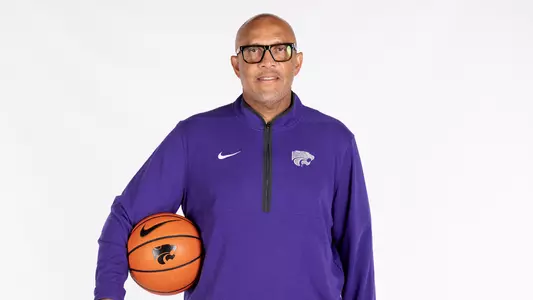
John Cooper is driving as he discusses his first month as an assistant coach on the Kansas State men's basketball team. The 57-year-old Cooper, a native of Kansas City, Kansas, who was recruited by Lon Kruger to K-State, and who eventually starred at Wichita State, and who was one of a few to play at both Ahearn Field House and Bramlage Coliseum, is grappling with a serious issue that he'll face when the Wildcats take the floor for the first time in about six months.
"Being closer to home means I'll have a few more headaches for tickets," he says, chuckling, "but it's a nice headache to have."
Cooper knows the history of K-State basketball better than head coach Casey Alexander, who arrived from Belmont for his first Power 4 head coaching job, and Cooper knows K-State better than any of his fellow assistant coaches, as well. Cooper, a gym rat and avid college basketball fan growing up near the former NCAA headquarters in Overland Park, as a child watched K-State, Kansas and Wichita State. He saw the grit, he saw the fight, and he saw the camaraderie and success of those squads. He had no trouble connecting as a fan because he could cheer on his favorite players through their four-year careers.
Cooper believes the coaches in the Alexander era at K-State can infuse those traits into their players — including prospects from across the region and the Kansas City area.
"Casey has been to Kansas City and has met the right people," Cooper says. "Listen, that's been done. We were in the city and toured for the day, and he met all the right people he needed to meet. Recruiting regionally is important. We understand whatever we're in in this day in age, but it's also important that if you think of K-State, you think of guys like Steve Henson, Dean Wade, Jacob Pullen and these guys that may not have been these super-highly recruited players, but they were good players, and they came to K-State and had incredible success. If you just look at those kinds of guys and the success and the history, that's been a calling card.
"To be able to get kids that are from the area – and I'm including Kansas City – and to have someone come into your program and have success, that's important. Hopefully, we can find those guys, and it makes it even more fun for the fan base, especially in this day in age."

Cooper arrived at K-State in April after serving three seasons (2022-25) as an assistant coach to Kevin Kruger, Lon Kruger's son, at UNLV. Prior to UNLV, Cooper served as assistant coach under K-State alum Tim Jankovich at SMU. Before that, Cooper served as special assistant to Oklahoma State head coach Mike Boynton Jr. from 2017-20. He also served as an assistant coach at Oregon in 2002-04, Auburn in 2004-09, and South Carolina in 1995 to 2001 with back-to-back NCAA Tournament appearances in 1997 and 1998.
Cooper brings vast experience and knowledge of the game along with a proven record of bringing in and developing talent and helping foster a foundation for program. He has been around Manhattan since his arrival in April and says, "The K-State faithful has been terrific, which always makes a transition much easier." But it was while sitting beside a K-State graduate on a recent flight from Kansas City to Las Vegas that the collective passion of K-Staters became emphatically evident.
"I was on an airplane from Kansas City because I was recruiting to Las Vegas, and I wore a K-State hoodie," Cooper says. "The guy I sat next to was a K-State booster and fan, and an engineering graduate. We talked the entire time. He's around the program. Just to sit and listen, and to hear his perspective about what he wants, and how there's an appreciation by the fan base of how the game is played and looks, those things are important. This has been really fun."
The first K-State roster of the Alexander era has been finalized, and players report in early June. New coaching staff. New players. And they'll share a basketball court at the Ice Family Training Center on the ground floor of building toward the upcoming season.
"What makes it unique this year is we're all new, and we're all going to hit this thing together," Cooper says. "We're going to figure it out. That actually makes it kind of fun and refreshing. You want to get to the point where that's not the situation, but those guys will be fine. The day in age that we're in now is that this is almost becoming the norm for this movement and for guys starting anew and going somewhere else. It's about the assimilation and figuring it out together and trying to build as much camaraderie as you possibly can in a short amount of time.
"Building camaraderie, as it looks now, is probably not the same as you knew 10 years ago. When you see a team that looks in sync and plays together and has built it fast, I'd guess 10 years ago and there were teams that played together for four years, that camaraderie would look different if those teams played each other. Everyone is trying to build it as quick as they can and a lot of it is dependent upon the kind of people you have, their egos when they come in, and if everyone is trying to understand what's going to make us successful, and how we go about that while players are able to achieve team and personal goals. They're sacrificing that. There's no way you do that without sacrificing."

The grit and fight and continuity of those past storied K-State, Kansas and Wichita State teams becomes a goal in this age of college basketball, where K-State returns only sophomore guard Andrej Kostic from last season's K-State roster.
Cooper says roster continuity is "a two-way street."
"If you're able to keep guys then certainly next year at this time that makes this transition a little bit easier, for sure," he says. "But let's face it, this thing is completely whatever it is, and it's about money a lot of times, and what you deem as important for your program and what you're willing to pay may not be the same thing for what we're willing to pay.
"When you talk about building culture and having guys who understand what's being looked for, that's key. Anytime you can keep guys and you want those guys around that's critically important because they make your job a little bit easier. When you get into practice and throw out the balls and run and drill, having guys that know what you're looking for and can hop out and run, those little things move things along more than you ever realize. Those are the kinds of things that having veterans on your roster that really help. That's something we'll be very in-tune with and really try to make that happen."
John Cooper is driving as he discusses his first month as an assistant coach on the Kansas State men's basketball team. The 57-year-old Cooper, a native of Kansas City, Kansas, who was recruited by Lon Kruger to K-State, and who eventually starred at Wichita State, and who was one of a few to play at both Ahearn Field House and Bramlage Coliseum, is grappling with a serious issue that he'll face when the Wildcats take the floor for the first time in about six months.
"Being closer to home means I'll have a few more headaches for tickets," he says, chuckling, "but it's a nice headache to have."
Cooper knows the history of K-State basketball better than head coach Casey Alexander, who arrived from Belmont for his first Power 4 head coaching job, and Cooper knows K-State better than any of his fellow assistant coaches, as well. Cooper, a gym rat and avid college basketball fan growing up near the former NCAA headquarters in Overland Park, as a child watched K-State, Kansas and Wichita State. He saw the grit, he saw the fight, and he saw the camaraderie and success of those squads. He had no trouble connecting as a fan because he could cheer on his favorite players through their four-year careers.
Cooper believes the coaches in the Alexander era at K-State can infuse those traits into their players — including prospects from across the region and the Kansas City area.
"Casey has been to Kansas City and has met the right people," Cooper says. "Listen, that's been done. We were in the city and toured for the day, and he met all the right people he needed to meet. Recruiting regionally is important. We understand whatever we're in in this day in age, but it's also important that if you think of K-State, you think of guys like Steve Henson, Dean Wade, Jacob Pullen and these guys that may not have been these super-highly recruited players, but they were good players, and they came to K-State and had incredible success. If you just look at those kinds of guys and the success and the history, that's been a calling card.
"To be able to get kids that are from the area – and I'm including Kansas City – and to have someone come into your program and have success, that's important. Hopefully, we can find those guys, and it makes it even more fun for the fan base, especially in this day in age."
Cooper arrived at K-State in April after serving three seasons (2022-25) as an assistant coach to Kevin Kruger, Lon Kruger's son, at UNLV. Prior to UNLV, Cooper served as assistant coach under K-State alum Tim Jankovich at SMU. Before that, Cooper served as special assistant to Oklahoma State head coach Mike Boynton Jr. from 2017-20. He also served as an assistant coach at Oregon in 2002-04, Auburn in 2004-09, and South Carolina in 1995 to 2001 with back-to-back NCAA Tournament appearances in 1997 and 1998.
Cooper brings vast experience and knowledge of the game along with a proven record of bringing in and developing talent and helping foster a foundation for program. He has been around Manhattan since his arrival in April and says, "The K-State faithful has been terrific, which always makes a transition much easier." But it was while sitting beside a K-State graduate on a recent flight from Kansas City to Las Vegas that the collective passion of K-Staters became emphatically evident.
"I was on an airplane from Kansas City because I was recruiting to Las Vegas, and I wore a K-State hoodie," Cooper says. "The guy I sat next to was a K-State booster and fan, and an engineering graduate. We talked the entire time. He's around the program. Just to sit and listen, and to hear his perspective about what he wants, and how there's an appreciation by the fan base of how the game is played and looks, those things are important. This has been really fun."
The first K-State roster of the Alexander era has been finalized, and players report in early June. New coaching staff. New players. And they'll share a basketball court at the Ice Family Training Center on the ground floor of building toward the upcoming season.
"What makes it unique this year is we're all new, and we're all going to hit this thing together," Cooper says. "We're going to figure it out. That actually makes it kind of fun and refreshing. You want to get to the point where that's not the situation, but those guys will be fine. The day in age that we're in now is that this is almost becoming the norm for this movement and for guys starting anew and going somewhere else. It's about the assimilation and figuring it out together and trying to build as much camaraderie as you possibly can in a short amount of time.
"Building camaraderie, as it looks now, is probably not the same as you knew 10 years ago. When you see a team that looks in sync and plays together and has built it fast, I'd guess 10 years ago and there were teams that played together for four years, that camaraderie would look different if those teams played each other. Everyone is trying to build it as quick as they can and a lot of it is dependent upon the kind of people you have, their egos when they come in, and if everyone is trying to understand what's going to make us successful, and how we go about that while players are able to achieve team and personal goals. They're sacrificing that. There's no way you do that without sacrificing."
The grit and fight and continuity of those past storied K-State, Kansas and Wichita State teams becomes a goal in this age of college basketball, where K-State returns only sophomore guard Andrej Kostic from last season's K-State roster.
Cooper says roster continuity is "a two-way street."
"If you're able to keep guys then certainly next year at this time that makes this transition a little bit easier, for sure," he says. "But let's face it, this thing is completely whatever it is, and it's about money a lot of times, and what you deem as important for your program and what you're willing to pay may not be the same thing for what we're willing to pay.
"When you talk about building culture and having guys who understand what's being looked for, that's key. Anytime you can keep guys and you want those guys around that's critically important because they make your job a little bit easier. When you get into practice and throw out the balls and run and drill, having guys that know what you're looking for and can hop out and run, those little things move things along more than you ever realize. Those are the kinds of things that having veterans on your roster that really help. That's something we'll be very in-tune with and really try to make that happen."
Players Mentioned

G
/ Men's BasketballK-State Baseball | Special delivery for Dee Kennedy from the Golden Spikes 🌟📦
Tuesday, May 26
K-State Volleyball | Top 10 Aces of the Spring
Tuesday, May 26
K-State Men's Basketball | Chief of Staff Wes Long Media Availability - May 22, 2026
Friday, May 22
K-State Men's Basketball | General Manager Sean Rutigliano Media Availability - May 22, 2026
Friday, May 22