‘We Won Today’
Jul 06, 2026 | Football, Sports Extra
By: D. Scott Fritchen
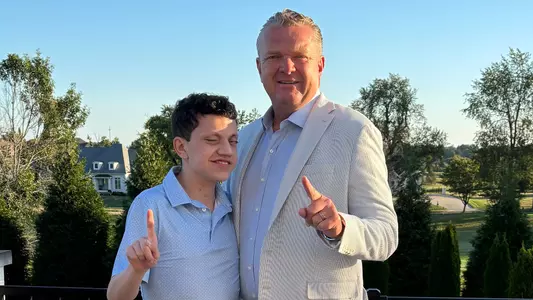
Eric Wolford is the longest-tenured active offensive line coach in the Southeastern Conference. The son of a steel mill plant supervisor in Youngstown, Ohio, Wolford grew up strong, tough and gritty. He played offensive guard at Kansas State under Bill Snyder. Along his professional journey, Wolford served as head coach at Youngstown State, and he coached offensive lines at South Florida, Houston, North Texas, Arizona, Illinois, South Carolina, San Francisco 49ers, Kentucky, Alabama and now LSU. He played or coached under head coaches such as Bill Snyder, Steve Spurrier, Mark Stoops, Nick Saban and now Lane Kiffin.
But Wolford need only saunter down the hallway in the family home to see the biggest MVP of his life each morning.
It's Stone, Wolford's 20-year-old son. It's Stone, who continues to make an incredible impact. It's Stone, who brings a smile to his father's face — simply by being Stone, an inspiration, a young man who has a sense of humor, who is pleasant, and who loves 4-wheelers, who loves to swim, and who adores his 28-pound Bengal cat named Yeti.
It's Stone, who is his father's best friend.
"When I leave the house every morning, I always check on Stone in bed," Wolford says. "I put my hand on his chest. I feel that heartbeat. And I whisper…"
He pauses. The emotions flow.
"I whisper," he continues, "'We won today.'"

In this crazy game of college football, where years — and at times college football coaching destinations — can go by in a blur, and where Wolford's offensive lines, regardless of school, always rank among the best units in the SEC, there are a few constants that drive the 55-year-old man who once helped anchor a powerful K-State offensive line that helped the Snyder-led Wildcats to their first-ever bowl victory in the 1993 Copper Bowl.
There's Eric's wife, Melinda. There's his daughter, Marlee. And there's Stone, who's daily victories are a blessing by God. On November 26, 2005, God bestowed upon Eric and Melinda one of the world's greatest gifts, this special miracle, and He directed them on a path not yet fully revealed, a trip through patience and faith, and along the way He gave them strength, and hope, and ultimately, a mission — to help an entire nation.
"Stone is 20 years old and how about that?" Wolford says. "It's crazy. I still remember when doctors told me and Melinda that Stone's life expectancy would be between 4 and 14 years old. We've beat the odds, and he's doing great."
Wolford pauses.
"I mean," he says, "he's doing great."
Shortly after Stone's five-star birth in Arizona — Wolford was coaching Arizona's offensive line in the mid-2000s — the symptoms crawled into focus once the Wolford's returned home from the hospital. Stone had trouble eating, and when he could keep food down, he couldn't absorb some of the nutrients, and he began losing weight. He vomited 18 times a day. He couldn't sleep. He was in constant pain. Then there were his eyes — the eyes of a child that normally focus on mom and dad, couldn't track properly, and instead strayed back and forth.
The Wolford's visited doctors throughout Arizona. The doctors had no answers. Then when Wolford became offensive line coach at Illinois, they searched for a diagnosis in Champaign as well. It became one doctor after another. Eventually, time and money became issues. They saw 41 doctors over a span of 2 ½ years. Wolford says "it was scary times" and they rushed Stone to the hospital a few times for IVs due to dehydration.
Melinda earned her Ph.D. in School Psychology with a minor/specialty in Neuropsychology and began practicing as a school psychologist in 1994. The phone call that she received from a doctor one day shook her to her core.
Stone had Cardio-Facio-Cutaneous (CFC) Syndrome, a rare genetic disorder characterized by congenital heart defects, distinctive facial features, sparse/curly hair, and developmental delays. CFC Syndrome affects multiple systems in the body. Diagnosis and management require a specialized, multidisciplinary medical team. How rare is CFC Syndrome? CBS reports that the disease affects between 200 and 300 people worldwide and that many with the condition do not survive infancy. At the time, the oldest known individual with CFC Syndrome passed away at age 26.
"The biggest gut-punch you could get," Wolford says. "They told us basically, 'Your son's life expectancy is 4 to 14. There's no cure for this disease. About 450 kids in the world have it. And not a lot of people know about it.' When you grow up as a coach, you envision your son playing football, and you have high hopes. But this made me realize that we have two choices — we can curl up and feel sorry for ourselves, but we can do something positive with it."
Wolford continues.
"At the same time, Stone's head was odd-shaped," he says. "We took him to doctors, and they placed a plastic helmet on him, the one with a certain hole cut out so the head grows in to be shaped like a normal head, and doctors measured him, then came back and said insurance wouldn't cover the helmet. The helmet didn't meet the insurance requirements by three millimeters."
Wolford told the doctors, "OK, I'll pay for it."

On the way home, Eric told Melinda, "You know, there are a bunch of people out here that don't have the resources to help their children, and it's not their fault that their child has a disability. They'll do whatever it takes for their kid, won't pay rent, and next thing you know they're evicted. It becomes a spiraling effect just because you don't have a place to get the help your kid needs."
An idea was born.
"Because all the doctor's visits and trying to find therapy for Stone was such a struggle, we began thinking," Wolford says. "I said, 'We're going to make the best of this.' This has been our approach. It's made Melinda and I better people.
"We decided to start No Stone Unturned."
No Stone Unturned, a foundation started by the Wolford's in 2008, provides customized care to help children of all ability levels make progress as a one-stop shop with a full team working together to provide comprehensive integrated care while helping parents find answers and return to the joy of parenthood. The Wolford's gave birth to the foundation's therapeutic learning center in 2012 as a 501(C)(3) non-profit organization.
Where would the Wolford's put No Stone Unturned?
That was easy.
"Manhattan, Kansas, was always so good to us," Wolford says. "There was no better place. It's home. Manhattan needed this."
In the beginning, No Stone Unturned rented a 10,000-square-foot building.
"There's no better feeling than helping out someone in a time of need and expecting nothing in return," Wolford says. "There's no worse feeling than being in bed at night knowing you can't find therapy or have resources to help your child, you know? It's hard. And I've seen it. As a parent, you have all this information but it's hard to metabolize that and act on it and look for ways to serve the needs that are there, so we started No Stone Unturned Foundation with the full intent of helping other families through the kinds of challenges that we had and more. We've been several places where people are on a nine-month waiting list to get their son or daughter assessed for learning disorders. That should never happen. That's something we're proud of, is giving families the tools they need and therapies they need for their kid to be successful.
"We started hearing stories about kids who came to No Stone Unturned, who weren't talking at age 6, 7 or 8 years old, and next thing you know they're the captain of their baseball team. Those stories warm your heart, and that's what I love about the people of Manhattan."
Soon, No Stone Unturned had to grow to better accommodate its growing lists of children and families.
Today, No Stone Unturned offers occupational therapy, speech-language pathology, physical therapy and applied behavioral analysis, and prides itself on its ability to aid with 25 different specialized areas.

In November 2024, The No Stone Unturned Foundation completed a 24,000-square-foot therapeutic learning center that includes sensory gyms, feeding kitchens, group classrooms and an aqua therapy pool. The project broke ground in July 2023 and celebrated its ribbon cutting in November 2024 and officially opened its doors, doubling the foundation's capacity to serve children. The $8 million facility on Tuttle Creek Boulevard allows a massive team of experts to provide customized, integrated therapy for children with special needs, and it was funded by the "No Need Unmet" capital campaign, chaired by Collin and Shalin Klein, which continues to raise funds to support the building and program expansions.
The No Stone Unturned Therapeutic Learning Center has a staff of 50 employees, featuring occupational therapists (11 therapists), physical therapy specialists (5), speech therapists (4), and applied behavioral therapists (13), and it currently serves families from 25 counties in Kansas and is easily within driving distance of 20 to 30 more counties. The therapeutic learning center serves nearly 250 children and families per month, which amounts to 1,800 kid visits annually.

Meanwhile, Stone — and his remarkable story — continues to grow as well.
"Stone has gotten to a point now where he's getting infusion shots, which my wife has set up now with a doctor here in Baton Rouge, and he's on Skyrizi, which has really helped him recently," Wolford says. "We've seen some growth just since he started using Skyrizi. Therapy for Stone has always been one of the first things we check into when we move and most of the towns we've been to, and most of the time there's been somewhere to go. Now that Stone is 20, he just goes to a normal hospital if we have to do something like that. Baton Rouge is a pretty good-sized town with a big medical community."
This week, Eric and Melinda will fly from Baton Rouge to Manhattan for the 18th annual Wildcats for No Stone Unturned Golf and Gala Weekend, an annual fundraiser hosted by the No Stone Unturned Foundation. The multi-day event includes golf tournaments — 64 golf teams are expected for Friday and Saturday's golf tournaments — and it will feature a gala on Friday hosted at the Hilton Garden Inn with live and silent auctions. Since its inception, No Stone Unturned weekend has become a can't-miss summer event for former K-State football players from all parts of the country and from all eras.
"What a great opportunity to come back to Manhattan," Wolford says. "My best friends in the world are my former K-State teammates and the opportunity to see Coach Snyder, who gave me the opportunity to play at K-State and taught me so much, is tremendous. What a tremendous coach and man. It's great to come back and celebrate No Stone Unturned.
"There's been a lot of people who've volunteered and have worked to get this thing to where it is, and it just continues to grow."

Stone's story and the determination of the Wolford's became the object of a six-minute story on CBS Sports prior to the 2023 SEC Championship Game. That beautifully produced segment stole the hearts of college football fans across the country.
"We got a tremendous response from people all over," Wolford says. "A lot of people reached out to our people at the No Stone Unturned facility and have contacted Melinda directly. When someone tells you that your son has CFC, it's always nice to be able to talk to someone who's been through it, and my wife can help those people navigate the things you can do, because we have been through it."
Today, Stone is like many 20-year-olds. He loves his iPad, loves his cat, loves motorized vehicles, and loves his parents and sister. But he still faces daily challenges as well.
"He still drinks out of a baby bottle," Wolford says. "The ability to actually eat, chew and swallow, he cannot do, and that's one of the contributing factors why the CFC kids don't live that long. A lot of those kids end up on a feeding tube. But Melinda concocted a shake that she makes with a bunch of different things that are all blended together and that's basically what's kept Stone alive."
As for Stone's biggest hobby? He keeps track of his best friend.
"Stone loves football and he loves to look up scores, but one thing Stone cannot handle is the crowd noise, so when he does come to a game, he wears headphones, because we've obviously been in some loud stadiums," Wolford says. "But Stone loves to watch our football games on TV, he's constantly pulling up ESPN on his phone, looking at scores. Anywhere I've ever coached, he's always checking those scores. He loves football, and football has basically become our life."
And Stone's life is plenty special.
"No Stone Unturned and the No Stone Unturned Therapeutic Learning Center in Manhattan — that'll be Stone's legacy," Wolford says. "He'll probably touch more people through his foundation than he probably would as a professional football player."
After this weekend's gala event, the Wolford's will return home to Baton Rouge. On Monday, Wolford will work out his LSU offensive linemen at 10:00 a.m. He thinks back to his journey to this point and his life as a coach.
But before Wolford reports to duty as the longest-tenured active offensive line coach in the SEC, he'll saunter down the hallway inside his home to see his favorite star. He'll put his hand on Stone's chest. He'll feel his heartbeat. And as he does each and every morning, Wolford's eyes will grow glossy as he gazes at his sleeping miracle, and he'll whisper three words.
"We won today."
Eric Wolford is the longest-tenured active offensive line coach in the Southeastern Conference. The son of a steel mill plant supervisor in Youngstown, Ohio, Wolford grew up strong, tough and gritty. He played offensive guard at Kansas State under Bill Snyder. Along his professional journey, Wolford served as head coach at Youngstown State, and he coached offensive lines at South Florida, Houston, North Texas, Arizona, Illinois, South Carolina, San Francisco 49ers, Kentucky, Alabama and now LSU. He played or coached under head coaches such as Bill Snyder, Steve Spurrier, Mark Stoops, Nick Saban and now Lane Kiffin.
But Wolford need only saunter down the hallway in the family home to see the biggest MVP of his life each morning.
It's Stone, Wolford's 20-year-old son. It's Stone, who continues to make an incredible impact. It's Stone, who brings a smile to his father's face — simply by being Stone, an inspiration, a young man who has a sense of humor, who is pleasant, and who loves 4-wheelers, who loves to swim, and who adores his 28-pound Bengal cat named Yeti.
It's Stone, who is his father's best friend.
"When I leave the house every morning, I always check on Stone in bed," Wolford says. "I put my hand on his chest. I feel that heartbeat. And I whisper…"
He pauses. The emotions flow.
"I whisper," he continues, "'We won today.'"
In this crazy game of college football, where years — and at times college football coaching destinations — can go by in a blur, and where Wolford's offensive lines, regardless of school, always rank among the best units in the SEC, there are a few constants that drive the 55-year-old man who once helped anchor a powerful K-State offensive line that helped the Snyder-led Wildcats to their first-ever bowl victory in the 1993 Copper Bowl.
There's Eric's wife, Melinda. There's his daughter, Marlee. And there's Stone, who's daily victories are a blessing by God. On November 26, 2005, God bestowed upon Eric and Melinda one of the world's greatest gifts, this special miracle, and He directed them on a path not yet fully revealed, a trip through patience and faith, and along the way He gave them strength, and hope, and ultimately, a mission — to help an entire nation.
"Stone is 20 years old and how about that?" Wolford says. "It's crazy. I still remember when doctors told me and Melinda that Stone's life expectancy would be between 4 and 14 years old. We've beat the odds, and he's doing great."
Wolford pauses.
"I mean," he says, "he's doing great."
Shortly after Stone's five-star birth in Arizona — Wolford was coaching Arizona's offensive line in the mid-2000s — the symptoms crawled into focus once the Wolford's returned home from the hospital. Stone had trouble eating, and when he could keep food down, he couldn't absorb some of the nutrients, and he began losing weight. He vomited 18 times a day. He couldn't sleep. He was in constant pain. Then there were his eyes — the eyes of a child that normally focus on mom and dad, couldn't track properly, and instead strayed back and forth.
The Wolford's visited doctors throughout Arizona. The doctors had no answers. Then when Wolford became offensive line coach at Illinois, they searched for a diagnosis in Champaign as well. It became one doctor after another. Eventually, time and money became issues. They saw 41 doctors over a span of 2 ½ years. Wolford says "it was scary times" and they rushed Stone to the hospital a few times for IVs due to dehydration.
Melinda earned her Ph.D. in School Psychology with a minor/specialty in Neuropsychology and began practicing as a school psychologist in 1994. The phone call that she received from a doctor one day shook her to her core.
Stone had Cardio-Facio-Cutaneous (CFC) Syndrome, a rare genetic disorder characterized by congenital heart defects, distinctive facial features, sparse/curly hair, and developmental delays. CFC Syndrome affects multiple systems in the body. Diagnosis and management require a specialized, multidisciplinary medical team. How rare is CFC Syndrome? CBS reports that the disease affects between 200 and 300 people worldwide and that many with the condition do not survive infancy. At the time, the oldest known individual with CFC Syndrome passed away at age 26.
"The biggest gut-punch you could get," Wolford says. "They told us basically, 'Your son's life expectancy is 4 to 14. There's no cure for this disease. About 450 kids in the world have it. And not a lot of people know about it.' When you grow up as a coach, you envision your son playing football, and you have high hopes. But this made me realize that we have two choices — we can curl up and feel sorry for ourselves, but we can do something positive with it."
Wolford continues.
"At the same time, Stone's head was odd-shaped," he says. "We took him to doctors, and they placed a plastic helmet on him, the one with a certain hole cut out so the head grows in to be shaped like a normal head, and doctors measured him, then came back and said insurance wouldn't cover the helmet. The helmet didn't meet the insurance requirements by three millimeters."
Wolford told the doctors, "OK, I'll pay for it."
On the way home, Eric told Melinda, "You know, there are a bunch of people out here that don't have the resources to help their children, and it's not their fault that their child has a disability. They'll do whatever it takes for their kid, won't pay rent, and next thing you know they're evicted. It becomes a spiraling effect just because you don't have a place to get the help your kid needs."
An idea was born.
"Because all the doctor's visits and trying to find therapy for Stone was such a struggle, we began thinking," Wolford says. "I said, 'We're going to make the best of this.' This has been our approach. It's made Melinda and I better people.
"We decided to start No Stone Unturned."
No Stone Unturned, a foundation started by the Wolford's in 2008, provides customized care to help children of all ability levels make progress as a one-stop shop with a full team working together to provide comprehensive integrated care while helping parents find answers and return to the joy of parenthood. The Wolford's gave birth to the foundation's therapeutic learning center in 2012 as a 501(C)(3) non-profit organization.
Where would the Wolford's put No Stone Unturned?
That was easy.
"Manhattan, Kansas, was always so good to us," Wolford says. "There was no better place. It's home. Manhattan needed this."
In the beginning, No Stone Unturned rented a 10,000-square-foot building.
"There's no better feeling than helping out someone in a time of need and expecting nothing in return," Wolford says. "There's no worse feeling than being in bed at night knowing you can't find therapy or have resources to help your child, you know? It's hard. And I've seen it. As a parent, you have all this information but it's hard to metabolize that and act on it and look for ways to serve the needs that are there, so we started No Stone Unturned Foundation with the full intent of helping other families through the kinds of challenges that we had and more. We've been several places where people are on a nine-month waiting list to get their son or daughter assessed for learning disorders. That should never happen. That's something we're proud of, is giving families the tools they need and therapies they need for their kid to be successful.
"We started hearing stories about kids who came to No Stone Unturned, who weren't talking at age 6, 7 or 8 years old, and next thing you know they're the captain of their baseball team. Those stories warm your heart, and that's what I love about the people of Manhattan."
Soon, No Stone Unturned had to grow to better accommodate its growing lists of children and families.
Today, No Stone Unturned offers occupational therapy, speech-language pathology, physical therapy and applied behavioral analysis, and prides itself on its ability to aid with 25 different specialized areas.
In November 2024, The No Stone Unturned Foundation completed a 24,000-square-foot therapeutic learning center that includes sensory gyms, feeding kitchens, group classrooms and an aqua therapy pool. The project broke ground in July 2023 and celebrated its ribbon cutting in November 2024 and officially opened its doors, doubling the foundation's capacity to serve children. The $8 million facility on Tuttle Creek Boulevard allows a massive team of experts to provide customized, integrated therapy for children with special needs, and it was funded by the "No Need Unmet" capital campaign, chaired by Collin and Shalin Klein, which continues to raise funds to support the building and program expansions.
The No Stone Unturned Therapeutic Learning Center has a staff of 50 employees, featuring occupational therapists (11 therapists), physical therapy specialists (5), speech therapists (4), and applied behavioral therapists (13), and it currently serves families from 25 counties in Kansas and is easily within driving distance of 20 to 30 more counties. The therapeutic learning center serves nearly 250 children and families per month, which amounts to 1,800 kid visits annually.
Meanwhile, Stone — and his remarkable story — continues to grow as well.
"Stone has gotten to a point now where he's getting infusion shots, which my wife has set up now with a doctor here in Baton Rouge, and he's on Skyrizi, which has really helped him recently," Wolford says. "We've seen some growth just since he started using Skyrizi. Therapy for Stone has always been one of the first things we check into when we move and most of the towns we've been to, and most of the time there's been somewhere to go. Now that Stone is 20, he just goes to a normal hospital if we have to do something like that. Baton Rouge is a pretty good-sized town with a big medical community."
This week, Eric and Melinda will fly from Baton Rouge to Manhattan for the 18th annual Wildcats for No Stone Unturned Golf and Gala Weekend, an annual fundraiser hosted by the No Stone Unturned Foundation. The multi-day event includes golf tournaments — 64 golf teams are expected for Friday and Saturday's golf tournaments — and it will feature a gala on Friday hosted at the Hilton Garden Inn with live and silent auctions. Since its inception, No Stone Unturned weekend has become a can't-miss summer event for former K-State football players from all parts of the country and from all eras.
"What a great opportunity to come back to Manhattan," Wolford says. "My best friends in the world are my former K-State teammates and the opportunity to see Coach Snyder, who gave me the opportunity to play at K-State and taught me so much, is tremendous. What a tremendous coach and man. It's great to come back and celebrate No Stone Unturned.
"There's been a lot of people who've volunteered and have worked to get this thing to where it is, and it just continues to grow."
Stone's story and the determination of the Wolford's became the object of a six-minute story on CBS Sports prior to the 2023 SEC Championship Game. That beautifully produced segment stole the hearts of college football fans across the country.
"We got a tremendous response from people all over," Wolford says. "A lot of people reached out to our people at the No Stone Unturned facility and have contacted Melinda directly. When someone tells you that your son has CFC, it's always nice to be able to talk to someone who's been through it, and my wife can help those people navigate the things you can do, because we have been through it."
Today, Stone is like many 20-year-olds. He loves his iPad, loves his cat, loves motorized vehicles, and loves his parents and sister. But he still faces daily challenges as well.
"He still drinks out of a baby bottle," Wolford says. "The ability to actually eat, chew and swallow, he cannot do, and that's one of the contributing factors why the CFC kids don't live that long. A lot of those kids end up on a feeding tube. But Melinda concocted a shake that she makes with a bunch of different things that are all blended together and that's basically what's kept Stone alive."
As for Stone's biggest hobby? He keeps track of his best friend.
"Stone loves football and he loves to look up scores, but one thing Stone cannot handle is the crowd noise, so when he does come to a game, he wears headphones, because we've obviously been in some loud stadiums," Wolford says. "But Stone loves to watch our football games on TV, he's constantly pulling up ESPN on his phone, looking at scores. Anywhere I've ever coached, he's always checking those scores. He loves football, and football has basically become our life."
And Stone's life is plenty special.
"No Stone Unturned and the No Stone Unturned Therapeutic Learning Center in Manhattan — that'll be Stone's legacy," Wolford says. "He'll probably touch more people through his foundation than he probably would as a professional football player."
After this weekend's gala event, the Wolford's will return home to Baton Rouge. On Monday, Wolford will work out his LSU offensive linemen at 10:00 a.m. He thinks back to his journey to this point and his life as a coach.
But before Wolford reports to duty as the longest-tenured active offensive line coach in the SEC, he'll saunter down the hallway inside his home to see his favorite star. He'll put his hand on Stone's chest. He'll feel his heartbeat. And as he does each and every morning, Wolford's eyes will grow glossy as he gazes at his sleeping miracle, and he'll whisper three words.
"We won today."

Wednesday, September 23
Wednesday, September 23
Monday, September 21
Saturday, September 19