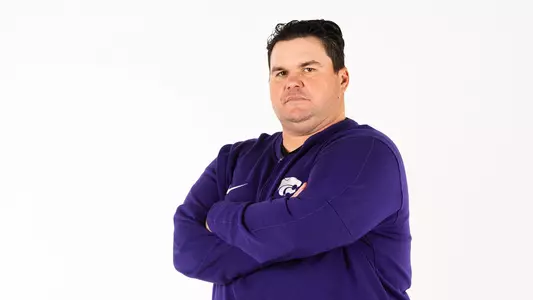
Attitude, Edge and Effort
Jan 13, 2026 | Football, Sports Extra
By: D. Scott Fritchen
The first phone call wasn't from Collin Klein. No, the first voice Mike Schmidt heard on the other end of the phone was that of Conor Riley, Schmidt's longtime friend and mentor, who left Kansas State for the Dallas Cowboys in February 2025 to serve as offensive line coach after an ultra-successful stint as offensive coordinator and offensive line coach in Manhattan.
Riley phoned Schmidt, the run game coordinator and offensive line coach at his alma mater, San Diego State, the morning before the Aztecs faced North Texas in the New Mexico Bowl on December 27.
Riley suggested that Schmidt speak with new K-State head coach Collin Klein about the vacant offensive line position for the Wildcats.
Boom.
After an initial phone call and subsequent Zoom call with Klein, the 38-year-old Schmidt was hired as K-State offensive line coach on January 2.
K-State is the latest stop for Schmidt, who began his career at San Diego State in 2009, moved to Syracuse in 2021, then spent the 2023 season at Mississippi State, then returned to San Diego State and spent the past two seasons with the Aztecs before packing up for Manhattan.
"Coach Riles has been busy with his season and all that, but his phone call to me proved to me the love Conor has for K-State and the enjoyment he and his family had here," Schmidt says. "It also showed his respect for Coach Klein. Hearing Conor talk about this place, it was a no-brainer to come here if the opportunity presented itself at Kansas State, just out of the respect I have for Conor and the way our career paths have come together."
It's been a crazy two weeks for Schmidt and the K-State coaching staff. Things are cooking.
And Schmidt is ready to roll.
"It's always going to start up front," Schmidt says, "and we have to do a great job in understanding the personnel we have and adapting to that personnel and developing a plan. Not speaking for Coach Klein, but offenses will evolve, and we must evolve and accept feedback the proper way on what we can and can't do and mold the plan around the players. Obviously, with a returning quarterback like we have, there'll be some options in how we attack defenses, and that's always a little bit of a pacifier for an offensive line coach where you're not 100% relying on us up front. But, at the same time, in order to have success on offense, you have to be adequate, play together, be glued as a group, and play with great effort and toughness.
"That's one thing I can promise is we're going to play hard, attack the line of scrimmage and play north on people."
Mike Schmidt spoke with K-State Sports Extra's D. Scott Fritchen about his career path to K-State, the transfer portal, and his plans in developing one of the meanest offensive lines in the Big 12 Conference.

D. SCOTT FRITCHEN: On January 2 it was announced that you were hired as K-State's new offensive line coach. Exactly when did talks with Collin begin and describe the progressions of these discussions to the point where he offered you the job?
MIKE SCHMIDT: We were out in New Mexico playing in the bowl game on December 27th. The morning of the bowl game, I got a call from a former mentor of mine, a guy I grew up in this thing. I've been a self-made offensive line coach and started really young at San Diego State and was in my early years of coaching. That's where I met Conor Riley. Conor Riley reached out to me and gauged my interest in taking a jump up back to this level, which was exactly what I was looking for. Number two, I had the opportunity to be around a young, impressive offensive mind in Collin Klein. So, it checked both boxes. That next day after the bowl game, I got on the phone with Collin Klein and spoke with him for 1 ½ hours. There was a general offensive connection between the two of us. Then I spent about two hours with him on Zoom on Sunday. It took him about a day and a half to debrief. I got the call Tuesday morning, about 24 hours after the interview, and jumped right at the opportunity to come out to Manhattan. I arrived on December 31.
I've never been in Manhattan before. I saw pictures. When I first got here the first day, I'd always kind of known Kansas State as a player-development program, but I didn't know anything about the facilities or anything. But the first thing you notice is it's player-development first here, and you can tell that just by the way it's built. You go to some universities, and everybody is going to preach that, but you don't even have to say a word when you walk into the K-State facilities. Player development is No. 1 by the way this facility is built, and that is really, really what's impressed me about being here for the 12 or so days I've been here.
FRITCHEN: How did your initial conversation go with Conor?
SCHMIDT: Coach Riles has been busy with his season and all that, but it proved to me the love Conor has for this place and the enjoyment he and his family had here. Then it showed his respect for Coach Klein. Then hearing him talk about this place, it was a no-brainer to come here if the opportunity presented itself at Kansas State, just out of the respect I have for him and the way our career paths have come together.
I was a young offensive line coach at San Diego State, but Coach Riles and I were in the old-school two-back pro-style offense under center with I-backs. It was really us at the time on the west coast, and it was Stanford doing its thing with Coach Mike Bloomgren as offensive line coach, and then Coach Riley out there at North Dakota State. So, we'd get together in the offseason for about three or four years 2015-17, somewhere in there, and we'd would do our own two-back, pro-style offensive clinics there. We'd spend about three or four days together sharing ideas and offensive philosophies and offensive line fundamentals and techniques together.
FRITCHEN: What did you know about Collin Klein prior to speaking with him? From what you've gathered so far, how would you describe Collin Klein?
SCHMIDT: The first thing that comes to mind is his success as a player here and the success his offenses had jumped at me, and then him taking over the offense here at Kansas State and just following him and seeing the product he put on the field at Texas A&M. That really fired me up to link up and connect with such a young, talented offensive mind. It was really clear when we got talking football that even though we've been in different offenses, we spoke the same language. That's what really fired me up, to get back to that more pro-style attack of an offense, and obviously spread principles are going to be built into this thing. We got on Zoom and spoke the same language even though we've never been in the same offense, and that really fired me up there.
I'm just impressed by his organization in bringing this thing all together and the way that the whole staff has jumped in and handled this during a unique time where it's everybody's first time doing this under this calendar. The way that we came together and his organization of the whole thing really impressed me — and we haven't even been able to sit down and really get things organized. But the organization of it has really impressed me in the 12 days I've been on campus.

FRITCHEN: You and Collin speak the same language offensively. Can you put into words how potent this offensive could be and what it might look like in the fall?
SCHMIDT: Yeah, I think we're still in the embryotic stages of really developing that and knowing exactly the personnel. I think there's going to be a little bit of discovery mode here early in winter training that's probably got to take place. The thing that hopefully made me the guy that he ended up going with was the ability to adapt in my career. Depending upon the personnel, we've generally found a way to run the ball efficiently and explosively. That was going back to my first stint at San Diego State and being that traditional pro-style under-center attack, and then going to Syracuse and being strictly a gun operation with a dual-threat quarterback and an all-league running back.
Being able to adapt to the personal is probably the thing I've had familiarity with. Right now, there is a little bit more transition in college football honestly, so understanding what you have in that more traditional offense, I think key thing for us is going to be understanding the feedback that we receive in the next couple months, develop a plan and then attack it and believe in what we're doing, and getting the players to believe in what we're doing so we can go full-speed ahead. But, I think we're in a discovery phase in understanding, especially me, understanding all the returners. I've watched tape on them, but really intimately understanding their strengths and weaknesses and developing a plan beyond that. That's more critical than just throwing a plan out there and saying, "We're doing this."
FRITCHEN: You've been around college football. This is your first time in Manhattan. But when you hear the words "Kansas State football" what comes to mind?
SCHMIDT: Physicality and toughness are the things that I've always seen, and obviously with my relationship with Coach Riley in studying them and his tape on a consistent bases, that definitely shows up on tape, and I'm going to do everything in my power to uphold that standard and honor this beautiful facility we're in and the great people in this town. That's going to be a core to what we train and develop each and every day here.
FRITCHEN: When you arrived at K-State on December 31, what was the first order of business?
SCHMIDT: First order of business was getting to know the roster and what we had coming back in the offensive line room. So, I met with the former offensive line coach, Coach Brian Lepak, and met with assistant offensive line coach Drew Liddle, and understood what we have, and developed a plan. We knew we had to fill some holes in the interior, so plugging the holes inside was the No. 1 priority, and we've done that over the last couple of weeks.
FRITCHEN: Can you describe your first 11 or 12 days here on the job?
SCHMIDT: Early mornings and late nights. That's what it's been. We've hit the ground running. The communication with a lot of new bodies has been really smooth, and that comes from the top down. It's been a good run. We finally have this dead period here, so we have some down time, but we're still trying to finish this room out the right way. We're still searching for one more player to add to the depth and improve the competition in the room.
This is the first time we're going through this calendar. In the past, you had two opportunities to get that room right. Right now, you have one. So, coming in here, I had to really rely on the people who were retained in the offensive line room to understand what we have in that room. Obviously, I watched some tape to get a feel, but you have to act fast in the transfer portal, so we made some quick decisions, and I'm comfortable with the decisions we've made because they've come from great recommendations from the people I trust in this profession. I don't think there are a bunch of unknowns in what we've gone out there and have tried to improve along the offensive line.
FRITCHEN: What do you like best about the offensive linemen you've been able to acquire over the past couple weeks?
SCHMIDT: They all come with different experience levels. You're obviously searching for production, and the production is there. There are two things, you're either looking for production or potential. If they have production, you still want to see stuff in their game where there's still improvement to be made, where you can still believe in your plan as a coach to even get more out of that production. So, not only have some of these guys played a lot of football, there's still upside in their game. The ceiling is not hit yet. That's what I've hung my hat on in my career. Being down at the Group of 5 level in the past, you're not always taking the most productive players. You're taking a lot of players with potential and getting the production out of them in the prime of their career.
Coming back with returners like (John) Pastore and (George) Fitzpatrick, I really think if we can maintain our health, we can have some really talented edges at offensive tackle. Then it's continuing to find the best fit and mold those five together in however variation that is. We're in the very embryotic stages of understanding exactly what we have in that room, but I think through winter conditioning, and getting to know them personally, I do believe there's going to be enough parts in there to maneuver around and create an explosive running attack.
FRITCHEN: What's been the impression of K-State to incoming transfer prospects?
SCHMIDT: Some of them have been out here before and some of them have not, and I see it similar to my reaction, coming out here not expecting — you're going to Manhattan, Kansas, for the first time and you know it's a small city, but you don't much about that program. I found it pretty easy to talk about player development when they see the training table and support staff we have around them to help make them grow, whether it's the nutrition side, the physical training down there, the weight room — all those kinds of things I didn't have to talk about really, because visually, you see it. When the parents come through here and they see the same thing I'm seeing as a 38-year-old position coach, it's pretty crystal clear that it's really easy to back up your plan on developing their son when they see it right in front of them.

FRITCHEN: How vital will the success of the offensive line be in helping determine the success of the offense in 2026?
SCHMIDT: It's always going to start up front, and we have to do a great job in understanding the personnel we have and adapting to that personnel and developing a plan. Not speaking for Coach Klein, but offenses will evolve, and we must evolve and accept feedback the proper way on what we can and can't do and mold the plan around the players. Obviously, with a returning quarterback like we have, there'll be some options in how we attack defenses, and that's always a little bit of a pacifier for an offensive line coach where you're not 100% relying on us up front. But, at the same time, in order to have success on offense, you have to be adequate, play together, be glued as a group, and play with great effort and toughness. That's one thing I can promise is we're going to play hard, attack the line of scrimmage and play north on people.
FRITCHEN: You've played with many quarterbacks before. You've probably seen tape on Avery Johnson. Exactly how does Avery Johnson help out the offensive line?
SCHMIDT: It helps us tremendously. You're seeing a national trend of defenses playing one-high defenses and having a guy who can hurt you throwing the football and with his legs helps even out those numbers slightly when you're a little outnumbered in the box.
FRITCHEN: Collin calls your offensive lines "physical, detailed and diverse schematically." What is your philosophy on making an offensive line physical?
SCHMIDT: There are three things we hang our hat on in the offensive line room when it comes to the philosophy of things and how we get it done. That starts with coaching attitude and making sure guys understand that development is number one, but having the proper attitude in which you develop is going to be stressed daily. There are three moments where offensive linemen can develop on a daily basis. It's in the meeting room, the weight room and on the practice field. The first thing we're going to stress is having the proper approach to those three activities. When we do have the right approach, that'll allow us to separate from the competition. We're going to coach attitude, having the right approach to everything that we do, and then we're going to develop an edge in that room. That edge isn't just given to a player. It's earned. It's earned through having the right attitude. That edge is we have to develop confidence and get the guys to do it right, but the only way you can develop an edge in an offensive lineman is having a direct process in which they are trained.
So, how will those guys will be trained here? The first thing we're going to understand in that meeting room is we have to have great speed of information, and we have to know exactly what we're doing. I've never seen an offensive lineman who puts his hand on the ground and has a little concern or question about what he's doing ever go out there and be violent and physical. So, that's where we're going to start. You got to know exactly what you're doing and know exactly how to do it with your fundamentals and techniques, and once that becomes second nature, now you can go out there and really worry about what's most important about offensive line play, how in the heck you're going to do it, and with what intent are you going to execute that job that coach is asking, and that's kind of the plan that we use in order to create the edge that it's going to take on Saturday afternoon to really strike people and have success.
That edge is going to show up in protection and show the confidence in putting feet on people and play with great length, too. That's what we're going to develop. One thing that's also going to be stressed in there is playing with great effort. Playing through the whistle is a no-brainer. Talking with Coach Klein in the interview process, those are the three things we're going to hang our hat on. That's how we're going to develop the guys, and if we have those three things on a daily basis — play with a great attitude, develop an edge, and play with great effort — that's what's going to make us successful.
FRITCHEN: Collin also mentioned that you're detailed. What all goes into developing a detail-oriented offensive line?
SCHMIDT: It's making sure we have proper ways to introduce blocking progressions. My whole thing with the offensive line is it's a coach's job to set them up for success. Give them the proper knowledge without overloading them so they can get into the right spot in the block. We'll train post-contact and finish, but that is what a player wants to become to separate from the competition. That's what I'm huge on. It is my job to detail the progression, get them into the right spot, and then train them to finish blocks properly at the moment of truth. That's what we'll do on a daily basis. Breaking down each step, how we're going to put our hands, all of that stuff is going to be detailed for every block progression we do, and it'll be as simple as possible, but detailed enough to be effective.
FRITCHEN: Collin finally mentioned you being diverse schematically.
SCHMIDT: It's pretty simple. You can look back at my career going from two-back with 21 and 22 personnel and being effective running the ball early in my career, and utilizing those seven- and eight-man protections, and then taking a job at Syracuse where you're about as wide split and mostly no tight end in the corps, and a little bit of option game from the gun, and just seeing that transition, and that was very similar. Then last year, my last stint at San Diego State, we were just 11 personnel and three wide. Being in those different offenses and still being able to generate different running schemes to fit the personnel is what I've hung my hat on over the years regardless of the personnel. We've found ways to get it done.

FRITCHEN: On the recruiting front, you've been at San Diego State, Syracuse, and Mississippi State. What's your recruiting footprint, what areas of the county do you tend to have the most success recruiting, and what does it take to be a good recruiter?
SCHMIDT: Most of my footprint is obviously on the west coast, whether it's California, Arizona, Nevada, and the boundary states there. I've had 14 falls and 11 of them have been west-coast ties. I haven't really dug my heels into a particular region — two years at Syracuse and one at Mississippi State — to create many ties there. What I've always done a good job of is identifying offensive linemen. Evaluation is the key to this position. Talking with Coach Riles, that was his key at Kansas State, too, was being able to evaluate prospects that you have the ability to recruit. Just like when you're developing an offensive lineman, you have to have a recruiting plan to hopefully out-evaluate the competition. You're trying to out-evaluate other offensive line coaches around you in this league.
The way I look at it from a recruiting philosophy is with personality traits, you're going to develop a rapport with a kid and ask questions of the coaches, and there's no doubt, but the guy has to be willing and be a great teammate in order to develop as an offensive lineman. It ain't going to be easy. As long as he's willing and is a great teammate, he can fit right into a room. When I look at it from a physical standpoint, I tend to categorize these guys, break them down and rank them. I'll look at four general traits of a kid. I'll look at his frame, then his feet, then his flexibility, and then the way he faces up contact and finishes blocks. I categorize that and create a way to evaluate and rank the guys, so I have a number to a name from a physical trait perspective. That's how I've looked at it.
I'm a hard worker as a recruiter, but I want to be known as a guy who can really break down tape and be a great evaluator. Through the guys I've recruited over my career at a lower level, being able to get the correct guys in the program and develop them and have some NFL Draft picks, the evaluation process is critical, and that'll remain the same here at Kansas State.
FRITCHEN: How would you best sell a recruit on K-State?
SCHMIDT: The history of production from the offensive line and through the great player development we've been able to produce is big. The guys that find that important are going to fit in here and in this town. You might not be able to go out and get a five-star guys or something like that, but the guys who truly want to develop and have that edge to them, those are the guys that are going to fall in love with this place, because when you walk around and see the names of the previous offensive linemen on the wall, then you see the facilities and care that we put into player development, it'll be crystal clear that we'll go out there and find K-State guys.
FRITCHEN: Final question. From that little boy in San Diego, California, to where you sit today, what have you learned most about yourself during your journey?
SCHMIDT: What I've learned most, which made this decision to come here very easy, is that I'm a better version of myself when I'm a little uncomfortable. When I left for Syracuse, I made the biggest strides of my career. I was at San Diego State for nine falls, left for Syracuse, and I didn't know anybody and had to go prove it.
I'm here to do the same thing.
The first phone call wasn't from Collin Klein. No, the first voice Mike Schmidt heard on the other end of the phone was that of Conor Riley, Schmidt's longtime friend and mentor, who left Kansas State for the Dallas Cowboys in February 2025 to serve as offensive line coach after an ultra-successful stint as offensive coordinator and offensive line coach in Manhattan.
Riley phoned Schmidt, the run game coordinator and offensive line coach at his alma mater, San Diego State, the morning before the Aztecs faced North Texas in the New Mexico Bowl on December 27.
Riley suggested that Schmidt speak with new K-State head coach Collin Klein about the vacant offensive line position for the Wildcats.
Boom.
After an initial phone call and subsequent Zoom call with Klein, the 38-year-old Schmidt was hired as K-State offensive line coach on January 2.
K-State is the latest stop for Schmidt, who began his career at San Diego State in 2009, moved to Syracuse in 2021, then spent the 2023 season at Mississippi State, then returned to San Diego State and spent the past two seasons with the Aztecs before packing up for Manhattan.
"Coach Riles has been busy with his season and all that, but his phone call to me proved to me the love Conor has for K-State and the enjoyment he and his family had here," Schmidt says. "It also showed his respect for Coach Klein. Hearing Conor talk about this place, it was a no-brainer to come here if the opportunity presented itself at Kansas State, just out of the respect I have for Conor and the way our career paths have come together."
It's been a crazy two weeks for Schmidt and the K-State coaching staff. Things are cooking.
And Schmidt is ready to roll.
"It's always going to start up front," Schmidt says, "and we have to do a great job in understanding the personnel we have and adapting to that personnel and developing a plan. Not speaking for Coach Klein, but offenses will evolve, and we must evolve and accept feedback the proper way on what we can and can't do and mold the plan around the players. Obviously, with a returning quarterback like we have, there'll be some options in how we attack defenses, and that's always a little bit of a pacifier for an offensive line coach where you're not 100% relying on us up front. But, at the same time, in order to have success on offense, you have to be adequate, play together, be glued as a group, and play with great effort and toughness.
"That's one thing I can promise is we're going to play hard, attack the line of scrimmage and play north on people."
Mike Schmidt spoke with K-State Sports Extra's D. Scott Fritchen about his career path to K-State, the transfer portal, and his plans in developing one of the meanest offensive lines in the Big 12 Conference.
D. SCOTT FRITCHEN: On January 2 it was announced that you were hired as K-State's new offensive line coach. Exactly when did talks with Collin begin and describe the progressions of these discussions to the point where he offered you the job?
MIKE SCHMIDT: We were out in New Mexico playing in the bowl game on December 27th. The morning of the bowl game, I got a call from a former mentor of mine, a guy I grew up in this thing. I've been a self-made offensive line coach and started really young at San Diego State and was in my early years of coaching. That's where I met Conor Riley. Conor Riley reached out to me and gauged my interest in taking a jump up back to this level, which was exactly what I was looking for. Number two, I had the opportunity to be around a young, impressive offensive mind in Collin Klein. So, it checked both boxes. That next day after the bowl game, I got on the phone with Collin Klein and spoke with him for 1 ½ hours. There was a general offensive connection between the two of us. Then I spent about two hours with him on Zoom on Sunday. It took him about a day and a half to debrief. I got the call Tuesday morning, about 24 hours after the interview, and jumped right at the opportunity to come out to Manhattan. I arrived on December 31.
I've never been in Manhattan before. I saw pictures. When I first got here the first day, I'd always kind of known Kansas State as a player-development program, but I didn't know anything about the facilities or anything. But the first thing you notice is it's player-development first here, and you can tell that just by the way it's built. You go to some universities, and everybody is going to preach that, but you don't even have to say a word when you walk into the K-State facilities. Player development is No. 1 by the way this facility is built, and that is really, really what's impressed me about being here for the 12 or so days I've been here.
FRITCHEN: How did your initial conversation go with Conor?
SCHMIDT: Coach Riles has been busy with his season and all that, but it proved to me the love Conor has for this place and the enjoyment he and his family had here. Then it showed his respect for Coach Klein. Then hearing him talk about this place, it was a no-brainer to come here if the opportunity presented itself at Kansas State, just out of the respect I have for him and the way our career paths have come together.
I was a young offensive line coach at San Diego State, but Coach Riles and I were in the old-school two-back pro-style offense under center with I-backs. It was really us at the time on the west coast, and it was Stanford doing its thing with Coach Mike Bloomgren as offensive line coach, and then Coach Riley out there at North Dakota State. So, we'd get together in the offseason for about three or four years 2015-17, somewhere in there, and we'd would do our own two-back, pro-style offensive clinics there. We'd spend about three or four days together sharing ideas and offensive philosophies and offensive line fundamentals and techniques together.
FRITCHEN: What did you know about Collin Klein prior to speaking with him? From what you've gathered so far, how would you describe Collin Klein?
SCHMIDT: The first thing that comes to mind is his success as a player here and the success his offenses had jumped at me, and then him taking over the offense here at Kansas State and just following him and seeing the product he put on the field at Texas A&M. That really fired me up to link up and connect with such a young, talented offensive mind. It was really clear when we got talking football that even though we've been in different offenses, we spoke the same language. That's what really fired me up, to get back to that more pro-style attack of an offense, and obviously spread principles are going to be built into this thing. We got on Zoom and spoke the same language even though we've never been in the same offense, and that really fired me up there.
I'm just impressed by his organization in bringing this thing all together and the way that the whole staff has jumped in and handled this during a unique time where it's everybody's first time doing this under this calendar. The way that we came together and his organization of the whole thing really impressed me — and we haven't even been able to sit down and really get things organized. But the organization of it has really impressed me in the 12 days I've been on campus.
FRITCHEN: You and Collin speak the same language offensively. Can you put into words how potent this offensive could be and what it might look like in the fall?
SCHMIDT: Yeah, I think we're still in the embryotic stages of really developing that and knowing exactly the personnel. I think there's going to be a little bit of discovery mode here early in winter training that's probably got to take place. The thing that hopefully made me the guy that he ended up going with was the ability to adapt in my career. Depending upon the personnel, we've generally found a way to run the ball efficiently and explosively. That was going back to my first stint at San Diego State and being that traditional pro-style under-center attack, and then going to Syracuse and being strictly a gun operation with a dual-threat quarterback and an all-league running back.
Being able to adapt to the personal is probably the thing I've had familiarity with. Right now, there is a little bit more transition in college football honestly, so understanding what you have in that more traditional offense, I think key thing for us is going to be understanding the feedback that we receive in the next couple months, develop a plan and then attack it and believe in what we're doing, and getting the players to believe in what we're doing so we can go full-speed ahead. But, I think we're in a discovery phase in understanding, especially me, understanding all the returners. I've watched tape on them, but really intimately understanding their strengths and weaknesses and developing a plan beyond that. That's more critical than just throwing a plan out there and saying, "We're doing this."
FRITCHEN: You've been around college football. This is your first time in Manhattan. But when you hear the words "Kansas State football" what comes to mind?
SCHMIDT: Physicality and toughness are the things that I've always seen, and obviously with my relationship with Coach Riley in studying them and his tape on a consistent bases, that definitely shows up on tape, and I'm going to do everything in my power to uphold that standard and honor this beautiful facility we're in and the great people in this town. That's going to be a core to what we train and develop each and every day here.
FRITCHEN: When you arrived at K-State on December 31, what was the first order of business?
SCHMIDT: First order of business was getting to know the roster and what we had coming back in the offensive line room. So, I met with the former offensive line coach, Coach Brian Lepak, and met with assistant offensive line coach Drew Liddle, and understood what we have, and developed a plan. We knew we had to fill some holes in the interior, so plugging the holes inside was the No. 1 priority, and we've done that over the last couple of weeks.
FRITCHEN: Can you describe your first 11 or 12 days here on the job?
SCHMIDT: Early mornings and late nights. That's what it's been. We've hit the ground running. The communication with a lot of new bodies has been really smooth, and that comes from the top down. It's been a good run. We finally have this dead period here, so we have some down time, but we're still trying to finish this room out the right way. We're still searching for one more player to add to the depth and improve the competition in the room.
This is the first time we're going through this calendar. In the past, you had two opportunities to get that room right. Right now, you have one. So, coming in here, I had to really rely on the people who were retained in the offensive line room to understand what we have in that room. Obviously, I watched some tape to get a feel, but you have to act fast in the transfer portal, so we made some quick decisions, and I'm comfortable with the decisions we've made because they've come from great recommendations from the people I trust in this profession. I don't think there are a bunch of unknowns in what we've gone out there and have tried to improve along the offensive line.
FRITCHEN: What do you like best about the offensive linemen you've been able to acquire over the past couple weeks?
SCHMIDT: They all come with different experience levels. You're obviously searching for production, and the production is there. There are two things, you're either looking for production or potential. If they have production, you still want to see stuff in their game where there's still improvement to be made, where you can still believe in your plan as a coach to even get more out of that production. So, not only have some of these guys played a lot of football, there's still upside in their game. The ceiling is not hit yet. That's what I've hung my hat on in my career. Being down at the Group of 5 level in the past, you're not always taking the most productive players. You're taking a lot of players with potential and getting the production out of them in the prime of their career.
Coming back with returners like (John) Pastore and (George) Fitzpatrick, I really think if we can maintain our health, we can have some really talented edges at offensive tackle. Then it's continuing to find the best fit and mold those five together in however variation that is. We're in the very embryotic stages of understanding exactly what we have in that room, but I think through winter conditioning, and getting to know them personally, I do believe there's going to be enough parts in there to maneuver around and create an explosive running attack.
FRITCHEN: What's been the impression of K-State to incoming transfer prospects?
SCHMIDT: Some of them have been out here before and some of them have not, and I see it similar to my reaction, coming out here not expecting — you're going to Manhattan, Kansas, for the first time and you know it's a small city, but you don't much about that program. I found it pretty easy to talk about player development when they see the training table and support staff we have around them to help make them grow, whether it's the nutrition side, the physical training down there, the weight room — all those kinds of things I didn't have to talk about really, because visually, you see it. When the parents come through here and they see the same thing I'm seeing as a 38-year-old position coach, it's pretty crystal clear that it's really easy to back up your plan on developing their son when they see it right in front of them.
FRITCHEN: How vital will the success of the offensive line be in helping determine the success of the offense in 2026?
SCHMIDT: It's always going to start up front, and we have to do a great job in understanding the personnel we have and adapting to that personnel and developing a plan. Not speaking for Coach Klein, but offenses will evolve, and we must evolve and accept feedback the proper way on what we can and can't do and mold the plan around the players. Obviously, with a returning quarterback like we have, there'll be some options in how we attack defenses, and that's always a little bit of a pacifier for an offensive line coach where you're not 100% relying on us up front. But, at the same time, in order to have success on offense, you have to be adequate, play together, be glued as a group, and play with great effort and toughness. That's one thing I can promise is we're going to play hard, attack the line of scrimmage and play north on people.
FRITCHEN: You've played with many quarterbacks before. You've probably seen tape on Avery Johnson. Exactly how does Avery Johnson help out the offensive line?
SCHMIDT: It helps us tremendously. You're seeing a national trend of defenses playing one-high defenses and having a guy who can hurt you throwing the football and with his legs helps even out those numbers slightly when you're a little outnumbered in the box.
FRITCHEN: Collin calls your offensive lines "physical, detailed and diverse schematically." What is your philosophy on making an offensive line physical?
SCHMIDT: There are three things we hang our hat on in the offensive line room when it comes to the philosophy of things and how we get it done. That starts with coaching attitude and making sure guys understand that development is number one, but having the proper attitude in which you develop is going to be stressed daily. There are three moments where offensive linemen can develop on a daily basis. It's in the meeting room, the weight room and on the practice field. The first thing we're going to stress is having the proper approach to those three activities. When we do have the right approach, that'll allow us to separate from the competition. We're going to coach attitude, having the right approach to everything that we do, and then we're going to develop an edge in that room. That edge isn't just given to a player. It's earned. It's earned through having the right attitude. That edge is we have to develop confidence and get the guys to do it right, but the only way you can develop an edge in an offensive lineman is having a direct process in which they are trained.
So, how will those guys will be trained here? The first thing we're going to understand in that meeting room is we have to have great speed of information, and we have to know exactly what we're doing. I've never seen an offensive lineman who puts his hand on the ground and has a little concern or question about what he's doing ever go out there and be violent and physical. So, that's where we're going to start. You got to know exactly what you're doing and know exactly how to do it with your fundamentals and techniques, and once that becomes second nature, now you can go out there and really worry about what's most important about offensive line play, how in the heck you're going to do it, and with what intent are you going to execute that job that coach is asking, and that's kind of the plan that we use in order to create the edge that it's going to take on Saturday afternoon to really strike people and have success.
That edge is going to show up in protection and show the confidence in putting feet on people and play with great length, too. That's what we're going to develop. One thing that's also going to be stressed in there is playing with great effort. Playing through the whistle is a no-brainer. Talking with Coach Klein in the interview process, those are the three things we're going to hang our hat on. That's how we're going to develop the guys, and if we have those three things on a daily basis — play with a great attitude, develop an edge, and play with great effort — that's what's going to make us successful.
FRITCHEN: Collin also mentioned that you're detailed. What all goes into developing a detail-oriented offensive line?
SCHMIDT: It's making sure we have proper ways to introduce blocking progressions. My whole thing with the offensive line is it's a coach's job to set them up for success. Give them the proper knowledge without overloading them so they can get into the right spot in the block. We'll train post-contact and finish, but that is what a player wants to become to separate from the competition. That's what I'm huge on. It is my job to detail the progression, get them into the right spot, and then train them to finish blocks properly at the moment of truth. That's what we'll do on a daily basis. Breaking down each step, how we're going to put our hands, all of that stuff is going to be detailed for every block progression we do, and it'll be as simple as possible, but detailed enough to be effective.
FRITCHEN: Collin finally mentioned you being diverse schematically.
SCHMIDT: It's pretty simple. You can look back at my career going from two-back with 21 and 22 personnel and being effective running the ball early in my career, and utilizing those seven- and eight-man protections, and then taking a job at Syracuse where you're about as wide split and mostly no tight end in the corps, and a little bit of option game from the gun, and just seeing that transition, and that was very similar. Then last year, my last stint at San Diego State, we were just 11 personnel and three wide. Being in those different offenses and still being able to generate different running schemes to fit the personnel is what I've hung my hat on over the years regardless of the personnel. We've found ways to get it done.
FRITCHEN: On the recruiting front, you've been at San Diego State, Syracuse, and Mississippi State. What's your recruiting footprint, what areas of the county do you tend to have the most success recruiting, and what does it take to be a good recruiter?
SCHMIDT: Most of my footprint is obviously on the west coast, whether it's California, Arizona, Nevada, and the boundary states there. I've had 14 falls and 11 of them have been west-coast ties. I haven't really dug my heels into a particular region — two years at Syracuse and one at Mississippi State — to create many ties there. What I've always done a good job of is identifying offensive linemen. Evaluation is the key to this position. Talking with Coach Riles, that was his key at Kansas State, too, was being able to evaluate prospects that you have the ability to recruit. Just like when you're developing an offensive lineman, you have to have a recruiting plan to hopefully out-evaluate the competition. You're trying to out-evaluate other offensive line coaches around you in this league.
The way I look at it from a recruiting philosophy is with personality traits, you're going to develop a rapport with a kid and ask questions of the coaches, and there's no doubt, but the guy has to be willing and be a great teammate in order to develop as an offensive lineman. It ain't going to be easy. As long as he's willing and is a great teammate, he can fit right into a room. When I look at it from a physical standpoint, I tend to categorize these guys, break them down and rank them. I'll look at four general traits of a kid. I'll look at his frame, then his feet, then his flexibility, and then the way he faces up contact and finishes blocks. I categorize that and create a way to evaluate and rank the guys, so I have a number to a name from a physical trait perspective. That's how I've looked at it.
I'm a hard worker as a recruiter, but I want to be known as a guy who can really break down tape and be a great evaluator. Through the guys I've recruited over my career at a lower level, being able to get the correct guys in the program and develop them and have some NFL Draft picks, the evaluation process is critical, and that'll remain the same here at Kansas State.
FRITCHEN: How would you best sell a recruit on K-State?
SCHMIDT: The history of production from the offensive line and through the great player development we've been able to produce is big. The guys that find that important are going to fit in here and in this town. You might not be able to go out and get a five-star guys or something like that, but the guys who truly want to develop and have that edge to them, those are the guys that are going to fall in love with this place, because when you walk around and see the names of the previous offensive linemen on the wall, then you see the facilities and care that we put into player development, it'll be crystal clear that we'll go out there and find K-State guys.
FRITCHEN: Final question. From that little boy in San Diego, California, to where you sit today, what have you learned most about yourself during your journey?
SCHMIDT: What I've learned most, which made this decision to come here very easy, is that I'm a better version of myself when I'm a little uncomfortable. When I left for Syracuse, I made the biggest strides of my career. I was at San Diego State for nine falls, left for Syracuse, and I didn't know anybody and had to go prove it.
I'm here to do the same thing.
Players Mentioned

QB
/ FootballMonday, October 12
Monday, October 12
Monday, October 12
Sunday, October 11