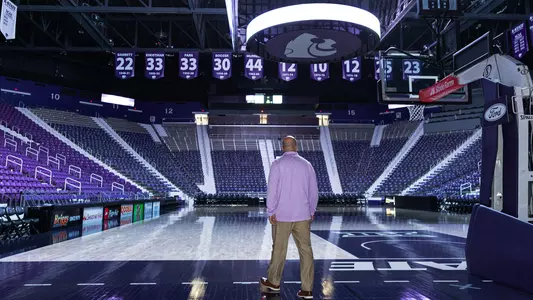
Confident Alexander Ready to Get to Work
Mar 17, 2026 | Men's Basketball, Sports Extra
By: D. Scott Fritchen
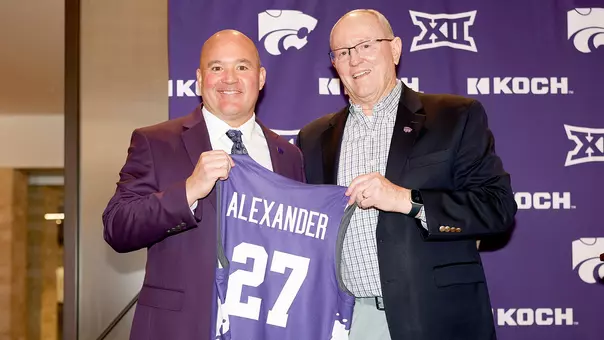
In his introductory news conference as Kansas State men's basketball coach, Casey Alexander, hired last Friday after a successful seven-year run at Belmont, admitted that there would be an adjustment in making the jump from a mid-major program to the powerhouse Big 12 Conference, which is considered one of the best leagues in the nation each year.
While Alexander won 166 games and four conference titles the last seven seasons, including the 2026 Missouri Valley Conference Championship, the Big 12 Conference is taking eight teams to the NCAA Tournament, as announced on Sunday.
"We all have plenty to learn, whether I was going to be at Belmont for another year, I'd still have to learn," Alexander said. "The level is very different, and I'm not naïve to anything we're walking into here. It's a heck of a league with great teams and Hall-of-Fame coaches, unbelievable venues, and fan bases that dictate winning and losing."
Alexander did his research and knew that three different K-State coaches went to the Elite Eight in the last 16 years — Frank Martin (2010), Bruce Weber (2018) and Jerome Tang (2023).
Alexander looked up K-State's track record for success for a reason.
He intends to help add to that success in the future.
"They wanted to make sure K-State got the right guy," Alexander said. "And I think I'm the right guy. And I look forward to you feeling the same way over time. And it'll take some time, but we'll all get there together, for sure."

One day after this year's NCAA Tournament brackets were announced, Alexander in front of a crowd of donors and fans at the Shamrock Zone at Bramlage Coliseum, said that he remained optimistic for the Wildcats' success in the Big 12 — and beyond.
"I'm confident in who we are and how we're going to do it," Alexander said. "I'm confident we can win here. I'm confident we can win here quickly. I'm confident we can win here consistently. That'll be my job. I'll work with a staff and try to get the right kind of players and with your help, we'll get there, and we'll stay there."
Alexander replaces Tang, who led K-State to the 2023 Elite Eight his first season but was unable to make it to another NCAA Tournament over the next three seasons as success diminished — going from 19-15 in 2023-24 to 16-17 in 2024-25 to 10-15 this season before he was fired on February 15.
"One thing that attracts me about this job is not just being resourced, but it allows me to coach in such a way that when we can do it the way I want to do it," Alexander said. "Let's go find the players that fit our program, and collectively the puzzle pieces work, and you have a chance to keep those guys and develop those guys and build a team with some retention, and retention more so than faces coming back. That's leadership, style of play, and culture in the locker room. All those things are what makes programs good.
"There are a lot of ways to winning. There are teams that turn their roster over every season and a few of them figure out to make that work, but it's not a great formula for most places. You have to live in the modern world of change and portal and everything else, but there's still a great opportunity for some old-school in how you build a program and do it that way."

The 53-year-old Alexander, who agreed to a five-year contract that begins at $3.3 million in 2026-27 with a base salary that increases by $50,000 each year remaining on the contract, comes to his first major-conference program with a 303-180 record in 15 seasons that includes stops at Stetson, Lipscomb and his alma mater Belmont.
"It's a thrill for me to be in a place where everybody in the town cares about K-State and everybody on campus is wearing K-State gear," Alexander said. "I have to do some shopping, but we'll get there for sure. Bramlage Coliseum is an awesome facility. I was here one time 20 or so years ago, and I've seen the Wabash and I can't wait to get started."
Alexander has reaped 10 consecutive 20-win seasons (238-91), including double-digit conference win totals each season (138-42) while navigating the Atlantic Sun, Ohio Valley and Missouri Valley. He went 166-60 overall and 102-33 in conference at Belmont. Belmont joins the likes of Arizona, Duke, Gonzaga, Houston and Kansas as teams that have won at least 160 games since the start of the 2019-20 season. The 166 wins are 14th-most about Division I programs over that span and its 73.5% winning percentage ranks 11th.
Belmont, Gonzaga and Kansas are the only Division I programs to win at least 20 games in each of the last 16 seasons.
"Coach checked a lot of our boxes that we were looking for," K-State athletics director Gene Taylor said. "We were looking for an experienced head coach, a coach with a proven track record of success and consistent success wherever he used to coach. He's won every place he's been. Those are things important to us. The most important thing is he really, really wanted to be at K-State. That came through in our conversations with him.
"He talked about the transition from Belmont and Lipscomb to here, and that it's very clear that the Big 12 isn't an easy place to coach, but his plan and vision for the program is clear and thought out. We really appreciated that."

Coaching in one-bid conferences his entire career, Alexander has been to three postseason tournaments and has coached one NCAA Tournament game — the 2018 NCAA Tournament in which Lipscomb ended its season with a first-round loss to No. 2-seed North Carolina. Belmont earned an automatic bid to the 2020 NCAA Tournament before it was canceled due to the COVID-19 pandemic.
"It's been a journey, and my favorite part of coaching is the journey," Alexander said. "We're all measured by wins and losses – there's no escaping that – but whether it's the journey of taking a team from the beginning of a season to the end, that's a really special short period of time, or the journey of a player's career, or the journey of my career.
"As a young coach, you think you have everything figured out, and if everybody will just do what we say, it'll work out for everybody. It's important to have that kind of confidence but at the same time, in hindsight, you have a lot to learn. Regardless of the success that's happened now, I'm a life-long learner and learning how to adapt and learning how to do it with new people and learning to do it in new places, that's what life is right there. This is just another chapter of that for me."
One of the bigger adjustments in this upcoming chapter for Alexander is being on the other side of the transfer portal in which high-caliber players from lower-conference schools — typically enticed by increased NIL opportunities, stiffer competition and greater national exposure — move to higher-conference programs.
Some of K-State's rosters in recent years have been comprised of first-year transfers.
"There's been a lot of change across the board, and it really doesn't matter what level," Alexander said. "There's significant change, and it still is changing. We're all getting used to it and learning a little bit more about it, but just when we think we have it figured out it flips again. I've been on the other side.
"We've had many good players who played for us that we had no ability to keep because we just couldn't afford it… and they ended up at places like K-State."
Future roster retention becomes a major focus on Alexander's agenda.
"It's a missing piece for a lot of programs out there right now that are fluctuating from bad to good to great, and it just depends upon what year you're looking at, and it's not easy at all," he said. "There are a lot of guys out there with people in their ear and everybody seems to have a different agenda, but the like-mindedness that is required to be a really good team and program requires some retention from year to year. It'll be probably the most important part of our plan when you think about recruiting and year to year and building something.
"In the old days, when a coach got hired, it was like, 'Let's give that guy three or four years to get his players in here.' It's about a three or four-month turnaround now because you never know what's going to happen. The retention piece is so huge. We want to recruit some really good high school players, and we want to keep them. The more you do that and you're winning the more retention you're going to have. You're always going to have to fill needs with portal guys, but we don't want turnover where everything is brand new every year. The language and the system, the carryover from year to year with leadership, all those things, are so important to the success of your team, if you really care about the team. That'll be a focus of ours."

What can K-State fans expect to see on the basketball court?
"What's it going to look like?" Alexander said. "It's going to be a work in progress, but everything for me starts with style — style of play, style of player, style of program. We can get deeper into it, but the style of play dictates everything else. We want to have a style that's fun to play, fun to watch, fun to cheer for, and that leads to wins. We want to be high tempo. We want to be a high-assist team, a really unselfish team, get a lot of work done at the 3-point line and not live or die at the 3-point line, and be really efficient outside and inside.
"Our team this year at Belmont was the No. 1 effective field goal percentage team in the country. We had great success offensively through the years, but we've done it in an efficient way. It's not a track meet, it's how to get the right kind of players who have the right skills above all else and understand what it means to play together. They're going to share the ball and understand what it means to be a great teammate. All of those things this day in age are hard to come by. There's a lot out there that distracts from the business at hand, which is winning, but we want guys who are committed to that, and that's exactly how we're going to build."
The Wildcats could also build by acquiring a star player here and there as well. In recent years, K-State attracted Keyontae Johnson, then Coleman Hawkins, and then Preseason All-American PJ Haggerty this season.
"The good thing about doing this in this modern day is things can change quickly," Alexander said. "Sometimes you throw darts and hope you get lucky and strike gold, and it happens and it's a short-term pleasure that everybody loves."
However, Alexander leans toward longevity and consistency on his roster.
"What I'd love for you to see is a program that from year to year you know the identity of our team, recognize faces year to year, know the style of play you're going to get, and it's super predictable," he said. "We have to be able to adapt and chance and that stuff happens all the time within a game, but I want you to see some consistency. I want you to know our players, and I want them in the community, and I want them to be here consistently, and see some retention. I don't want to flip a roster over every season. That might take a minute or two for us to get to that point. We probably have quite a bit of turnover this go around, but we don't want to see that on an annual basis. We want to build a program."
Alexander paused.
"That's another thing that really, really impressed me with K-State," he said. "We believe it's the kind of place with the kind of people who want that. Everybody wants to win, wants excitement, but what I believe about this community is you want something you can really hold onto and believe in and wrap your arms around. It's really important to me that we do it that way."
In his introductory news conference as Kansas State men's basketball coach, Casey Alexander, hired last Friday after a successful seven-year run at Belmont, admitted that there would be an adjustment in making the jump from a mid-major program to the powerhouse Big 12 Conference, which is considered one of the best leagues in the nation each year.
While Alexander won 166 games and four conference titles the last seven seasons, including the 2026 Missouri Valley Conference Championship, the Big 12 Conference is taking eight teams to the NCAA Tournament, as announced on Sunday.
"We all have plenty to learn, whether I was going to be at Belmont for another year, I'd still have to learn," Alexander said. "The level is very different, and I'm not naïve to anything we're walking into here. It's a heck of a league with great teams and Hall-of-Fame coaches, unbelievable venues, and fan bases that dictate winning and losing."
Alexander did his research and knew that three different K-State coaches went to the Elite Eight in the last 16 years — Frank Martin (2010), Bruce Weber (2018) and Jerome Tang (2023).
Alexander looked up K-State's track record for success for a reason.
He intends to help add to that success in the future.
"They wanted to make sure K-State got the right guy," Alexander said. "And I think I'm the right guy. And I look forward to you feeling the same way over time. And it'll take some time, but we'll all get there together, for sure."
One day after this year's NCAA Tournament brackets were announced, Alexander in front of a crowd of donors and fans at the Shamrock Zone at Bramlage Coliseum, said that he remained optimistic for the Wildcats' success in the Big 12 — and beyond.
"I'm confident in who we are and how we're going to do it," Alexander said. "I'm confident we can win here. I'm confident we can win here quickly. I'm confident we can win here consistently. That'll be my job. I'll work with a staff and try to get the right kind of players and with your help, we'll get there, and we'll stay there."
Alexander replaces Tang, who led K-State to the 2023 Elite Eight his first season but was unable to make it to another NCAA Tournament over the next three seasons as success diminished — going from 19-15 in 2023-24 to 16-17 in 2024-25 to 10-15 this season before he was fired on February 15.
"One thing that attracts me about this job is not just being resourced, but it allows me to coach in such a way that when we can do it the way I want to do it," Alexander said. "Let's go find the players that fit our program, and collectively the puzzle pieces work, and you have a chance to keep those guys and develop those guys and build a team with some retention, and retention more so than faces coming back. That's leadership, style of play, and culture in the locker room. All those things are what makes programs good.
"There are a lot of ways to winning. There are teams that turn their roster over every season and a few of them figure out to make that work, but it's not a great formula for most places. You have to live in the modern world of change and portal and everything else, but there's still a great opportunity for some old-school in how you build a program and do it that way."
The 53-year-old Alexander, who agreed to a five-year contract that begins at $3.3 million in 2026-27 with a base salary that increases by $50,000 each year remaining on the contract, comes to his first major-conference program with a 303-180 record in 15 seasons that includes stops at Stetson, Lipscomb and his alma mater Belmont.
"It's a thrill for me to be in a place where everybody in the town cares about K-State and everybody on campus is wearing K-State gear," Alexander said. "I have to do some shopping, but we'll get there for sure. Bramlage Coliseum is an awesome facility. I was here one time 20 or so years ago, and I've seen the Wabash and I can't wait to get started."
Alexander has reaped 10 consecutive 20-win seasons (238-91), including double-digit conference win totals each season (138-42) while navigating the Atlantic Sun, Ohio Valley and Missouri Valley. He went 166-60 overall and 102-33 in conference at Belmont. Belmont joins the likes of Arizona, Duke, Gonzaga, Houston and Kansas as teams that have won at least 160 games since the start of the 2019-20 season. The 166 wins are 14th-most about Division I programs over that span and its 73.5% winning percentage ranks 11th.
Belmont, Gonzaga and Kansas are the only Division I programs to win at least 20 games in each of the last 16 seasons.
"Coach checked a lot of our boxes that we were looking for," K-State athletics director Gene Taylor said. "We were looking for an experienced head coach, a coach with a proven track record of success and consistent success wherever he used to coach. He's won every place he's been. Those are things important to us. The most important thing is he really, really wanted to be at K-State. That came through in our conversations with him.
"He talked about the transition from Belmont and Lipscomb to here, and that it's very clear that the Big 12 isn't an easy place to coach, but his plan and vision for the program is clear and thought out. We really appreciated that."
Coaching in one-bid conferences his entire career, Alexander has been to three postseason tournaments and has coached one NCAA Tournament game — the 2018 NCAA Tournament in which Lipscomb ended its season with a first-round loss to No. 2-seed North Carolina. Belmont earned an automatic bid to the 2020 NCAA Tournament before it was canceled due to the COVID-19 pandemic.
"It's been a journey, and my favorite part of coaching is the journey," Alexander said. "We're all measured by wins and losses – there's no escaping that – but whether it's the journey of taking a team from the beginning of a season to the end, that's a really special short period of time, or the journey of a player's career, or the journey of my career.
"As a young coach, you think you have everything figured out, and if everybody will just do what we say, it'll work out for everybody. It's important to have that kind of confidence but at the same time, in hindsight, you have a lot to learn. Regardless of the success that's happened now, I'm a life-long learner and learning how to adapt and learning how to do it with new people and learning to do it in new places, that's what life is right there. This is just another chapter of that for me."
One of the bigger adjustments in this upcoming chapter for Alexander is being on the other side of the transfer portal in which high-caliber players from lower-conference schools — typically enticed by increased NIL opportunities, stiffer competition and greater national exposure — move to higher-conference programs.
Some of K-State's rosters in recent years have been comprised of first-year transfers.
"There's been a lot of change across the board, and it really doesn't matter what level," Alexander said. "There's significant change, and it still is changing. We're all getting used to it and learning a little bit more about it, but just when we think we have it figured out it flips again. I've been on the other side.
"We've had many good players who played for us that we had no ability to keep because we just couldn't afford it… and they ended up at places like K-State."
Future roster retention becomes a major focus on Alexander's agenda.
"It's a missing piece for a lot of programs out there right now that are fluctuating from bad to good to great, and it just depends upon what year you're looking at, and it's not easy at all," he said. "There are a lot of guys out there with people in their ear and everybody seems to have a different agenda, but the like-mindedness that is required to be a really good team and program requires some retention from year to year. It'll be probably the most important part of our plan when you think about recruiting and year to year and building something.
"In the old days, when a coach got hired, it was like, 'Let's give that guy three or four years to get his players in here.' It's about a three or four-month turnaround now because you never know what's going to happen. The retention piece is so huge. We want to recruit some really good high school players, and we want to keep them. The more you do that and you're winning the more retention you're going to have. You're always going to have to fill needs with portal guys, but we don't want turnover where everything is brand new every year. The language and the system, the carryover from year to year with leadership, all those things, are so important to the success of your team, if you really care about the team. That'll be a focus of ours."
What can K-State fans expect to see on the basketball court?
"What's it going to look like?" Alexander said. "It's going to be a work in progress, but everything for me starts with style — style of play, style of player, style of program. We can get deeper into it, but the style of play dictates everything else. We want to have a style that's fun to play, fun to watch, fun to cheer for, and that leads to wins. We want to be high tempo. We want to be a high-assist team, a really unselfish team, get a lot of work done at the 3-point line and not live or die at the 3-point line, and be really efficient outside and inside.
"Our team this year at Belmont was the No. 1 effective field goal percentage team in the country. We had great success offensively through the years, but we've done it in an efficient way. It's not a track meet, it's how to get the right kind of players who have the right skills above all else and understand what it means to play together. They're going to share the ball and understand what it means to be a great teammate. All of those things this day in age are hard to come by. There's a lot out there that distracts from the business at hand, which is winning, but we want guys who are committed to that, and that's exactly how we're going to build."
The Wildcats could also build by acquiring a star player here and there as well. In recent years, K-State attracted Keyontae Johnson, then Coleman Hawkins, and then Preseason All-American PJ Haggerty this season.
"The good thing about doing this in this modern day is things can change quickly," Alexander said. "Sometimes you throw darts and hope you get lucky and strike gold, and it happens and it's a short-term pleasure that everybody loves."
However, Alexander leans toward longevity and consistency on his roster.
"What I'd love for you to see is a program that from year to year you know the identity of our team, recognize faces year to year, know the style of play you're going to get, and it's super predictable," he said. "We have to be able to adapt and chance and that stuff happens all the time within a game, but I want you to see some consistency. I want you to know our players, and I want them in the community, and I want them to be here consistently, and see some retention. I don't want to flip a roster over every season. That might take a minute or two for us to get to that point. We probably have quite a bit of turnover this go around, but we don't want to see that on an annual basis. We want to build a program."
Alexander paused.
"That's another thing that really, really impressed me with K-State," he said. "We believe it's the kind of place with the kind of people who want that. Everybody wants to win, wants excitement, but what I believe about this community is you want something you can really hold onto and believe in and wrap your arms around. It's really important to me that we do it that way."

Players Mentioned

W
/ Men's BasketballK-State Men's Basketball | Head Coach Casey Alexander Introduction Radio Interview
Tuesday, March 17
K-State MBB | New Head Coach Casey Alexander Introductory Press Conference
Monday, March 16
K-State Volleyball | Purple and White Scrimmage
Saturday, March 14
K-State Track & Field | Indoor Nationals Hype Video
Friday, March 13