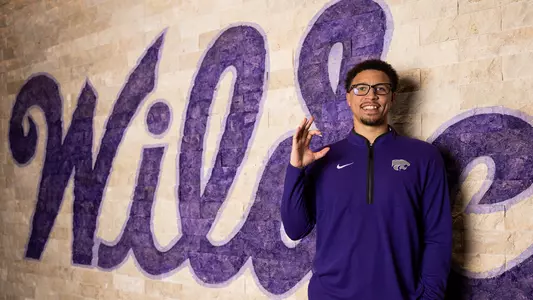
Butler is Thrilled and Energized
Apr 01, 2026 | Men's Basketball, Sports Extra
By: D. Scott Fritchen
Once an assistant coach at Division III Susquehanna University, then a head coach at Division II Chestnut Hill, then an assistant coach at Delaware and at Belmont, JJ Butler is proud of the hard work that helped pave the path along his journey.
Opening the front door to the Ice Family Basketball Center, though, was surreal, as Butler, named a K-State assistant coach after spending one season under new K-State head coach Casey Alexander at Belmont, was stepping into a new world at Big 12 Conference member K-State.
"K-State has everything that you'd imagine a P4 program being with resources, facilities and people and having a community that's behind the program," Butler says. "It's everything you dream of when you think about what a P4 program should look like. So, the opportunity to walk in and see it firsthand was thrilling."
For more than a decade, Butler has seen Alexander at work. Butler had 128 points, 70 rebounds, 109 assists, four blocks and 38 steals in 85 games under Alexander at Lipscomb before finishing his eligibility with 116 points, 62 rebounds, 52 assists, two blocks and 38 steals in 21 games at Chestnut Hill.
A 2016 graduate from Lipscomb, Butler admits "hindsight being 20-20, I wasn't a good enough player" at Lipscomb, but he stayed close to Alexander through the years, which along with his basketball IQ enabled him to join Alexander's staff at Belmont in 2025-26.
Now at K-State, Butler is on a mission.
"I'll be recruiting and scouting," he says. "Recruiting? I'm from Maryland originally, and I do think the DMV has the best basketball in the country, so I'm excited to make an impact on the recruiting trail and hopefully get some east coast guys into Manhattan. The Little Apple is a lot different than the Big Apple, but K-State basketball has enough to get guys over here, to say the least."
The transfer portal opens on April 7.
"Hopefully, as years go on, we're going into the portal a lot less, because we're able to retain guys and create a sense of consistency and continuity within our program where players are developing," Butler says. "I know Manhattan can get behind a kid that they watched as a freshman, develop as a sophomore, become a leader as a junior like Jacob Pullen — kind of like an old-school style of college basketball. That'll hopefully neutralize the impact that the portal will have. It's always going to play a factor, but getting to that point is important for us."
Like anything else, it's a journey. Year One is upon Alexander, Butler and the rest of the new K-State coaching staff.
Butler is ready.
"We've all gotten to experience a NCAA Tournament at some point in our career either as a player or coach," Butler says. "That's an experience that we want not just for ourselves but for K-State and Manhattan and for the players who come through this program. That's what it's about. You're not coming to Manhattan to just play college basketball. You're coming to play on the biggest stage and to play in the Big Dance."
Butler spoke with K-State Sports Extra's D. Scott Fritchen about his path to K-State and about goals going forward.

D. Scott Fritchen: What was your immediate reaction when you heard Casey accepted the K-State job?
JJ Butler: I was excited, thrilled, and a little nervous, just for the transition with my family. I'd just moved from Delaware to Nashville, so to tell my wife, "We're going to pack up and move again," that just initially gave me a little bit of nerves, but my wife, my family, and I, are thrilled to be at K-State and to be a part of the K-State basketball family. More than anything, I'm really confident and excited to see the impact that Casey and our staff can have on the basketball program and on the athletic department as a whole.
At some point, Casey mentioned that K-State had reached out. He said, "Hey, if this comes to fruition, is this something you and your family would be interested in?" He encouraged me to take some time and talk with my wife. To be honest, there wasn't much of a conversation about if we'd be interested, it was just whether or not the opportunity was going to come to fruition. If it came to fruition, my wife and I were going to be thrilled to come to Manhattan.
Fritchen: What did it mean to you that Casey wanted you to come along to K-State?
Butler: It's validating in the work that we've put in together, not just he and I, but the rest of our staff at Belmont. We're a very close-knit unit and enabled a ton of success for us. To know that he feels the same way and thinks we can continue to do it at this level is very much appreciated, to say the least.
Fritchen: What do you admire most about Casey as a person and then what do you admire most about Casey as a coach?
Butler: He's so committed to being genuine in the relationships that he has outside of basketball. It's funny, I played for Casey at Lipscomb, who's Belmont's rival and where Casey had great success before taking over at Belmont, and the relationships that he had with friends and people in Nashville who'd come to practice and support Lipscomb, that's the closest rival in college basketball, and there's — and I say this loosely — bad blood between the two schools, but to see those relationships being continued when I joined the staff at Belmont, and walked into practice and see a lot of the same faces, that speaks volumes to who he is as a man off the court.
As far as who he is as a father, I had the chance to know his kids when they were younger, and getting a chance to come back to Nashville and re-meet them and re-introduce myself and my family to them, it's funny, because I didn't even recognize his youngest son. His youngest son was a manager for us, and it took me three days to recognize it was his son. Seeing how he maintains success at such a high level as a basketball coach but keeps his family close every step of the way is inspiring.
Fritchen: Describe your chemistry with Casey and what makes you both tick?
Butler: This was my first year on staff with him. My chemistry with Casey when I played for him as a player wasn't very eye-to-eye. I didn't play a ton and didn't have a huge role, but there was a ton of respect. I respected his basketball IQ, his knowledge, and the way he was able to play chess with the game of basketball. It's funny, my disdain for him was more of a selfish thing because I wasn't playing as much as I should have, but hindsight being 20-20 I wasn't a good enough player. Then, becoming a head coach myself, and seeing the pressures that fall upon your shoulders and the decisions you have to make, you learn quickly that everybody isn't going to be happy with the decisions you make, and honestly, that made me respect him a lot more, just seeing that he was true to his vision and what his vision unfolded as is how successful he was at Lipscomb and Belmont.
Professionally, I'm inspired by him. He does a lot of work. He works harder than you'd anticipate as a head coach. We as assistants are really responsible for scouting and recruiting, and how willing he is to put in the time with as many years as he's had, you'd think complacency would creep in. I can't say it would for everybody, but one would anticipate at some point complacency creeping him. For as long as he's been a head coach, and to work with him this year, and to watch how hard he works as a scouter and recruiter, and how hard he works for preparation for games, that part is inspiring.

Fritchen: You were to begin your second year as an assistant coach at Belmont this next season after spending the previous two seasons as an assistant coach at Delaware. Three years before that, you were head coach at Division II Chestnut Hill College in Pennsylvania. Now you're a first-year assistant on a Power 4 team that competes in arguably the toughest conference in the nation. What are the emotions that go along with making that jump?
Butler: I'm thrilled and energized. As people go through their coaching career, I'd imagine that everybody has a sense of self-confidence that hopefully pushes them to succeed and pursue the next endeavor. I'm very thankful for the opportunities that I've earned, but that have been given to me by people like Casey bringing me on board at K-State. More than anything, it fuels a hunger to continue to prove that this is where I want to be personally. As a professional in this career and in this profession, I say, "Hey, I'm really confident in the impact I can make on winning in a program, and I'm really excited to get after the challenge at arguably the best league in the country."
Fritchen: What kinds of thoughts were running through your head as you opened the front door and entered the K-State basketball facility for the first time?
Butler: I was thankful, appreciative, and I keep saying excited, but yeah, man, this is an awesome opportunity for us. K-State has everything that you'd imagine a P4 program being with resources, facilities and people and having a community that's behind the program. It's everything you dream of when you think about what a P4 program should look like. So, the opportunity to walk in and see it firsthand was thrilling.
Fritchen: What's thumbnail sketch of the duties you'll undertake as an assistant coach on this staff?
Butler: I'll be recruiting and scouting. Recruiting? I'm from Maryland originally, and I do think the DMV has the best basketball in the country. So, I'm excited to make an impact on the recruiting trail and hopefully get some east coast guys into Manhattan. The Little Apple is a lot different than the Big Apple, but K-State basketball has enough to get guys over here, to say the least. I'll be scouting opponents and preparing our team for non-conference and more importantly conference games in the Big 12, teams are as good as they're going to get, so I'm really excited to make an impact in preparation for teams. Casey is huge on development. It's something he's hung his hat on throughout his career, so we'll continue to develop talent and hopefully enable continuity in our program as guys continue to get better and take strides and make bigger impacts as they grow in the program.
Fritchen: What aspect of coaching do you enjoy the most?
Butler: The people and the relationships. Relationships is what keeps people going, whether it's family, friends, and the fact that my profession allows me to positively impact the next generation through the game of basketball, which I love, and which taught me so much as a young man, and as a kid growing up who learned so many lessons through it. To create authentic relationships with kids as they come through K-State and grow in the game of basketball is exciting. One of my favorite memories as a coach was being invited to a wedding of one of my former players. I was a young head coach, and we watched the guys that I coached stand behind him as he committed himself to his wife. It was a full-circle moment to me. The relationship piece is definitely huge.

Fritchen: Recruiting and signing guys out of the transfer portal is more crucial today than at any other time in the history of college basketball. It's a whole new world. What's the plan of attack when the portal opens on April 7?
Butler: First and foremost, we're going to find the guys that fit what we do. That's really important. There are a ton of ways to attack the portal. What Casey has found to be successful is finding guys that want to play a style of basketball where we're going to share it a ton and play fast and value the shot quality on offense and play together on defense. Finding guys who fit that mold is really important because it allows guys to love the game that they're playing because they're playing a style that they prefer, and then grow within that as well rather than trying to mold guys into a fashion that they're not accustomed to or even desire to play in. Finding guys who fit is very, very important.
Year One is a little different than Year Two, Three, Four, and Five, because in Year One we don't have the retention piece. Hopefully, as years go on, we're going into the portal a lot less, because we're able to retain guys and create a sense of consistency and continuity within our program where players are developing. I know Manhattan can get behind a kid that they watched as a freshman, develop as a sophomore, become a leader as a junior like Jacob Pullen — kind of like an old-school style of college basketball. That'll hopefully neutralize the impact that the portal will have. It's always going to play a factor, but getting to that point is important for us.
Fritchen: The NCAA Tournament is still going on. What kind of hunger do you feel this time of year in just imagining making a trip to compete in a NCAA Tournament?
Butler: Hungrier than you'd anticipate or anybody at K-State would anticipate. That goes for our staff as a whole. We've all gotten to experience a NCAA Tournament at some point in our career either as a player or coach. That's an experience that we want not just for ourselves but for K-State and Manhattan and for the players who come through this program. That's what it's about. You're not coming to Manhattan to just play college basketball. You're coming to play on the biggest stage and to play in the Big Dance. That's what kids grow up dreaming about. They're in their driveway saying, "Three…Two…One…" because it's March and you want to hit a game-winner. That's what we're telling guys that they need to be ready to compete for, and that's what we're expecting to compete for. That's what we want for everybody associated with K-State basketball to be able to enjoy.
Fritchen: From that young boy in Abingdon, Maryland, to the man you are today, what has JJ Butler learned most about himself during his journey?
Butler: I can't do it by myself. A younger me would've been arrogant and said I was good enough to make it happen. If I were to tell him, "This is where I'm at," he probably would think of all the ways and all the things that I did to get here, but an older me would tell him that there were so many people involved in propelling my career and in propelling me as a man. My wife is as supportive as a partner could be in this profession, where it's not easy for our wives. Having her as a partner through it all has been huge. Parents and colleagues, Casey brings me here. Colleagues and friends pushed me along the way. I'd tell the younger me to continue to cherish and nurture relationships that mean a lot to you because you don't know where they'll take you.
Once an assistant coach at Division III Susquehanna University, then a head coach at Division II Chestnut Hill, then an assistant coach at Delaware and at Belmont, JJ Butler is proud of the hard work that helped pave the path along his journey.
Opening the front door to the Ice Family Basketball Center, though, was surreal, as Butler, named a K-State assistant coach after spending one season under new K-State head coach Casey Alexander at Belmont, was stepping into a new world at Big 12 Conference member K-State.
"K-State has everything that you'd imagine a P4 program being with resources, facilities and people and having a community that's behind the program," Butler says. "It's everything you dream of when you think about what a P4 program should look like. So, the opportunity to walk in and see it firsthand was thrilling."
For more than a decade, Butler has seen Alexander at work. Butler had 128 points, 70 rebounds, 109 assists, four blocks and 38 steals in 85 games under Alexander at Lipscomb before finishing his eligibility with 116 points, 62 rebounds, 52 assists, two blocks and 38 steals in 21 games at Chestnut Hill.
A 2016 graduate from Lipscomb, Butler admits "hindsight being 20-20, I wasn't a good enough player" at Lipscomb, but he stayed close to Alexander through the years, which along with his basketball IQ enabled him to join Alexander's staff at Belmont in 2025-26.
Now at K-State, Butler is on a mission.
"I'll be recruiting and scouting," he says. "Recruiting? I'm from Maryland originally, and I do think the DMV has the best basketball in the country, so I'm excited to make an impact on the recruiting trail and hopefully get some east coast guys into Manhattan. The Little Apple is a lot different than the Big Apple, but K-State basketball has enough to get guys over here, to say the least."
The transfer portal opens on April 7.
"Hopefully, as years go on, we're going into the portal a lot less, because we're able to retain guys and create a sense of consistency and continuity within our program where players are developing," Butler says. "I know Manhattan can get behind a kid that they watched as a freshman, develop as a sophomore, become a leader as a junior like Jacob Pullen — kind of like an old-school style of college basketball. That'll hopefully neutralize the impact that the portal will have. It's always going to play a factor, but getting to that point is important for us."
Like anything else, it's a journey. Year One is upon Alexander, Butler and the rest of the new K-State coaching staff.
Butler is ready.
"We've all gotten to experience a NCAA Tournament at some point in our career either as a player or coach," Butler says. "That's an experience that we want not just for ourselves but for K-State and Manhattan and for the players who come through this program. That's what it's about. You're not coming to Manhattan to just play college basketball. You're coming to play on the biggest stage and to play in the Big Dance."
Butler spoke with K-State Sports Extra's D. Scott Fritchen about his path to K-State and about goals going forward.
D. Scott Fritchen: What was your immediate reaction when you heard Casey accepted the K-State job?
JJ Butler: I was excited, thrilled, and a little nervous, just for the transition with my family. I'd just moved from Delaware to Nashville, so to tell my wife, "We're going to pack up and move again," that just initially gave me a little bit of nerves, but my wife, my family, and I, are thrilled to be at K-State and to be a part of the K-State basketball family. More than anything, I'm really confident and excited to see the impact that Casey and our staff can have on the basketball program and on the athletic department as a whole.
At some point, Casey mentioned that K-State had reached out. He said, "Hey, if this comes to fruition, is this something you and your family would be interested in?" He encouraged me to take some time and talk with my wife. To be honest, there wasn't much of a conversation about if we'd be interested, it was just whether or not the opportunity was going to come to fruition. If it came to fruition, my wife and I were going to be thrilled to come to Manhattan.
Fritchen: What did it mean to you that Casey wanted you to come along to K-State?
Butler: It's validating in the work that we've put in together, not just he and I, but the rest of our staff at Belmont. We're a very close-knit unit and enabled a ton of success for us. To know that he feels the same way and thinks we can continue to do it at this level is very much appreciated, to say the least.
Fritchen: What do you admire most about Casey as a person and then what do you admire most about Casey as a coach?
Butler: He's so committed to being genuine in the relationships that he has outside of basketball. It's funny, I played for Casey at Lipscomb, who's Belmont's rival and where Casey had great success before taking over at Belmont, and the relationships that he had with friends and people in Nashville who'd come to practice and support Lipscomb, that's the closest rival in college basketball, and there's — and I say this loosely — bad blood between the two schools, but to see those relationships being continued when I joined the staff at Belmont, and walked into practice and see a lot of the same faces, that speaks volumes to who he is as a man off the court.
As far as who he is as a father, I had the chance to know his kids when they were younger, and getting a chance to come back to Nashville and re-meet them and re-introduce myself and my family to them, it's funny, because I didn't even recognize his youngest son. His youngest son was a manager for us, and it took me three days to recognize it was his son. Seeing how he maintains success at such a high level as a basketball coach but keeps his family close every step of the way is inspiring.
Fritchen: Describe your chemistry with Casey and what makes you both tick?
Butler: This was my first year on staff with him. My chemistry with Casey when I played for him as a player wasn't very eye-to-eye. I didn't play a ton and didn't have a huge role, but there was a ton of respect. I respected his basketball IQ, his knowledge, and the way he was able to play chess with the game of basketball. It's funny, my disdain for him was more of a selfish thing because I wasn't playing as much as I should have, but hindsight being 20-20 I wasn't a good enough player. Then, becoming a head coach myself, and seeing the pressures that fall upon your shoulders and the decisions you have to make, you learn quickly that everybody isn't going to be happy with the decisions you make, and honestly, that made me respect him a lot more, just seeing that he was true to his vision and what his vision unfolded as is how successful he was at Lipscomb and Belmont.
Professionally, I'm inspired by him. He does a lot of work. He works harder than you'd anticipate as a head coach. We as assistants are really responsible for scouting and recruiting, and how willing he is to put in the time with as many years as he's had, you'd think complacency would creep in. I can't say it would for everybody, but one would anticipate at some point complacency creeping him. For as long as he's been a head coach, and to work with him this year, and to watch how hard he works as a scouter and recruiter, and how hard he works for preparation for games, that part is inspiring.
Fritchen: You were to begin your second year as an assistant coach at Belmont this next season after spending the previous two seasons as an assistant coach at Delaware. Three years before that, you were head coach at Division II Chestnut Hill College in Pennsylvania. Now you're a first-year assistant on a Power 4 team that competes in arguably the toughest conference in the nation. What are the emotions that go along with making that jump?
Butler: I'm thrilled and energized. As people go through their coaching career, I'd imagine that everybody has a sense of self-confidence that hopefully pushes them to succeed and pursue the next endeavor. I'm very thankful for the opportunities that I've earned, but that have been given to me by people like Casey bringing me on board at K-State. More than anything, it fuels a hunger to continue to prove that this is where I want to be personally. As a professional in this career and in this profession, I say, "Hey, I'm really confident in the impact I can make on winning in a program, and I'm really excited to get after the challenge at arguably the best league in the country."
Fritchen: What kinds of thoughts were running through your head as you opened the front door and entered the K-State basketball facility for the first time?
Butler: I was thankful, appreciative, and I keep saying excited, but yeah, man, this is an awesome opportunity for us. K-State has everything that you'd imagine a P4 program being with resources, facilities and people and having a community that's behind the program. It's everything you dream of when you think about what a P4 program should look like. So, the opportunity to walk in and see it firsthand was thrilling.
Fritchen: What's thumbnail sketch of the duties you'll undertake as an assistant coach on this staff?
Butler: I'll be recruiting and scouting. Recruiting? I'm from Maryland originally, and I do think the DMV has the best basketball in the country. So, I'm excited to make an impact on the recruiting trail and hopefully get some east coast guys into Manhattan. The Little Apple is a lot different than the Big Apple, but K-State basketball has enough to get guys over here, to say the least. I'll be scouting opponents and preparing our team for non-conference and more importantly conference games in the Big 12, teams are as good as they're going to get, so I'm really excited to make an impact in preparation for teams. Casey is huge on development. It's something he's hung his hat on throughout his career, so we'll continue to develop talent and hopefully enable continuity in our program as guys continue to get better and take strides and make bigger impacts as they grow in the program.
Fritchen: What aspect of coaching do you enjoy the most?
Butler: The people and the relationships. Relationships is what keeps people going, whether it's family, friends, and the fact that my profession allows me to positively impact the next generation through the game of basketball, which I love, and which taught me so much as a young man, and as a kid growing up who learned so many lessons through it. To create authentic relationships with kids as they come through K-State and grow in the game of basketball is exciting. One of my favorite memories as a coach was being invited to a wedding of one of my former players. I was a young head coach, and we watched the guys that I coached stand behind him as he committed himself to his wife. It was a full-circle moment to me. The relationship piece is definitely huge.
Fritchen: Recruiting and signing guys out of the transfer portal is more crucial today than at any other time in the history of college basketball. It's a whole new world. What's the plan of attack when the portal opens on April 7?
Butler: First and foremost, we're going to find the guys that fit what we do. That's really important. There are a ton of ways to attack the portal. What Casey has found to be successful is finding guys that want to play a style of basketball where we're going to share it a ton and play fast and value the shot quality on offense and play together on defense. Finding guys who fit that mold is really important because it allows guys to love the game that they're playing because they're playing a style that they prefer, and then grow within that as well rather than trying to mold guys into a fashion that they're not accustomed to or even desire to play in. Finding guys who fit is very, very important.
Year One is a little different than Year Two, Three, Four, and Five, because in Year One we don't have the retention piece. Hopefully, as years go on, we're going into the portal a lot less, because we're able to retain guys and create a sense of consistency and continuity within our program where players are developing. I know Manhattan can get behind a kid that they watched as a freshman, develop as a sophomore, become a leader as a junior like Jacob Pullen — kind of like an old-school style of college basketball. That'll hopefully neutralize the impact that the portal will have. It's always going to play a factor, but getting to that point is important for us.
Fritchen: The NCAA Tournament is still going on. What kind of hunger do you feel this time of year in just imagining making a trip to compete in a NCAA Tournament?
Butler: Hungrier than you'd anticipate or anybody at K-State would anticipate. That goes for our staff as a whole. We've all gotten to experience a NCAA Tournament at some point in our career either as a player or coach. That's an experience that we want not just for ourselves but for K-State and Manhattan and for the players who come through this program. That's what it's about. You're not coming to Manhattan to just play college basketball. You're coming to play on the biggest stage and to play in the Big Dance. That's what kids grow up dreaming about. They're in their driveway saying, "Three…Two…One…" because it's March and you want to hit a game-winner. That's what we're telling guys that they need to be ready to compete for, and that's what we're expecting to compete for. That's what we want for everybody associated with K-State basketball to be able to enjoy.
Fritchen: From that young boy in Abingdon, Maryland, to the man you are today, what has JJ Butler learned most about himself during his journey?
Butler: I can't do it by myself. A younger me would've been arrogant and said I was good enough to make it happen. If I were to tell him, "This is where I'm at," he probably would think of all the ways and all the things that I did to get here, but an older me would tell him that there were so many people involved in propelling my career and in propelling me as a man. My wife is as supportive as a partner could be in this profession, where it's not easy for our wives. Having her as a partner through it all has been huge. Parents and colleagues, Casey brings me here. Colleagues and friends pushed me along the way. I'd tell the younger me to continue to cherish and nurture relationships that mean a lot to you because you don't know where they'll take you.
K-State Volleyball | Spring Scrimmage vs Oklahoma Recap
Wednesday, April 01
K-State Rowing | Regan Ahlers Senior Video
Friday, March 27
K-State Rowing | Kennedy Loyd Senior Video
Thursday, March 26
K-State Football | Collin Klein Spring Press Conference - March 25, 2026
Wednesday, March 25