Laying the Foundation
Mar 10, 2026 | Football, Sports Extra
By: D. Scott Fritchen
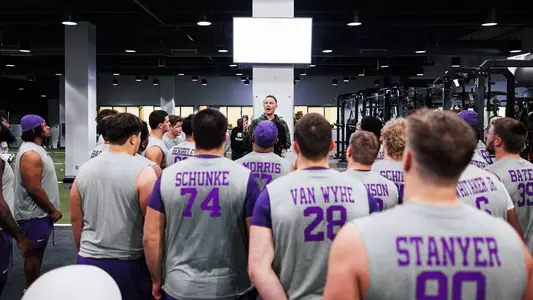
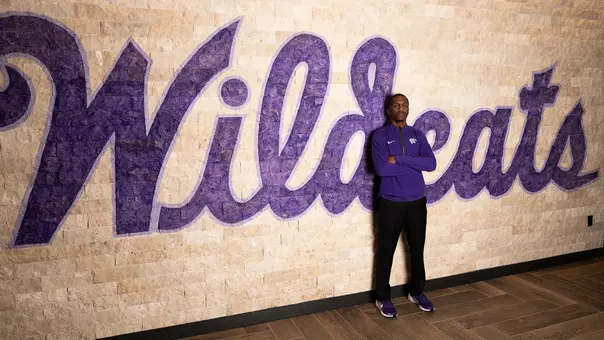
Exactly two months to the day that Jeremy Jacobs left in his truck at 3:30 a.m. from College Station, Texas, and began a journey to Manhattan that ended with him pulling into the Vanier Family Football Complex parking lot at 1:30 p.m., the Kansas State Director of Strength and Conditioning now stands inside the team theater room on the third level wearing a purple hoodie with a white old-school Willie Wildcat cradling a football, and he lays down a little black book bearing a purple Powercat on the front cover.
You notice the eyes first, piercing, narrowed when he discusses his craft — one that took him to three Power 4 schools over the last 10 seasons, most recently Texas A&M, and before that Duke, and before that LSU. Yes, Jacobs means business. He's been recognized by the National Strength and Conditioning Association and Collegiate Strength & Conditioning Coaches Association. He's also a Level 1 USA weightlifting sports performance coach and a functional range conditioning specialist.
Shortly after arriving at Vanier that day on January 4, Jacobs stepped into the K-State football weight room for the first time — his domain for about 12 hours a day from now until seemingly eternity — and the ideas and possibilities immediately flooded his head. So much potential. So little time.
Now, the time is now.
"We're laying a foundation," Jacobs says. "What I'm teaching our players and what they've done in the past is different. There's a lot of teaching. Everything me and my staff is doing right now is for the future. If I can teach them everything we want to do now, then we can build upon it in the future. We're laying a foundation, and in the calendar year of football, you're trying to relay what this group of athletes is going to be. Because it's a lot of new faces and they're all new to me, they're all starting from the same spot. It's really been, 'Here's what the program is and here's what the expectations are,' so it's something to grow from."

Jacobs served two seasons as the Associate Director of Football Strength and Conditioning/Director of Football Applied Sports Science at Texas A&M, serving on the same staff as new K-State head coach Collin Klein, who had two ultra-successful seasons as the Aggies' offensive coordinator. In search of a strength coach, Klein said that he went for the best. It took little time for Jacobs to decide to follow the 2012 Heisman Trophy finalist to the Little Apple.
"Jeremy is one of the best strength coaches in the country," Klein says. "He's a great leader, disciplined, tough and builds great relationships with his players. He's a huge part of building our K-State culture."
And a part of that, in Jacobs' mind, is training to thrive in discomfort.
Currently, K-State players are immersed in "stations" — agility and strength-based stations geared toward developing mental and physical preparedness, confidence, and which pushes players beyond their limits. In short, players are being pushed beyond where they've been before.
"After the very first workout we did with the players, they said, 'This is the hardest workout I've ever done in my life," Jacobs says. "I just kind of laughed. I said, 'Well, it's going to get even harder.'"
Jacobs is old-school strength and conditioning mixed with an Olympic lifting-based regimen. He says that "you can't get too far from the barbell," while also teaching the "real" lifts — clean, jerk, snatch, squat, bench, and overhead pressing. All is monitored with numbers and data to find that "razor's edge" that is impossible to find without tracking it to find it.

It's been a seven-week journey to this point. It's been a seven-week grind.
"It's a lot of uncomfortable movements to start and a lot of basic athleticism that you're building on the platform every single day," he says. "When we're in the weight room, we're on the platform 80% of the time. You're teaching from the ground up everything they're doing. They say, 'I've never done this before,' but that's why I'm here. We're teaching them what they're doing and why they're doing it. There's a huge buy-in when they learn why this is going to help me. That's on myself and on my staff to reinforce, 'This is why this is going to help you on Saturday.'
"The biggest change is just the openness and the explanation of why they're doing everything we're doing. That has added a lot of buy-in. Guys are excited and watching their bodies change. We've added a lot of good body weight already, and its only week seven now. It's allowed me seven weeks to build a relationship with some of these guys, so there's a trust factor that comes into this. There are a lot of new faces, and it takes some time, but if you lay your foundation well and take your time and don't rush that piece of it, it can catapult what you're doing as a program the rest of the year."

It's all a part of the process. The process — that's been embedded within Jacobs for many years. Once the same age of these K-State football players, Jacobs was entrenched in training of his own that tested his mental and physical limits. He was learning to be solider in the Army — an adventure that took him to combat rotations in Operation Iraqi Freedom and Operation Enduring Freedom. Jacobs spent time as a U.S. Army Airborne Ranger with the 2nd Ranger Battalion from 2003 to 2007.
One particular deployment to Iraq emphatically turned on the light bulb for Jacobs that his training had properly prepared him for not just his job — but for survival.
"When I was deployed to Iraq, we had a mission that was supposed to be about 24 hours," Jacobs says. "Due to a downed helicopter and other circumstances, it turned into nine days. It was nine days of rationing food and water. We were out, it was 127 degrees in the desert, and you had to ration your water and drink it at night because it was too hot during the day to drink it."
Jacobs thinks back to that mission, and says, "That was one of those times when I sat there like, 'This is why we did all that stuff.'"
"It was an epiphany moment of, 'Maybe I don't know everything. Maybe there's a reason why they have a training plan to put us in those situations,'" he continues. "That's something I talk about with Coach Klein all the time is, 'How do we put our guys into situations where they have to overcome things now, and it becomes a normal part of the culture in our program, so when you get into the fourth quarter, it's not the first time you've been there?' You use it as a teaching tool in walking through what you just did and show them how they had success, and you build confidence that way."

Upon his arrival in Manhattan, his gears turned for what he had planned for the Wildcats. He said words like "gratitude" and "service" and "consistency" and "standard" and "toughness" and "consistency."
Two months later, it's about "discomfort."
And Jacobs and his staff tell players why what they're doing is preparing them to be the toughest, best-conditioned team in the Big 12 Conference.
"From the minute Collin got the job," Jacobs says, "this has been a dream of mine since I got into this industry, and to do it at a program like this with a rich culture and tradition and standards and a phenomenal fan base, I couldn't ask for a better spot — and to do it with the quality people he's bringing into the building, too.
"I love college football in general, and K-State was always one of those programs I respected from afar. K-State was always that team you never wanted to play. It's something I'm really excited about. Just being here, you can see the pride and what people put into this program."
Exactly where have K-State players made the most strides during this seven-week stretch of training?
"Honestly, it's the mental expectation of what it takes to win," Jacobs says. "They're getting a good glimpse that there's a level to this that if you want to be successful there's a commitment you need. College football has changed with NIL, and these kids live in a world where they're constantly looking in a mirror of social media, and they've grown up in that world. So, there's a constant comparison every day. You can easily turn negative in that world. They're getting to a point where, 'I didn't realize this is what high-level organizations do.' Now, that becomes a part of your culture.
"This is what we do, this is the K-State way, this is how we do it. When new people come into the organization, our players carry that message. That's what you're seeing now, is guys are carrying the message themselves. We have a long way to go, but those are the strides we're starting to see."
Exactly two months to the day that Jeremy Jacobs left in his truck at 3:30 a.m. from College Station, Texas, and began a journey to Manhattan that ended with him pulling into the Vanier Family Football Complex parking lot at 1:30 p.m., the Kansas State Director of Strength and Conditioning now stands inside the team theater room on the third level wearing a purple hoodie with a white old-school Willie Wildcat cradling a football, and he lays down a little black book bearing a purple Powercat on the front cover.
You notice the eyes first, piercing, narrowed when he discusses his craft — one that took him to three Power 4 schools over the last 10 seasons, most recently Texas A&M, and before that Duke, and before that LSU. Yes, Jacobs means business. He's been recognized by the National Strength and Conditioning Association and Collegiate Strength & Conditioning Coaches Association. He's also a Level 1 USA weightlifting sports performance coach and a functional range conditioning specialist.
Shortly after arriving at Vanier that day on January 4, Jacobs stepped into the K-State football weight room for the first time — his domain for about 12 hours a day from now until seemingly eternity — and the ideas and possibilities immediately flooded his head. So much potential. So little time.
Now, the time is now.
"We're laying a foundation," Jacobs says. "What I'm teaching our players and what they've done in the past is different. There's a lot of teaching. Everything me and my staff is doing right now is for the future. If I can teach them everything we want to do now, then we can build upon it in the future. We're laying a foundation, and in the calendar year of football, you're trying to relay what this group of athletes is going to be. Because it's a lot of new faces and they're all new to me, they're all starting from the same spot. It's really been, 'Here's what the program is and here's what the expectations are,' so it's something to grow from."
Jacobs served two seasons as the Associate Director of Football Strength and Conditioning/Director of Football Applied Sports Science at Texas A&M, serving on the same staff as new K-State head coach Collin Klein, who had two ultra-successful seasons as the Aggies' offensive coordinator. In search of a strength coach, Klein said that he went for the best. It took little time for Jacobs to decide to follow the 2012 Heisman Trophy finalist to the Little Apple.
"Jeremy is one of the best strength coaches in the country," Klein says. "He's a great leader, disciplined, tough and builds great relationships with his players. He's a huge part of building our K-State culture."
And a part of that, in Jacobs' mind, is training to thrive in discomfort.
Currently, K-State players are immersed in "stations" — agility and strength-based stations geared toward developing mental and physical preparedness, confidence, and which pushes players beyond their limits. In short, players are being pushed beyond where they've been before.
"After the very first workout we did with the players, they said, 'This is the hardest workout I've ever done in my life," Jacobs says. "I just kind of laughed. I said, 'Well, it's going to get even harder.'"
Jacobs is old-school strength and conditioning mixed with an Olympic lifting-based regimen. He says that "you can't get too far from the barbell," while also teaching the "real" lifts — clean, jerk, snatch, squat, bench, and overhead pressing. All is monitored with numbers and data to find that "razor's edge" that is impossible to find without tracking it to find it.
It's been a seven-week journey to this point. It's been a seven-week grind.
"It's a lot of uncomfortable movements to start and a lot of basic athleticism that you're building on the platform every single day," he says. "When we're in the weight room, we're on the platform 80% of the time. You're teaching from the ground up everything they're doing. They say, 'I've never done this before,' but that's why I'm here. We're teaching them what they're doing and why they're doing it. There's a huge buy-in when they learn why this is going to help me. That's on myself and on my staff to reinforce, 'This is why this is going to help you on Saturday.'
"The biggest change is just the openness and the explanation of why they're doing everything we're doing. That has added a lot of buy-in. Guys are excited and watching their bodies change. We've added a lot of good body weight already, and its only week seven now. It's allowed me seven weeks to build a relationship with some of these guys, so there's a trust factor that comes into this. There are a lot of new faces, and it takes some time, but if you lay your foundation well and take your time and don't rush that piece of it, it can catapult what you're doing as a program the rest of the year."
It's all a part of the process. The process — that's been embedded within Jacobs for many years. Once the same age of these K-State football players, Jacobs was entrenched in training of his own that tested his mental and physical limits. He was learning to be solider in the Army — an adventure that took him to combat rotations in Operation Iraqi Freedom and Operation Enduring Freedom. Jacobs spent time as a U.S. Army Airborne Ranger with the 2nd Ranger Battalion from 2003 to 2007.
One particular deployment to Iraq emphatically turned on the light bulb for Jacobs that his training had properly prepared him for not just his job — but for survival.
"When I was deployed to Iraq, we had a mission that was supposed to be about 24 hours," Jacobs says. "Due to a downed helicopter and other circumstances, it turned into nine days. It was nine days of rationing food and water. We were out, it was 127 degrees in the desert, and you had to ration your water and drink it at night because it was too hot during the day to drink it."
Jacobs thinks back to that mission, and says, "That was one of those times when I sat there like, 'This is why we did all that stuff.'"
"It was an epiphany moment of, 'Maybe I don't know everything. Maybe there's a reason why they have a training plan to put us in those situations,'" he continues. "That's something I talk about with Coach Klein all the time is, 'How do we put our guys into situations where they have to overcome things now, and it becomes a normal part of the culture in our program, so when you get into the fourth quarter, it's not the first time you've been there?' You use it as a teaching tool in walking through what you just did and show them how they had success, and you build confidence that way."
Upon his arrival in Manhattan, his gears turned for what he had planned for the Wildcats. He said words like "gratitude" and "service" and "consistency" and "standard" and "toughness" and "consistency."
Two months later, it's about "discomfort."
And Jacobs and his staff tell players why what they're doing is preparing them to be the toughest, best-conditioned team in the Big 12 Conference.
"From the minute Collin got the job," Jacobs says, "this has been a dream of mine since I got into this industry, and to do it at a program like this with a rich culture and tradition and standards and a phenomenal fan base, I couldn't ask for a better spot — and to do it with the quality people he's bringing into the building, too.
"I love college football in general, and K-State was always one of those programs I respected from afar. K-State was always that team you never wanted to play. It's something I'm really excited about. Just being here, you can see the pride and what people put into this program."
Exactly where have K-State players made the most strides during this seven-week stretch of training?
"Honestly, it's the mental expectation of what it takes to win," Jacobs says. "They're getting a good glimpse that there's a level to this that if you want to be successful there's a commitment you need. College football has changed with NIL, and these kids live in a world where they're constantly looking in a mirror of social media, and they've grown up in that world. So, there's a constant comparison every day. You can easily turn negative in that world. They're getting to a point where, 'I didn't realize this is what high-level organizations do.' Now, that becomes a part of your culture.
"This is what we do, this is the K-State way, this is how we do it. When new people come into the organization, our players carry that message. That's what you're seeing now, is guys are carrying the message themselves. We have a long way to go, but those are the strides we're starting to see."
K-State Baseball | Game Highlights vs TCU
Saturday, April 04
K-State Volleyball | March Madness Tournament
Friday, April 03
K-State Football | 2026-2027 Student Athletic Passes ON SALE NOW 🔥
Friday, April 03
K-State Tennis | Timing is everything 🎤
Friday, April 03